
Sebutape primarily absorbs lipid-rich material from the skin surface, whereas adhesive tape stripping removes corneocytes and intercellular lipids from the stratum corneum. Choose Sebutape for sebum-focused questions and stratum corneum tape strips for barrier-lipid or depth-profile questions.
The distinction is not absolute. Surface sebum diffuses into the upper stratum corneum, and the first corneocyte-removing strip can contain abundant sebaceous lipids. Sebutape can also recover material beyond a chemically pure sebum fraction. These methods enrich different skin compartments; they do not isolate them perfectly.
In this article, "tape strips" refers to adhesive discs designed for sequential stratum corneum sampling, such as D-Squame-type collection, rather than using "tape" as a generic description of Sebutape.
Sebutape and Tape-Strip Skin Lipidomics at a Glance
- Primary compartment: Sebutape emphasizes skin-surface lipids; stratum corneum tape stripping removes corneocytes and their surrounding lipid matrix.
- Lipid emphasis: Sebutape favors sebum-associated triacylglycerols, wax esters, squalene, free fatty acids, and sterol lipids. Tape strips are better aligned with ceramides, cholesterol, free fatty acids, and depth-dependent barrier composition.
- Depth control: Sequential tape strips can probe progressively deeper stratum corneum layers, but strip number is not a universal measure of physical depth.
- Low-input risk: Adhesive background, variable collected biomass, extraction loss, oxidation, and inconsistent anatomical sites can exceed the biological effect.
- Normalization: Sebum-focused and corneocyte-focused samples require different denominators; raw peak area per tape is rarely sufficient by itself.
- Study choice: If the endpoint is surface oil composition, choose Sebutape. If the endpoint is the stratum corneum lipid matrix, choose adhesive tape stripping. If both matter, collect matched adjacent sites with separate methods.
What Does Sebutape Measure in Skin Lipidomics?
Sebutape is a microporous film developed to collect skin-surface sebum. Lipid fills pores in the film and changes its optical appearance, which has historically supported image-based assessment of sebaceous activity. For mass spectrometry, the absorbed material can be extracted and analyzed as a low-input skin-surface lipid sample.
Sebutape emphasizes sebaceous-gland output at the surface
Sebum contains substantial triacylglycerols and their hydrolysis products, wax esters, squalene, cholesterol, and cholesteryl esters. The measured profile reflects secretion, modification at the skin surface, interaction with the microbiome, oxidation, cleansing, and exposure to topical products (Kendall et al., 2018; Isom and Desaire, 2024).
This makes Sebutape suitable for research on surface oil composition, sebaceous activity, lipid oxidation, host-microbe interactions, personal-care product response, and regional differences between sebum-rich and sebum-poor sites.
It does not directly sample the entire sebaceous gland, viable epidermis, dermis, or full skin tissue. "Sebum lipidomics" should therefore be interpreted as the accessible surface fraction collected under a defined protocol.
Collection is sensitive to recent surface history
The sample can change with anatomical site, time since cleansing, recent product application, occlusion, temperature, humidity, physical activity, and the interval allowed for surface lipids to accumulate. A protocol that clears the skin before collection measures re-emergent surface lipids; a protocol without clearance measures the existing surface mixture. Those are different endpoints.
The collection area, contact duration, pressure, and handling must be consistent. If baseline and post-intervention samples are compared, the same accumulation logic should be used at every visit or time point.
The skin untargeted lipidomics service can support broad profiling of skin-surface and tape-derived extracts. The project request should identify the collection substrate rather than labeling every noninvasive sample simply as "skin tape."
What Do Stratum Corneum Tape Strips Measure?
Adhesive tape stripping removes corneocytes and material associated with the outer stratum corneum. The sampled matrix contains structural proteins, intercellular lipids, surface contaminants, and varying contributions from sebaceous lipids.
Tape stripping targets the barrier compartment
The stratum corneum barrier is organized around corneocytes embedded in a lipid matrix rich in ceramides, cholesterol, and free fatty acids. Tape-strip lipidomics can examine ceramide subclasses, chain-length patterns, unsaturation, cholesterol-related species, free fatty acids, and other lipids associated with barrier organization.
The ceramide targeted lipidomics service is relevant when the endpoint requires predefined ceramide classes or molecular species rather than a broad discovery profile. Long-chain and omega-O-acylceramides may require specialized extraction, separation, and standards because their structures and abundance differ from routine circulating lipids.
Sequential strips create a depth series, not identical replicates
Each successive strip samples a different layer and usually removes a different amount of material. The uppermost strips often contain more sebaceous lipids, while deeper strips can shift toward the stratum corneum matrix. Sadowski et al. observed pronounced depth gradients in sebaceous lipids and substantial variation by anatomical site in a quantitative skin-lipidomics survey (Sadowski et al., 2017).
Consecutive strips should not be treated as technical replicates of the same composition. They can be analyzed individually to retain depth information or pooled according to a predefined layer range to increase analyte amount.
Strip number does not equal fixed tissue depth
Adhesive strength, pressure, skin hydration, corneocyte cohesion, anatomical site, and individual variation affect how much stratum corneum is removed. Berdyshev et al. noted that the collected amount at the same strip number can differ markedly among individuals, supporting normalization to sampled biomass rather than strip count alone (Berdyshev et al., 2021).
If the question is barrier-lipid composition, choose stratum corneum tape stripping. If the question is surface sebum composition, choose Sebutape. Do not infer equivalent tissue depth from equal numbers of the two substrate types.
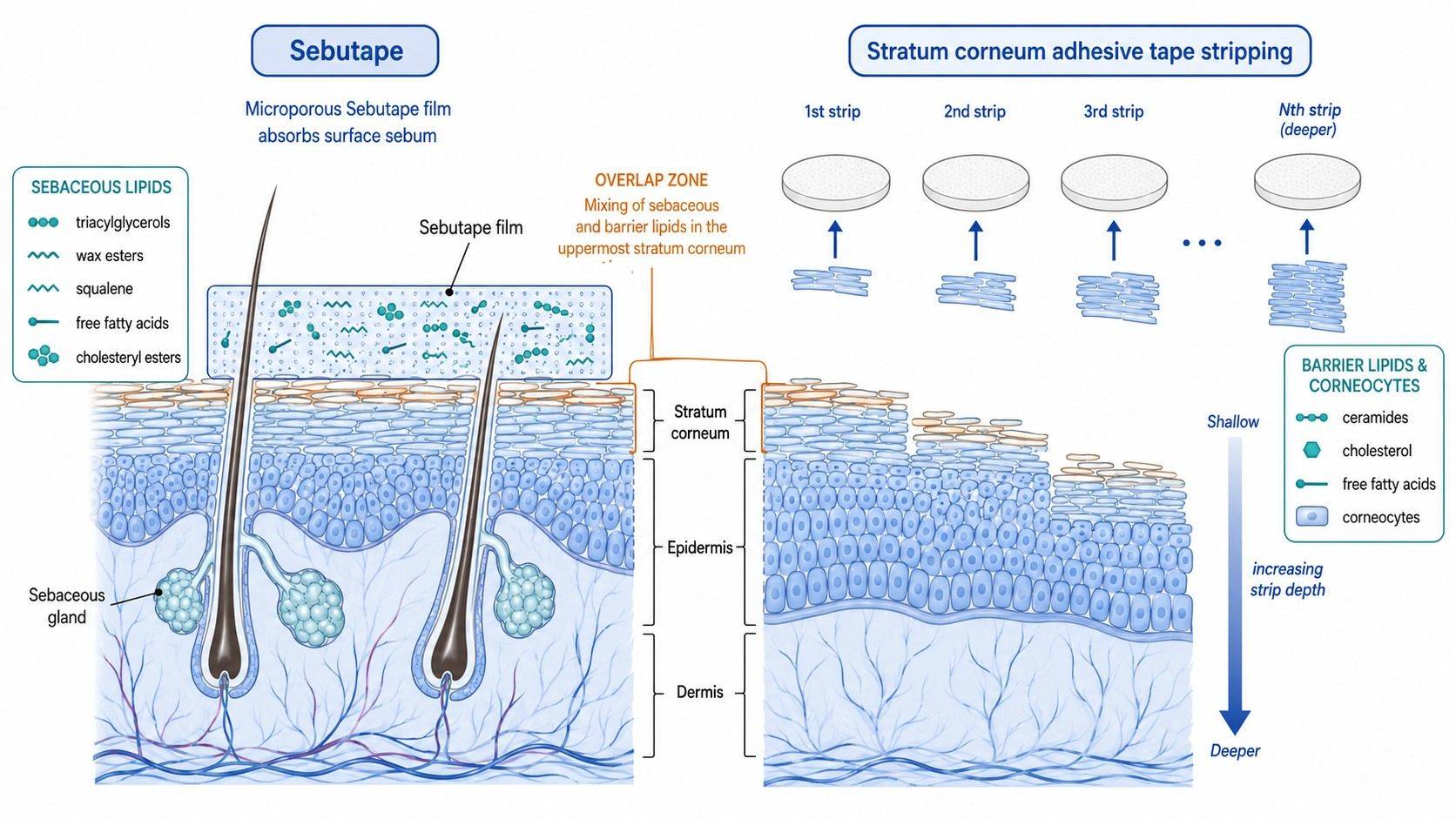 Sebutape enriches skin-surface sebum, while sequential tape stripping samples corneocytes and stratum corneum barrier lipids.
Sebutape vs Tape Strips: Method-Selection Table
| Decision factor | Sebutape | Stratum corneum adhesive tape strips |
|---|---|---|
| Main analytical target | Surface sebum and skin-surface lipids | Corneocytes and intercellular barrier lipids |
| Typical lipid emphasis | TG, DG, wax esters, squalene, FFA, cholesterol and esters | Ceramides, cholesterol, FFA, selected sphingolipids and epidermal lipids |
| Spatial meaning | Defined surface area and accumulation condition | Defined surface area plus sequential stratum corneum layer |
| Depth information | Limited | Available through ordered strips, with variable physical depth |
| Main preanalytical confounder | Cleansing, product use, accumulation interval, site, environment | Strip number, pressure, adhesion, skin hydration, site, prior strips |
| Useful normalization | Area, collection condition, sebum mass or optical loading, internal standards | Protein or corneocyte amount, collected mass, area, strip range, internal standards |
| Key blank | Unused Sebutape processed identically | Unused tape from the same lot processed identically |
| Strong use case | Sebaceous output or surface-lipid response | Barrier composition or stratum corneum depth profile |
The lipid classes overlap. The table describes analytical emphasis, not perfect anatomical purity. A study that needs both sebum and barrier lipids should collect them as separate sample types, not merge them under one normalization denominator.
How Many Sebutape or Tape-Strip Samples Are Needed?
There is no universal number. The correct sample amount is the lowest qualified collection that meets detection, recovery, precision, lipid coverage, and biological comparison requirements for the selected method.
Use a pilot to establish analytical input
A pilot should test representative low-, medium-, and high-yield samples or alternative pooling schemes. Evaluate extracted-lipid recovery, internal-standard response, signal relative to unused-tape blanks, detection frequency, replicate variation, and the number of lipids supported at the intended annotation level.
Published workflows illustrate method-specific possibilities rather than universal rules. Chen et al. found that repeated taping with a D-Squame substrate generated sufficient biomass for their optimized skin-surface lipidomics workflow (Chen et al., 2025). Shin and Moon reported that pooling five sequential layers was effective in their nanoflow LC-MS/MS study of selected skin lipids (Shin and Moon, 2025).
These findings should not be converted into a fixed "five tapes for every study" rule. Sebum-rich forehead, dry forearm, reconstructed skin, animal skin, and product-treated samples can yield different lipid amounts and backgrounds.
Pool only after deciding whether depth matters
Pooling increases input and can reduce the effect of one poorly loaded tape, but it averages depth. If the objective is a depth profile, analyze ordered strips or predefined layer blocks separately. If the objective is an overall barrier-lipid profile, a qualified pool may be more efficient.
Maintain one biological sample per experimental unit. Combining tape pools from different participants or animals creates a composite sample and reduces the ability to estimate biological variation.
For rare or structurally demanding lipid classes, a focused targeted lipidomics service may provide a more realistic low-input endpoint than untargeted coverage across the entire skin lipidome.
Low-Input Extraction and Isomer Resolution in Skin Lipidomics
Tape-derived samples combine little biological material with a relatively large polymer substrate. The extraction must recover lipids across the target polarity range without introducing adhesive-derived background that obscures the chromatogram or mass spectrum.
Match extraction chemistry to the lipid panel
Neutral sebum lipids, common barrier lipids, oxidized lipids, and highly polar signaling species do not share identical extraction behavior. The planned panel should therefore drive solvent selection, phase behavior, tube material, concentration strategy, and internal-standard coverage.
An unused-tape extraction study should precede the cohort. Adhesives and polymer films may release compounds under organic extraction conditions. A substrate that performs well for optical sampling may not be analytically clean for every LC-MS method.
Chen et al. systematically compared sampling materials and extraction conditions and found a D-Squame plus MTBE/methanol combination suitable for their skin-surface lipidomics workflow (Chen et al., 2025). This supports method qualification for each tape-solvent combination rather than assuming all adhesive substrates are interchangeable.
Add internal standards early enough to measure process variation
Internal standards added only before injection monitor instrument response but not extraction loss. For low-input tapes, standards should enter at the earliest validated stage compatible with the project so they can reflect extraction, transfer, evaporation, and reconstitution variability.
One standard per broad lipid class may not correct every molecular species equally. Class-matched and, when available, isotopically labeled standards provide better evidence for quantitative reporting. Standards also help reveal ion suppression from the tape extract or topical-product residues.
Decide the required structural level before analysis
Skin ceramides vary by headgroup, sphingoid base, fatty-acyl chain, hydroxylation, unsaturation, and esterification. Triacylglycerols and wax esters also contain many isomeric combinations. Accurate mass alone may support a sum composition without resolving the biologically relevant structure.
Chromatographic separation, retention behavior, MS/MS, ion mobility, derivatization, and authentic standards can increase confidence, but no single workflow resolves every isomer. The report should distinguish class-level, sum-composition, fatty-acyl, and more specific assignments.
When omega-O-acylceramides are central to the hypothesis, the acylceramides analysis service provides a more focused route than treating these species as incidental untargeted features.
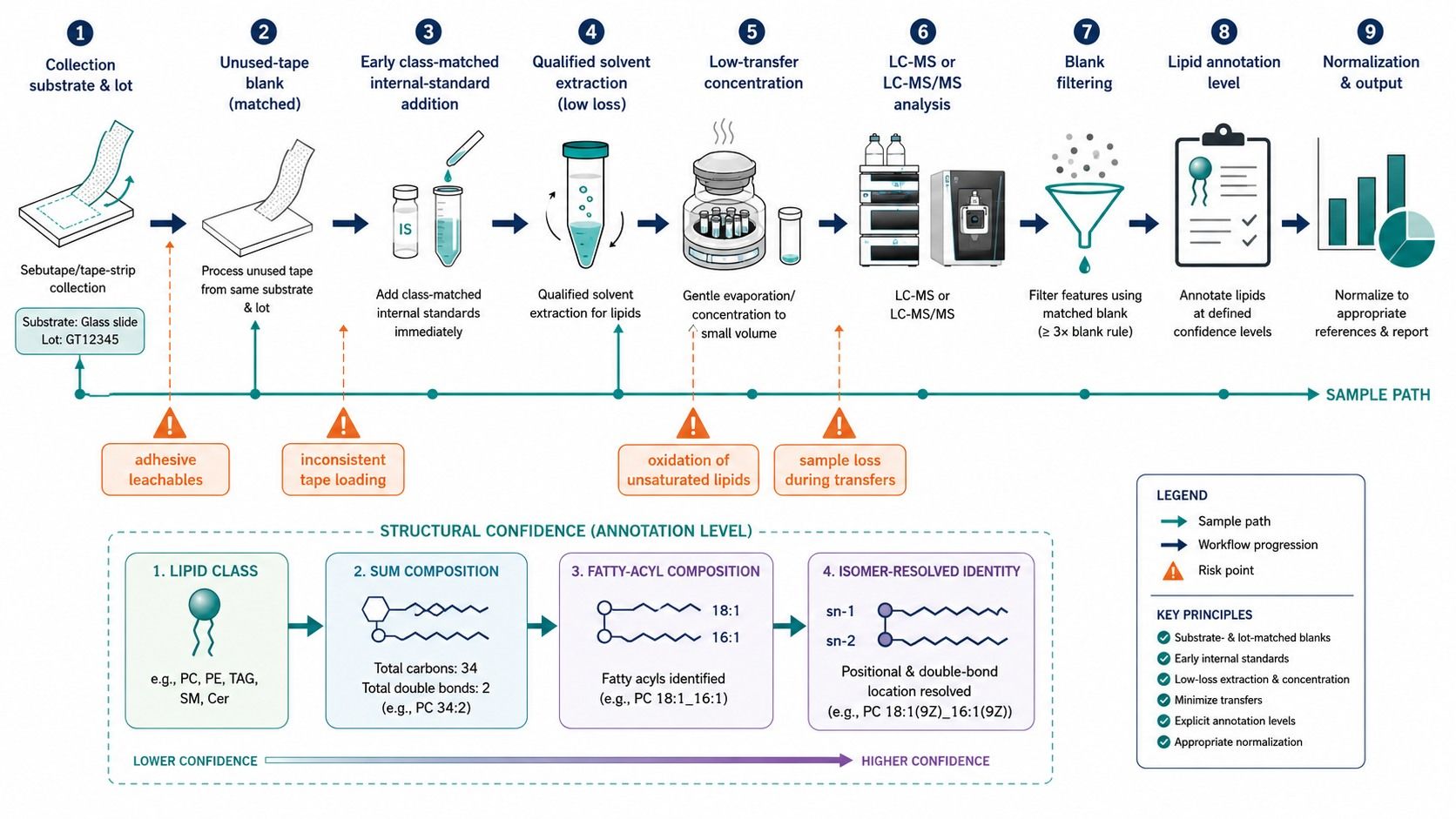 Low-input skin tape lipidomics requires substrate-specific blanks, early internal standards, low-loss extraction, and explicit annotation levels.
How Should Skin Tape Lipidomics Be Normalized?
Normalization must represent the biological quantity being compared. The same denominator should not be applied automatically to Sebutape and stratum corneum tape strips.
Sebutape normalization options
For surface-sebum studies, useful denominators can include sampled area, standardized accumulation condition, measured sebum loading, optical film response, gravimetric material, or an endogenous reference shown to be stable in the intended cohort. Internal standards correct analytical variation but do not correct inconsistent biological collection by themselves.
Area-normalized lipid amount answers "how much lipid was collected from this surface." Composition-normalized abundance answers "what fraction of the recovered sebum is this lipid." Those questions can yield different conclusions if total sebum output changes.
Stratum corneum tape-strip normalization options
For corneocyte-removing strips, total protein, keratin-related measures, optical corneocyte loading, or recovered stratum corneum mass can estimate sampled biomass. Berdyshev et al. described workflows that normalize lipid and polar analytes to total protein from limited tape-strip material (Berdyshev et al., 2021).
Protein normalization can improve comparison when the amount of stratum corneum varies, but it changes the biological interpretation to lipid per sampled protein. Reporting an additional value per area or per predefined strip range may help distinguish altered lipid composition from altered tissue removal.
Predefine primary and secondary denominators
A robust plan can specify one primary normalized endpoint and retain secondary collection metrics. For example, report a ceramide amount per total tape protein as the primary endpoint, while also retaining tape number, area, total recovered lipid, and internal-standard response for sensitivity analysis.
Do not select the normalization method after inspecting which denominator creates the desired group separation. The rule should be written before cohort analysis and applied consistently.
Sampling Variables That Can Overwhelm a Skin Lipidomics Study
Skin-surface lipids vary substantially across body sites and sampling depth. Sadowski et al. profiled 268 stratum corneum samples across 14 anatomical sites and found that sebaceous lipids were a major source of variability (Sadowski et al., 2017). A small technical inconsistency can therefore resemble a biological effect.
Standardize anatomical location precisely
"Face," "arm," or "back" may be too broad. Record side, distance from anatomical landmarks, sebum-rich or sebum-poor character, visible hair, and whether paired sites are truly comparable. Avoid comparing one treatment at a sebum-rich location with a control at a sebum-poor location.
Control surface preparation and product exposure
Record cleansing products, moisturizers, sunscreens, cosmetics, topical test materials, and their timing relative to collection. The protocol should also address bathing, physical activity, environmental exposure, and whether the site is occluded by clothing.
A fixed washout interval should not be copied blindly across studies. The necessary preparation depends on whether the research question concerns the natural surface state, newly secreted sebum, persistent formulation residues, or a response to an applied product.
Balance collection order and operator effects
Pressure, application angle, contact duration, and removal technique influence tape loading. Train operators, use consistent collection aids where appropriate, and record deviations. Balance experimental groups across operators, collection days, extraction batches, and LC-MS run order.
Prevent oxidation and carryover
Squalene, polyunsaturated lipids, and oxidized species can change during handling and storage. Minimize uncontrolled light, heat, oxygen exposure, and freeze-thaw variation. Include carryover checks because abundant sebum neutral lipids can affect subsequent injections.
The site's lipidomics sample collection guidelines provide general handling context. Tape-based studies require an additional substrate-specific plan because the film, adhesive, depth, and surface preparation become part of the sample matrix.
Essential Blanks and QC for Sebutape and Tape Strips
| Control or QC sample | Main purpose |
|---|---|
| Unused tape from each product and lot | Identifies polymer, adhesive, packaging, and lot-specific background |
| Field blank handled at the collection site | Captures handling and environmental contamination |
| Extraction blank without tape | Separates solvent and laboratory background from substrate background |
| Topical-product blank or product-spiked tape | Identifies formulation-derived ions and ion suppression when relevant |
| Pooled skin-tape extract QC | Monitors repeated analysis at the relevant matrix level |
| Internal-standard mixture | Tracks extraction, transfer, ionization, and analytical drift |
| Replicate adjacent-site collection | Estimates collection reproducibility without resampling the exact site |
| Carryover blank | Detects residual abundant sebum or formulation lipids after injection |
Blank filtering should consider both abundance and consistency. A feature that appears in an unused tape may still be reportable when the sample signal is clearly higher and reproducible, but the acceptance rule should be predefined.
Pooled QC is useful only if enough representative extract remains and the pool does not erase substrate-specific differences. If both Sebutape and D-Squame-type samples are analyzed, maintain separate pooled QCs or demonstrate that one matrix is suitable for monitoring both.
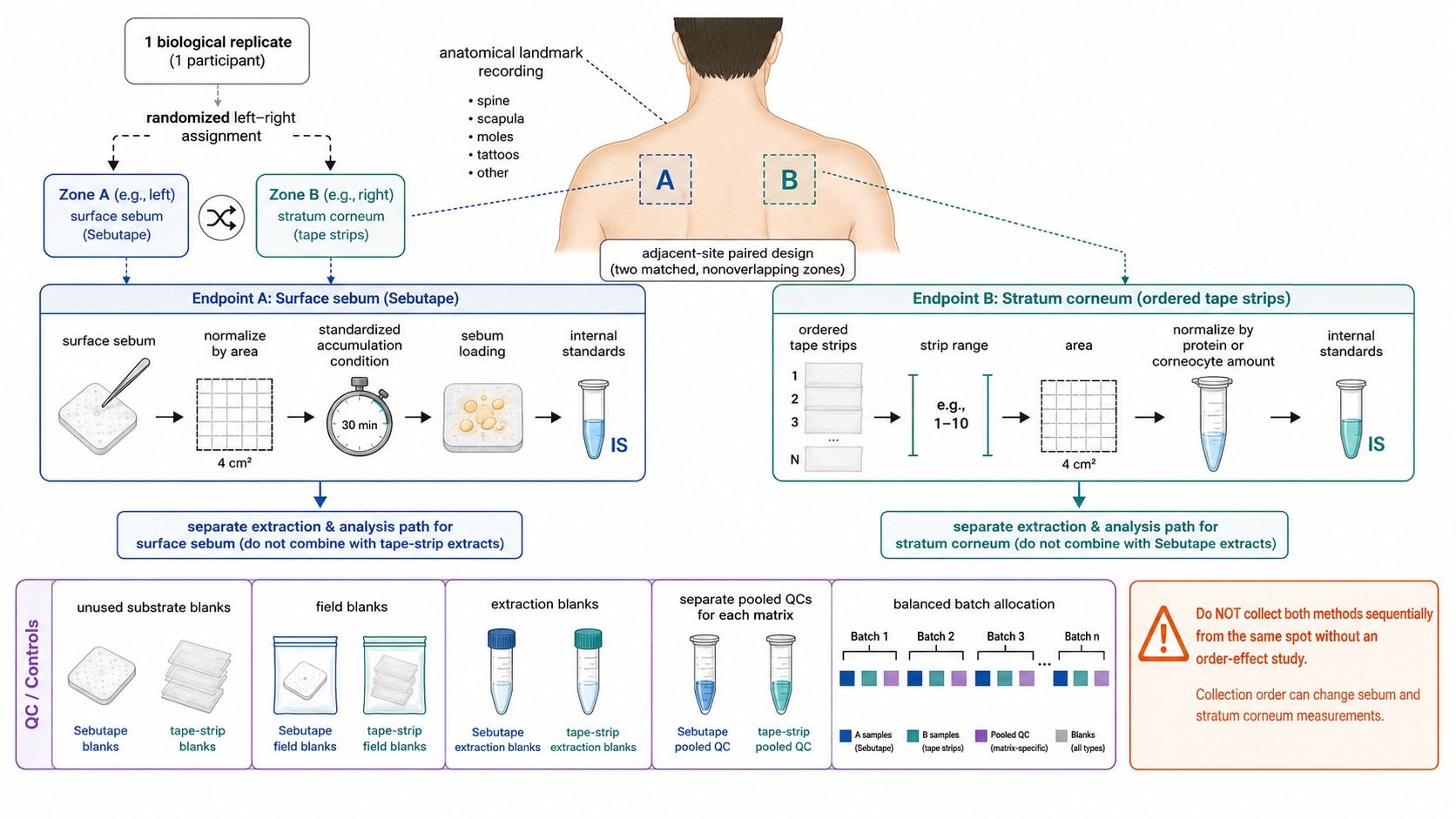 A paired Sebutape and tape-strip design separates surface-sebum endpoints from stratum corneum barrier-lipid endpoints.
When Should Sebutape and Tape Strips Be Used Together?
A paired design can separate surface-sebum changes from stratum corneum barrier changes. Collect the two matrices from matched adjacent areas or randomized contralateral sites, because sampling one method first can alter the surface available to the second.
The analysis plan should not assume that one-to-one lipid correlations prove transfer between compartments. Sebum and stratum corneum samples differ in collected biomass, depth, extraction background, and normalization. Compare each matrix within its own validated framework, then integrate results at the lipid-class or pathway level.
For an intervention study, one possible design is:
- Define sebum composition and barrier-lipid composition as separate endpoints.
- Randomize treatment and control sides or matched areas.
- Reserve distinct adjacent zones for Sebutape and stratum corneum tape stripping.
- Standardize surface preparation, environment, collection order, and substrate lot.
- Add substrate-specific blanks, internal standards, and pooled QCs.
- Analyze sebum and stratum corneum samples with separate normalization rules.
- Integrate only after each dataset passes its own QC and batch assessment.
If the primary question is surface oil control, Sebutape alone may be sufficient. If it is barrier ceramide remodeling, tape stripping alone is more direct. If the hypothesis links sebaceous output with barrier composition, use both on matched but nonoverlapping sites.
Planning a Low-Input Skin Lipidomics Project
A useful feasibility request should state the research model, anatomical site, collection substrate and catalog details, sample area, contact and removal method, number and order of strips, expected sebum level, surface-preparation plan, applied products, collection schedule, storage, biological replicate structure, and available pilot material.
Also specify the lipid endpoint: broad relative profiling, defined sebum lipids, ceramide subclasses, acylceramides, oxidized lipids, absolute amounts, composition ratios, or a depth profile. Provide the intended normalization denominator and whether protein, optical loading, or another biomass measure can be collected from the same or paired tape.
Creative Proteomics can review substrate choice, tape blank qualification, low-volume extraction, internal-standard coverage, targeted or untargeted LC-MS, ceramide annotation, pooling, normalization, batch allocation, and paired-compartment analysis. This review is most useful before collection materials and skin sites are fixed.
If the study targets surface sebum, submit a Sebutape-centered plan. If it targets stratum corneum barrier lipids, submit an ordered tape-strip plan. If both compartments are needed, identify separate sampling zones and endpoints in the initial request.
FAQs
Is Sebutape the same as D-Squame tape stripping?
No. Sebutape is designed to absorb skin-surface sebum, whereas D-Squame-type adhesive discs are commonly used to remove corneocytes from the stratum corneum. Both can recover lipids, but they emphasize different compartments and need different normalization strategies.
Can one tape provide enough material for lipidomics?
Sometimes, especially for abundant surface lipids or a focused targeted panel. Feasibility depends on anatomical site, collected biomass, substrate background, extraction recovery, instrument method, and reporting criteria. Qualify one-tape performance against blanks and higher-input pools before committing the cohort.
Should consecutive tape strips be pooled?
Pool them when the study needs more material and can accept an averaged stratum corneum layer range. Keep them separate when depth is the biological variable. Record every strip in each pool because pooled strips become one analytical sample.
Can Sebutape and stratum corneum tape strips be collected from the same spot?
Not sequentially without testing the order effect. The first collection changes the material available to the second. Use matched adjacent or contralateral areas and randomize the assignment when both sample types are required.
How should topical products be handled before collection?
The rule depends on the endpoint. Remove or control product residues when endogenous skin lipids are the target; preserve a defined exposure interval when the product response is the target. Document all cleansing and applications, and include product-related blanks when residues may enter the extract.
Is protein normalization appropriate for Sebutape samples?
Usually not as the only denominator for a sebum-focused endpoint because Sebutape is intended to collect surface lipid rather than a controlled corneocyte mass. Protein normalization is more directly aligned with stratum corneum tape strips. Sebutape studies may use area, collection condition, sebum loading, total lipid, and internal-standard metrics.
References:
- Berdyshev, E., Bronova, I., Leung, D. Y. M., & Goleva, E. (2021). Methodological Considerations for Lipid and Polar Component Analyses in Human Skin Stratum Corneum. Cell Biochemistry and Biophysics, 79(3), 659-668. https://doi.org/10.1007/s12013-021-01016-6
- Chen, H., Chen, Y., Zhou, Y., et al. (2025). Optimizing Skin Surface Metabolomics: A Comprehensive Evaluation of Sampling Methods, Extraction Solvents, and Analytical Techniques. Journal of Investigative Dermatology, 145(5), 1166-1179. https://doi.org/10.1016/j.jid.2024.08.027
- Isom, M., & Desaire, H. (2024). Skin Surface Sebum Analysis by ESI-MS. Biomolecules, 14(7), 790. https://doi.org/10.3390/biom14070790
- Kendall, A. C., Koszyczarek, M. M., Jones, E. A., et al. (2018). Lipidomics for Translational Skin Research: A Primer for the Uninitiated. Experimental Dermatology, 27(7), 721-728. https://doi.org/10.1111/exd.13558
- Sadowski, T., Klose, C., Gerl, M. J., et al. (2017). Large-Scale Human Skin Lipidomics by Quantitative, High-Throughput Shotgun Mass Spectrometry. Scientific Reports, 7, 43761. https://doi.org/10.1038/srep43761
- Shin, S. H., & Moon, M. H. (2025). Optimization of Skin Sampling Based on Tape Stripping for Lipidome Analysis by Nanoflow Ultrahigh Performance Liquid Chromatography-Tandem Mass Spectrometry. Talanta, 282, 126952. https://doi.org/10.1016/j.talanta.2024.126952
Author: CAIMEI LI, Senior Scientist