Creative Proteomics · Lipidomics
Request a Sample Report
Complete the form to request a representative analysis report. Our team will follow up by email.


Creative Proteomics provides matrix-aware omega-3 fatty acid analysis for biological research, ingredient characterization, food and feed studies, and formulation development. We align the target list, chemical form, reporting basis, sample preparation, and analytical platform before testing.
Target analytes: EPA, DHA, ALA, n-3 DPA, and related omega-3 fatty acids
Analytical routes: GC-FID, GC-MS, or targeted LC-MS/MS selected for the matrix and decision
Reporting options: Relative composition, concentration, mass fraction, totals, and defined ratios
Share your matrix, analytes, sample count, and reporting basis.
×Our services have earned the trust of companies, schools, and organizations globally, and we remain dedicated to maintaining that trust.









An omega-3 value is only as useful as the basis behind it. Two studies can report the same analyte and still produce figures that cannot be placed side by side, because the fraction measured, the units used, and the platform applied were never aligned. Defining those three points with the study objective in hand is what makes a result interpretable outside the lab that generated it.
| Project Decision | Available Options | Purpose |
|---|---|---|
| Measurement scope | Free, total, or fraction-associated fatty acids | Defines which fatty acid pool the result represents. |
| Reporting basis | Relative composition, concentration, mass fraction, molar amount, totals, or defined ratios | Keeps calculations and comparisons aligned with the study endpoint. |
| Analytical route | GC-FID, GC-MS, or targeted LC-MS/MS | Matches platform selectivity and coverage to the matrix and target panel. |
Broader projects can connect omega-3 measurements with polyunsaturated fatty acid analysis, a fatty acid profile by GC-FID and GC-MS, or a defined targeted lipidomics panel.
The final panel is confirmed against the matrix, analytical route, reference standards, and expected abundance. A typical n-3 panel can include the following fatty acids and selected adjacent species needed for interpretation.
| Common Name | Abbreviation | Lipid Shorthand | Typical Role in the Panel |
|---|---|---|---|
| Alpha-linolenic acid | ALA | 18:3 n-3 | Essential plant-derived precursor and common ingredient endpoint |
| Stearidonic acid | SDA | 18:4 n-3 | Intermediate in long-chain n-3 biosynthesis and specialty-oil target |
| Eicosatrienoic acid | ETE | 20:3 n-3 | Intermediate that may support pathway-focused research |
| Eicosatetraenoic acid | ETA | 20:4 n-3 | Long-chain n-3 intermediate included in expanded panels |
| Eicosapentaenoic acid | EPA | 20:5 n-3 | Major marine-derived analyte and frequent primary endpoint |
| Docosapentaenoic acid, n-3 | n-3 DPA | 22:5 n-3 | Long-chain n-3 analyte between EPA and DHA |
| Docosahexaenoic acid | DHA | 22:6 n-3 | Major long-chain n-3 analyte in marine oils and biological tissues |
Depending on the question, the panel can also include relevant omega-6 fatty acids, saturated and monounsaturated fatty acids, totals by class, and calculated ratios. Ratios are only reported when the numerator and denominator are measured in a compatible workflow and expressed on a consistent basis. Projects requiring a wider compositional context can be extended through our unsaturated fatty acid analysis, while studies focused on downstream oxygenated signaling molecules may benefit from a separate eicosanoid analysis service.
No single platform is automatically best for every omega-3 project. Method selection depends on whether the priority is broad composition, compound confirmation, selective quantification in a complex matrix, or a specific free or total fraction.
| Platform | Best Fit | Measurement Strengths | Important Design Considerations |
|---|---|---|---|
| GC-FID | Oils, foods, feeds, ingredients, and broad fatty acid composition | Robust chromatographic quantification across an established FAME profile; well suited to relative composition and product characterization | Fatty acids are commonly converted to methyl esters; peak resolution, response factors, and the reporting basis must be defined |
| GC-MS | Complex profiles that benefit from mass-spectral evidence in addition to retention behavior | Adds mass-spectral information for identification support while retaining GC separation of derivatized fatty acids | Derivatization and chromatographic separation remain critical; positional isomers can require specialized methods or standards |
| Targeted LC-MS/MS | Selective quantification in biological matrices or studies requiring a defined free/total workflow | Matrix-specific selectivity, targeted transitions, and isotope-labeled internal standards where available | Extraction, hydrolysis when applicable, matrix effects, calibration design, and analyte coverage require fit-for-purpose evaluation |
GC workflows commonly measure fatty acids after conversion to fatty acid methyl esters. When that route fits the objective, our fatty acid methyl ester analysis capabilities can support method planning. Targeted LC-MS/MS may be preferable when a biological matrix, selective analyte set, or free-versus-total distinction calls for a more narrowly defined assay. In either route, we avoid treating platform names as a substitute for assay design: extraction, standards, calibration, chromatographic separation, and QC determine how useful the final result will be.
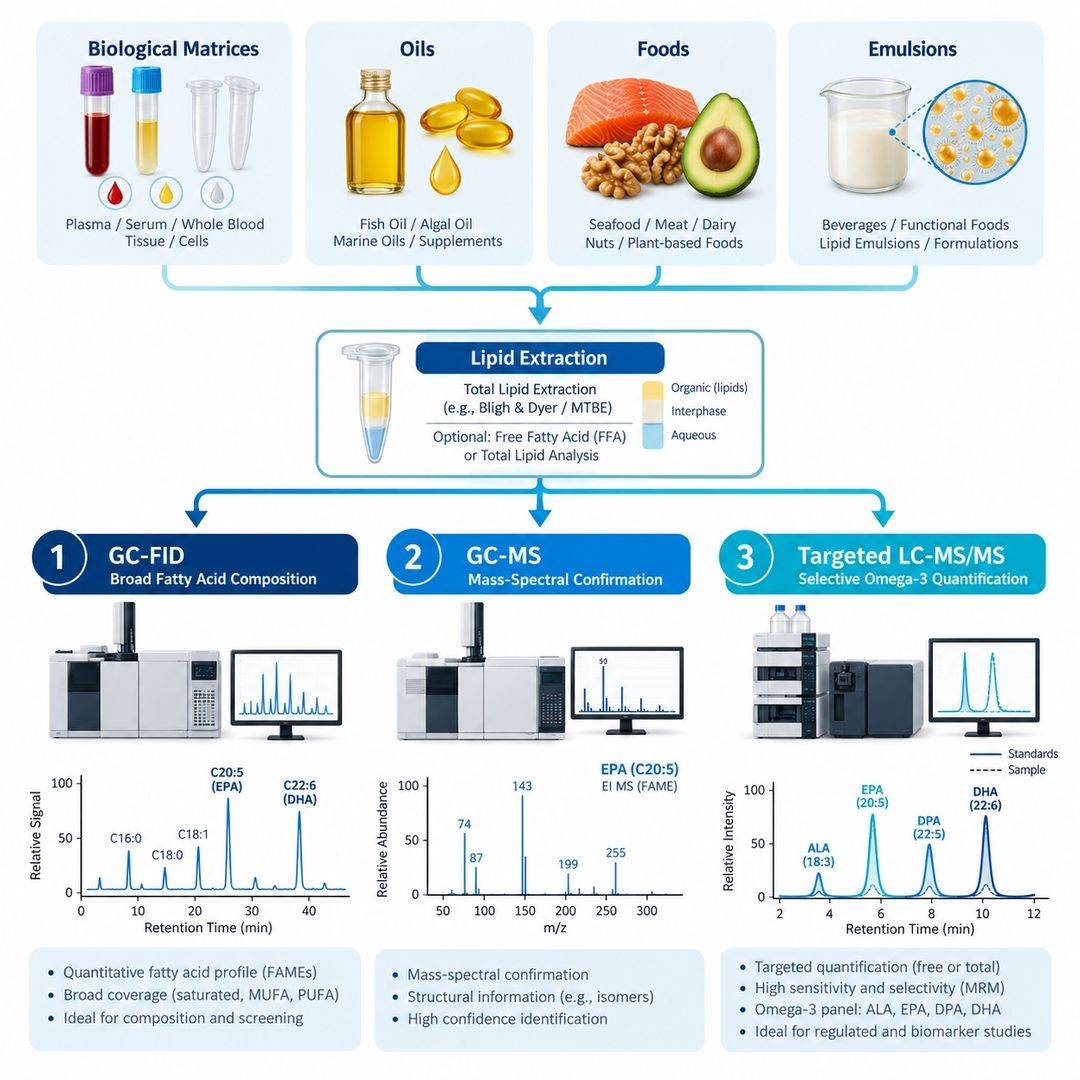 Method selection follows the matrix, chemical form, and reporting objective.
This workflow is intentionally modular. An oil-composition project may emphasize representative sampling, FAME conversion, peak resolution, and mass-fraction reporting. A plasma study may place more weight on collection consistency, storage history, hydrolysis choice, matrix effects, isotope-labeled internal standards, and concentration units. The common principle is that pre-analytical chemistry and the reporting basis are defined before data generation.
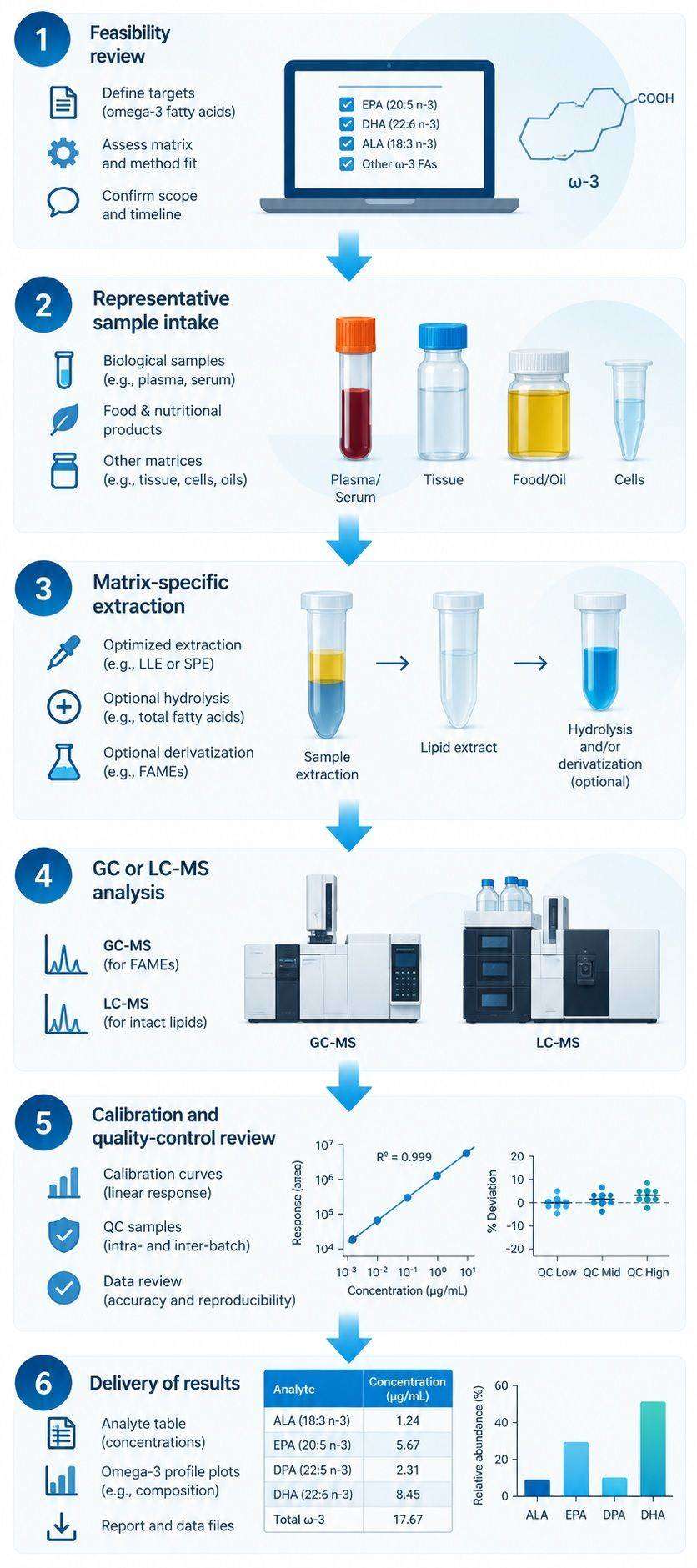 A project-specific path from study design to reviewed data.
Quality control is matched to the platform and claim. Depending on the project, the analytical plan can include solvent and process blanks, calibration standards, internal standards, pooled or matrix-representative QC samples, replicates, carryover checks, response monitoring, and batch-order controls. Isotope-labeled internal standards are used where they are available and appropriate; when exact analogs are not available, surrogate selection and its limitations are documented.
For absolute quantification, the feasibility review addresses calibration range, standard purity or value assignment, recovery, matrix effects, response behavior, and the suitability of the chosen internal standard. For relative-composition workflows, attention shifts toward chromatographic separation, peak assignment, response-factor treatment, and consistent calculation of the denominator. We do not convert relative peak area into an absolute concentration unless the method and calibration support that interpretation.
The QC summary is designed to help researchers understand whether a batch behaved as intended. It can include calibration performance, blank observations, internal-standard behavior, replicate agreement, drift or carryover observations, and notes on excluded or qualified results. Acceptance criteria are defined during method planning rather than imposed as generic thresholds across unrelated matrices.
| Sample Category | Examples | Planning Considerations |
|---|---|---|
| Blood-derived samples | Plasma, serum, whole blood, red blood cells | Use a consistent collection protocol and anticoagulant where applicable; record processing time and storage history; avoid repeated freeze-thaw cycles |
| Tissues and cells | Animal tissues, biopsies, cultured cells, cell pellets | Keep collection and normalization consistent; record wet weight, cell count, protein basis, or another normalization variable |
| Oils and lipid ingredients | Fish, algal, krill, plant, and blended oils | Protect from light, heat, and oxygen; provide formulation details, antioxidants, and expected concentration range |
| Foods, feeds, and raw materials | Fortified foods, powders, emulsions, feeds, and ingredients | Provide a representative homogenized sample and identify the desired reporting basis, such as per mass of sample, total fat, or total fatty acids |
| Formulations and test articles | Capsules, emulsions, specialty lipids, and research formulations | Disclose excipients, carrier oils, encapsulation, and other components that may affect extraction or chromatography |
Exact sample amounts and containers are confirmed after the target list and method route are selected. This avoids publishing a universal minimum that may be unsuitable for a low-abundance matrix, a broad panel, repeat analysis, or a stability-sensitive formulation. Samples should be labeled unambiguously, shipped under conditions that preserve their current state, and accompanied by a sample manifest.
For a useful feasibility review, provide the matrix, species or product type, number of groups and replicates, total sample count, priority analytes, expected range if known, free or total measurement preference, requested units, available sample amount, and storage history. Mention any treatments, diets, processing steps, or formulation components that could materially affect interpretation.
The core data package is tailored to the study question and may include:
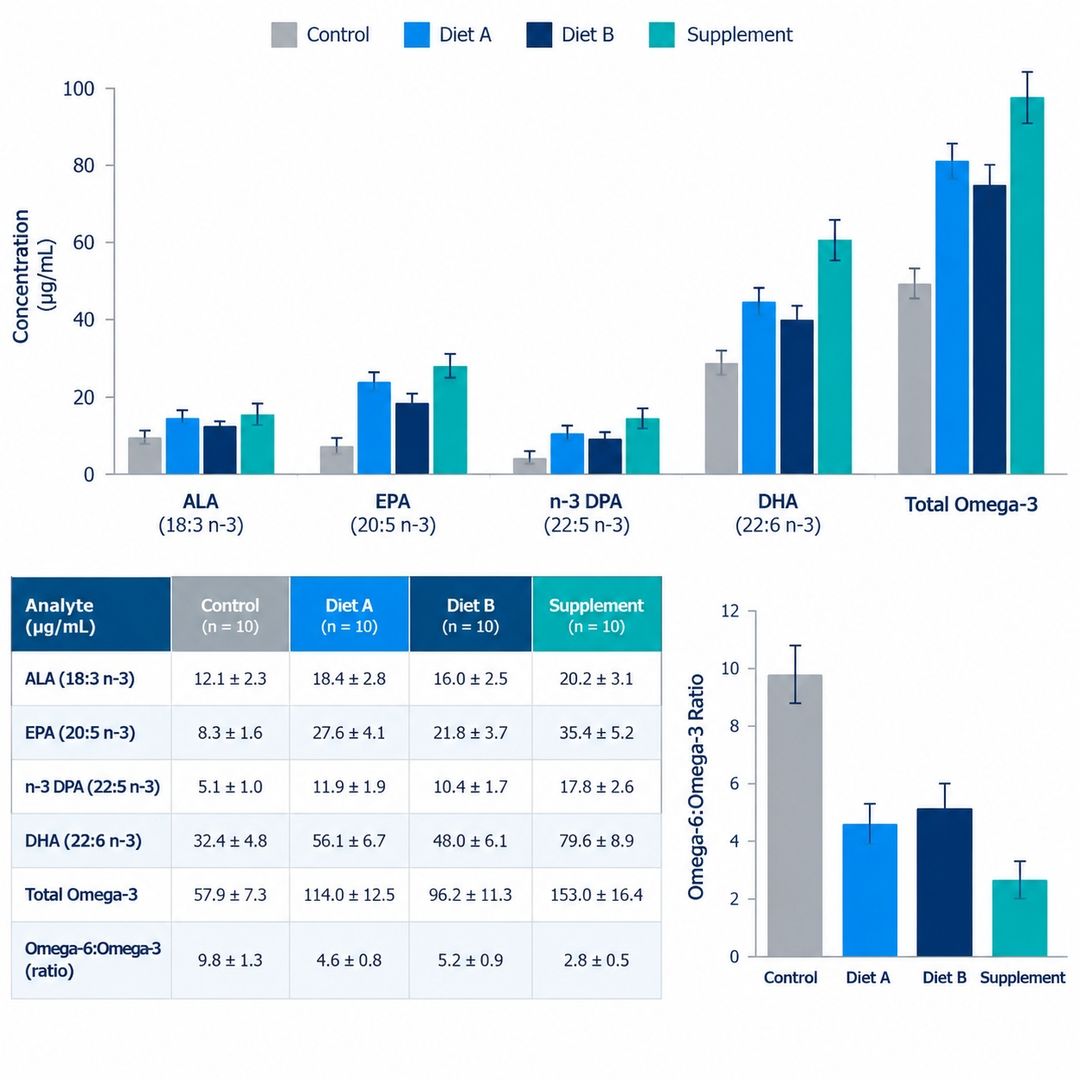
Representative quantitative profile delivered as a report-ready visual.
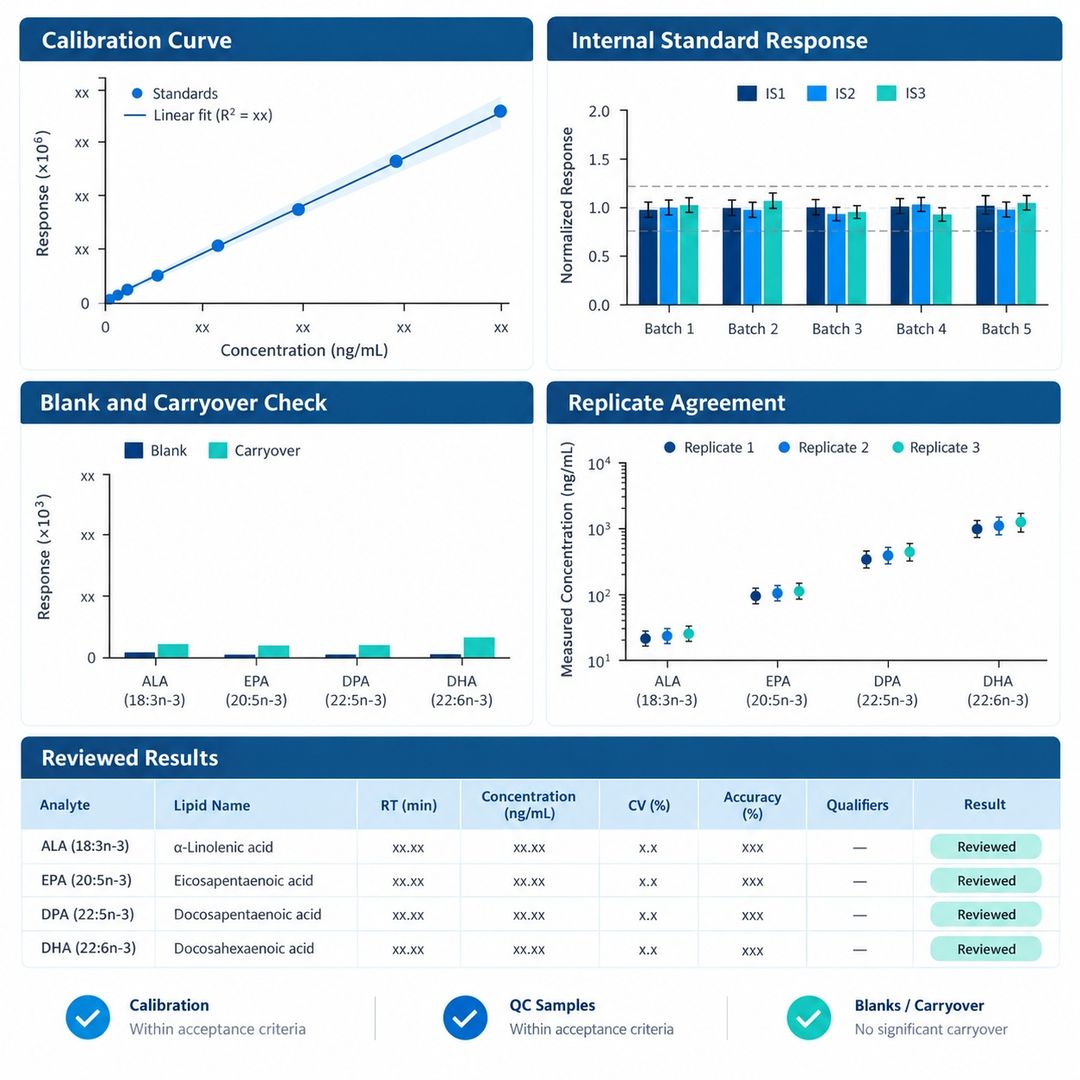
Representative QC summary supporting review of batch performance.
Raw instrument files can be discussed during project planning when they are required for archiving or independent review. Statistical analyses are agreed upon before execution so that group structure, replicate type, missing-value handling, normalization, and multiple-testing considerations are not decided after viewing the results.
Can you measure EPA, DHA, ALA, and n-3 DPA in the same project?
Often yes, but the final panel depends on the matrix, platform, expected range, chromatographic behavior, and availability of suitable standards. We confirm the target list during feasibility review and may recommend adjacent fatty acids when they are needed to calculate totals or ratios.
Should I request free or total omega-3 fatty acids?
Choose the fraction that matches the biological question. Free fatty acids represent the unesterified pool at collection. Total-fatty-acid workflows release fatty acids from esterified lipids and therefore measure a broader pool. Some studies instead isolate a fraction, such as plasma phospholipids. These results are not interchangeable.
When is GC-FID preferable to LC-MS/MS?
GC-FID is often a strong choice for broad fatty acid composition in oils, foods, feeds, and other matrices where an established FAME profile is the goal. LC-MS/MS may be preferable for a selective panel in a complex biological matrix, particularly when the study needs matrix-specific calibration or a defined free/total assay. GC-MS is useful when mass-spectral evidence adds value to a GC separation.
Can you report an omega-6:omega-3 ratio?
Yes, when the specified omega-6 and omega-3 analytes are measured on a compatible basis. The project plan defines which species contribute to each sum and whether the ratio is based on relative composition, molar amount, or concentration.
Do you provide a clinical Omega-3 Index result?
No. This page describes a research-use analytical service and is not presented as a clinical Omega-3 Index test. If red blood cells are submitted for research, the analytical scope and reporting basis are defined for the study without diagnostic interpretation.
How should oils and formulations be stored before shipment?
Minimize exposure to heat, light, and oxygen, and keep storage conditions consistent across samples. Provide information about antioxidants, carrier oils, encapsulation, and storage history. The project team will recommend shipment conditions after reviewing the formulation and analysis plan.
What information is needed for a quote?
Provide the matrix, species or product type, groups and replicates, total sample count, priority analytes, expected range if known, desired free or total measurement, reporting units, available sample amount, and storage constraints.
CONTACT US