Our services have earned the trust of companies, schools, and organizations globally,
and we remain dedicated to maintaining that trust.
What Liposome Characterization Covers and Why Composition Drives Function
A liposomal formulation is defined by its critical quality attributes rather than by one number, and those
attributes are linked: the lipid composition sets how the bilayer behaves, the bilayer sets what leaks, and
what leaks sets the release profile. Characterization therefore works best as a connected set of
measurements on one preparation, and composition is where lipid analysis contributes most, because a shifted
ratio or a hydrolysis product appears before size or release moves.
Liposomes and Lipid Nanoparticles Are Characterized Differently
Liposomes and lipid nanoparticles are both lipid-based carriers, but they are different objects and they are
not characterized the same way. A liposome encloses an aqueous core inside a bilayer, so encapsulation and
release are measured across a membrane. A lipid nanoparticle is a solid lipid core that complexes nucleic
acid electrostatically, so the useful measures are the component ratio and the fraction of cargo left
unbound.
Studies built around the nucleic acid carrier are served by our lipid nanoparticle route, while the routes on this page
are built for vesicles with an aqueous interior.
Liposome Characterization Services in
Creative Proteomics
The routes below address different attributes of the same preparation. They can be run as a set or chosen
individually, and the choice usually follows from which attribute the development decision depends on.
Size, Polydispersity, and Surface Charge
Measure the mean diameter, the distribution width, and the surface charge of a
preparation, with the measurement conditions stated so that values from different
batches, or from different laboratories, can be placed side by side.
Lipid Composition and Component Ratios
Quantify the phospholipids and the sterol in the bilayer by LC-MS and report them as
relative amounts, so that the intended formulation can be compared with what the
preparation actually contains.
Encapsulation Efficiency and Drug Loading
Separate encapsulated from free payload and quantify both, expressing the result as the
encapsulated fraction and as the payload amount per unit of lipid, because those two
figures answer different development questions.
Free Payload and Leakage Measurement
Quantify the payload that has left the vesicle in a stored or stressed sample, which is
the measurement that separates a release experiment from a stability observation.
Lysolipid and Hydrolysis Product Analysis
Measure the lysophospholipids and free fatty acids formed when an ester bond in the
bilayer hydrolyses, giving a chemical readout of degradation that a size measurement on
its own will not show.
Comparison Across Batches and Process Variants
Run the same measurement set on process variants, storage time points, or a test
preparation against a reference, so a difference is attributed to a defined attribute
rather than to the formulation as a whole.
What Is Characterized in a Liposomal
Formulation
Three attribute groups cover most development questions, and each one is reported with the conditions
that produced it. The tables below list what is measured in each group and how the value is expressed.
- Size and Surface
- Lipid Composition
- Encapsulation
Size, Surface Charge, and Lamellarity
These attributes describe the physical state of the dispersion, and each one depends on the
medium in which it is measured, so the conditions are reported with the value.
| Attribute |
What It Indicates |
How It Is Reported |
| Mean particle diameter |
Where the vesicle sits in the size range that governs distribution and retention
behaviour |
Mean diameter together with the distribution width, and the technique and
measurement conditions stated |
| Polydispersity |
Whether the preparation is one population or a mixture of populations |
Distribution profile or polydispersity value, with the basis on which it was
derived recorded |
| Surface charge |
Whether vesicles repel each other or aggregate, and how they will interact with
a surface |
Zeta potential with the medium composition and pH, because the value shifts with
both |
| Lamellarity and morphology |
How many bilayers enclose the core, which sets the internal volume available to
the payload |
Reported where the development question depends on it, with the method named and
the limitation stated |
Lipid Composition and Component Ratios
The bilayer is a defined mixture, so its composition is reported as relative amounts and as the
ratio between components, both from one extraction.
| Component |
Why It Matters |
Reported As |
| Phospholipid classes |
Set the phase behaviour of the bilayer and the temperature at which it changes
state |
Relative amount per class, measured in the same extraction as the sterol |
| Sterol content |
Modulates permeability and mechanical stability, and its effect depends on how
much is present |
Relative amount, with the sterol species identified because plant and animal
sources differ |
| Lysophospholipids |
Enter as an impurity in the raw lipid or form during processing and storage, and
destabilize the bilayer |
Relative amount per species, reported as a degradation indicator rather than as
a formulation component |
| Component ratios |
A formulation is defined as a ratio, so the ratio is the figure that can be
compared across batches |
Ratio of the components stated in the intended formulation, with the calculation
shown |
Where the bilayer phospholipids need to be reported as a full profile rather than as a ratio, the
measurement is planned with our phosphatidylcholine
analysis, phosphatidylethanolamine analysis,
and phosphatidylglycerol analysis routes, and the sterol
side is covered with cholesterol analysis so
that every component value comes from one preparation.
Encapsulation, Free Payload, and
Release
Encapsulation is only as reliable as the separation behind it, so the separation method is named
in the report rather than left implicit.
| Parameter |
Definition |
Measurement Basis |
| Encapsulation efficiency |
Share of the total payload held inside the vesicles at the time of sampling |
Measured after separating encapsulated from free payload, with the separation
method named |
| Drug loading |
Payload amount relative to the amount of lipid present |
Calculated from the encapsulated amount and the lipid content measured in the
same preparation |
| Free payload |
Payload remaining outside the vesicles at the time of sampling |
Measured directly in the separated free fraction rather than obtained by
subtraction |
| Release profile |
Change in free payload over time under defined conditions |
Measured at defined time points, with the medium, temperature, and separation
method recorded |
The three attribute groups are reported against one sample identifier, which is what allows a
composition result and a size result to be read as statements about the same preparation rather
than as two unrelated measurements.
The Degradation Signature of a Liposomal
Formulation
A liposome carries a record of what has happened to it, and that record is chemical. The ester bond between
the glycerol backbone and an acyl chain hydrolyses slowly during storage, releasing a lysophospholipid and a
free fatty acid; the reaction runs faster at elevated temperature, at pH extremes, and in the presence of
payloads that catalyse it.
Because the loss happens one acyl chain at a time, the parent lipid generally stays in the bilayer, so the
vesicle diameter can barely move while the lysophospholipid level is already climbing.
| Degradation Product |
Formed From |
Analytical Consequence |
Why a Size Measurement Will Not Show It |
| Lysophospholipid |
Hydrolysis of one acyl chain from a diacyl phospholipid |
More polar than its parent, so it separates early under reversed-phase conditions and needs
its own standard |
The parent lipid stays in the bilayer, so the diameter of the vesicle changes little at
first |
| Free fatty acid |
The acyl chain released by the same hydrolysis, or by oxidation of an unsaturated chain |
Measured as the free acid, which is a different analyte from the esterified form quantified
in a composition panel |
The released chain moves into the surrounding medium rather than changing the particle |
| Oxidized phospholipid |
Oxygenation of an unsaturated acyl chain that remains in the bilayer |
Requires its own method and its own standards, and is reported as a species rather than as a
total |
A chemical change can take place with no measurable change in particle size |
Two consequences follow for how a stability study is planned. First, composition and degradation markers are
measured on the same time points as the physical attributes, so a finding can be attributed to a chemical
change rather than to a physical one. Second, the raw lipid is profiled before preparation where the
question concerns a starting material, because a lysophospholipid present on day zero did not form in the
formulation.
The same logic applies to sphingolipid components, whose deacylated forms are measured beside the parent
through our lysophosphatidylcholine analysis and sphingomyelin analysis routes.
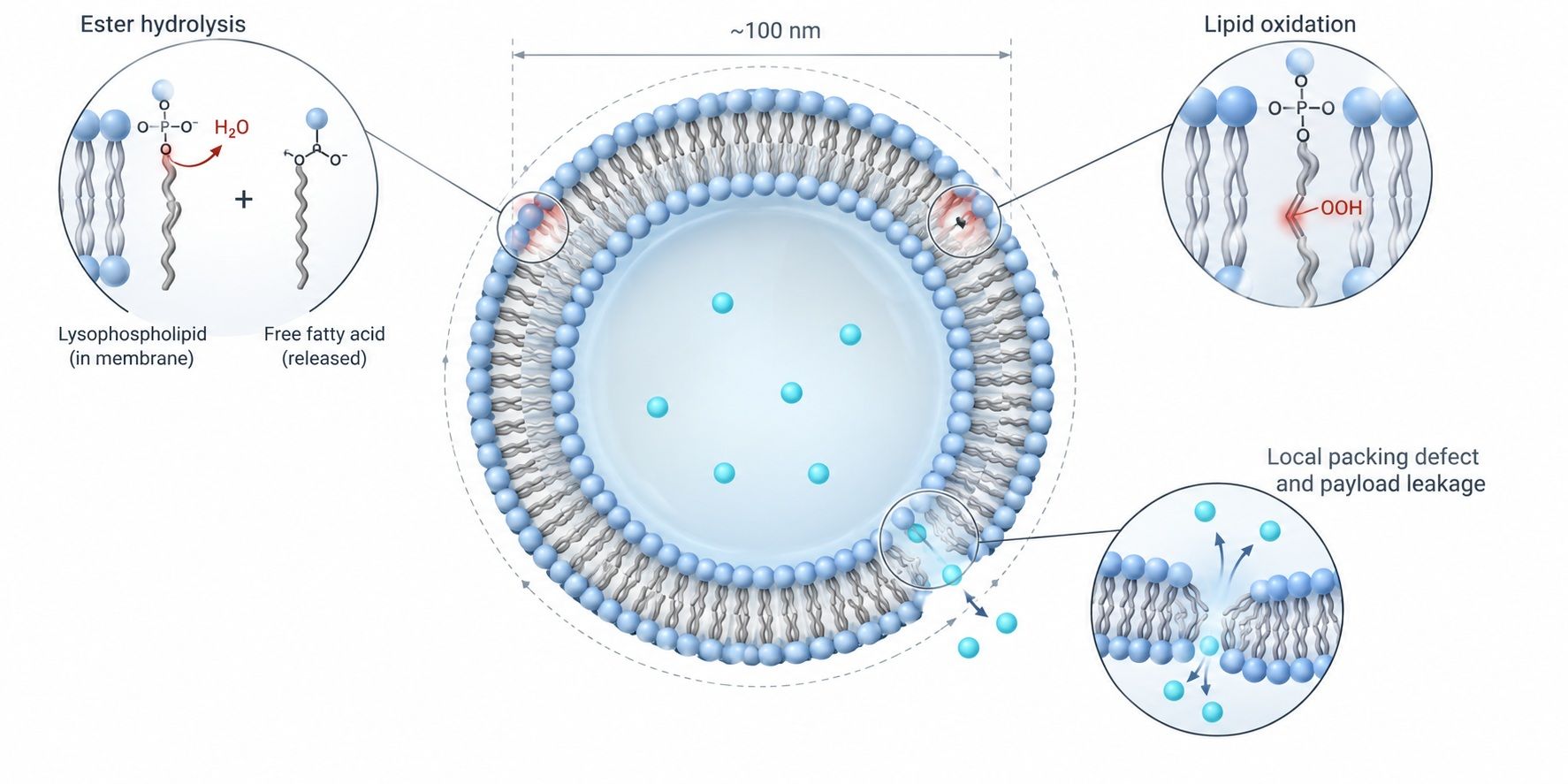 Liposome Degradation and Leakage Routes: a bilayer vesicle with an aqueous core, hydrolysis of one acyl chain from a bilayer phospholipid producing a lysophospholipid and a free fatty acid, oxidation of an unsaturated acyl chain that remains esterified, and the payload leaving through the bilayer as the packing order changes.
Where Liposome Characterization Is Used
Projects reaching this service differ in the attribute the decision depends on, and in whether the comparison
is against a specification, a reference preparation, or an earlier time point. Designs outside the patterns
below are adapted during feasibility review.
Formulation and Process Development
Compare preparations made with different lipid ratios, payloads, or processing steps,
using size, charge, composition, and encapsulation together so that a performance
difference can be traced to a specific attribute instead of the process as a whole.
Forced Degradation and Stability Studies
Follow how composition and the level of hydrolysis products change across storage time
points and stressed conditions, which is where a bilayer problem becomes visible before
it appears as a change in particle size or release.
Comparison Across Batches and Processes
Assess whether two preparations are interchangeable on the attributes that matter, by
running one measurement set on both and reporting the pairs on one table, so the
difference is quantified rather than described.
Payload Release and Retention Research
Establish how much payload is retained and how much is free at defined time points, which
supports formulation ranking in research settings and helps distinguish a formulation
that leaks from one that was loaded poorly.
Why Choose Our Liposome Characterization
Platform
- Attributes measured on one preparation: Size, charge, composition, and encapsulation are
reported against a single sample identifier, so the values describe the same material rather
than three separately aliquoted samples.
- Composition reported as a ratio: Phospholipid classes and sterol are returned as relative
amounts and as the component ratio, which is the form in which a formulation is defined and
the form that can be compared across batches.
- Degradation markers included by design: Lysophospholipids, free fatty acids, and oxidized
species are part of the standard measurement set, because a bilayer can change chemically
while the particle size stays inside its expected range.
- Separations named, not assumed: The method used to separate free from encapsulated payload
is stated in the report, since an encapsulation figure is only as sound as the separation
behind it.
- Conditions attached to physical values: Diameter and zeta potential are reported with the
medium, temperature, and pH, so a number can be compared with data generated elsewhere
without guessing the context.
- Raw material checked separately: Where the question concerns a starting lipid, it is
characterized before preparation so that an impurity already present is not later read as
something the formulation produced.
Liposome Characterization Workflow
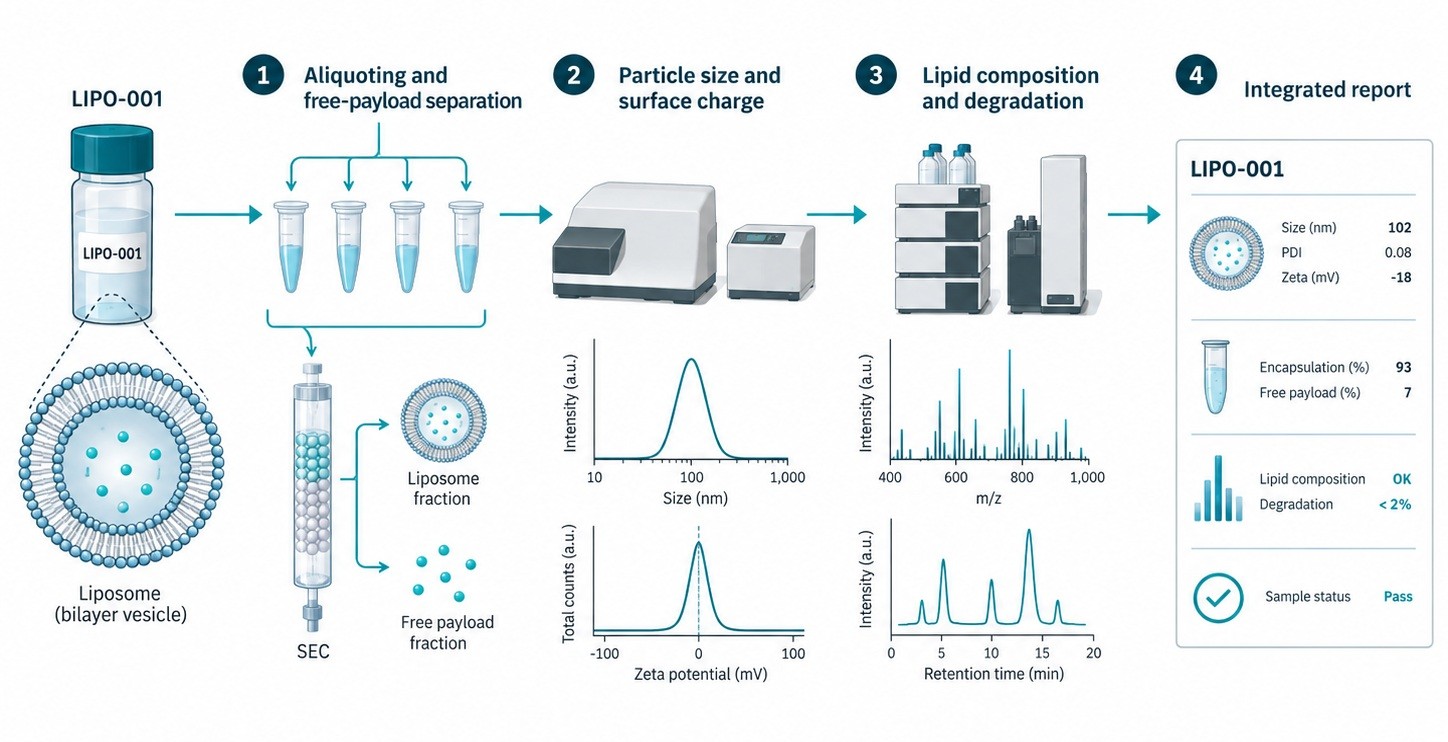 Five-step liposome characterization workflow: review of the development question and the attribute it depends on, sample preparation and separation of free from encapsulated payload, physical measurement of size and surface charge, lipid composition and degradation analysis by chromatography and mass spectrometry, and reporting of all attributes against one sample identifier.
The workflow is modular, and one decision shapes it: whether the question concerns the physical state of the
dispersion, the chemical state of the bilayer, or the payload. A process comparison usually needs the
physical attributes and the ratio; a stability question needs the chemical side, including the hydrolysis
products; a loading question needs the separation and the free fraction. Fixing that first decides which
sample preparation is used, because a preparation optimized for light scattering is not the one used for
lipid extraction.
Platforms Used for Liposome Characterization
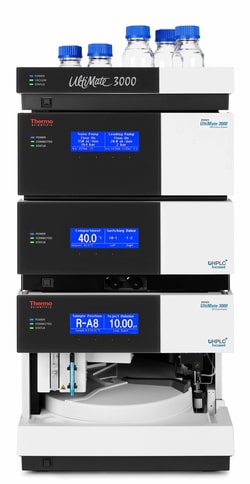
Thermo Scientific UltiMate 3000 (Figure from Thermo Fisher) — separation of free
from encapsulated payload and quantification of lipid components
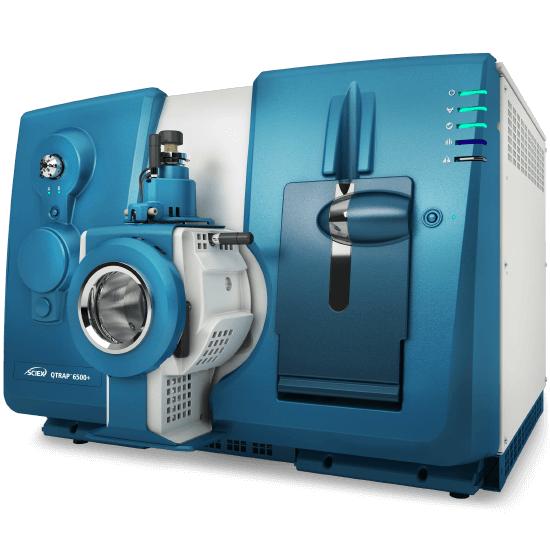
SCIEX Triple Quad 6500+ (Figure from SCIEX) — scheduled MRM for phospholipid
classes, sterol, and hydrolysis products
Method Specifications for Liposome Characterization
| Parameter |
Specification |
| Dilution and medium for size |
Samples diluted into a defined medium at a stated pH and temperature, because dilution
changes the measured diameter and the surface charge together |
| Light scattering |
Dynamic light scattering for the size distribution and electrophoretic light scattering
for surface charge, with the same sample handled under both conditions where possible
|
| Lipid extraction |
Matrix-specific extraction from the vesicle suspension, with an internal standard added
before extraction so that recovery is measured rather than assumed |
| LC separation |
Reversed-phase or hydrophilic interaction separation depending on whether the target is
a phospholipid class, a lysophospholipid, or a sterol |
| Detection |
Mass spectrometry for species-level composition and hydrolysis products; charged aerosol
or evaporative light scattering detection where class-level amounts are sufficient |
| Encapsulation separation |
Size exclusion, dialysis, or an equivalent validated separation, chosen according to the
payload and named in the report |
| Release conditions |
Medium, temperature, and time points defined with the study, and the same separation
applied at every time point so the profile is internally consistent |
| Degradation markers |
Lysophospholipids and free fatty acids measured against a baseline sample from the same
preparation, rather than against a fixed reference value |
| Reporting basis |
Absolute amount, relative amount, or ratio, with the conditions, the separation method,
and the internal standard stated for every value |
Results and Data Analysis
Liposome Characterization Report
The core report places the physical attributes, the lipid composition, and the payload results on
one structure, so that a formulation can be read as a whole rather than attribute by attribute.
Key Features:
- Diameter, distribution, and surface charge reported with the medium, temperature, and pH at
which they were measured
- Phospholipid classes and sterol given as relative amounts and as the component ratio, with
the calculation shown
- Encapsulation efficiency, drug loading, and free payload reported separately, with the
separation method named
- A quality control summary covering calibration performance, blank observations, replicate
agreement, and any value qualified for falling outside the calibrated range
Raw instrument files can be discussed during project planning when they are needed for archiving
or independent review.
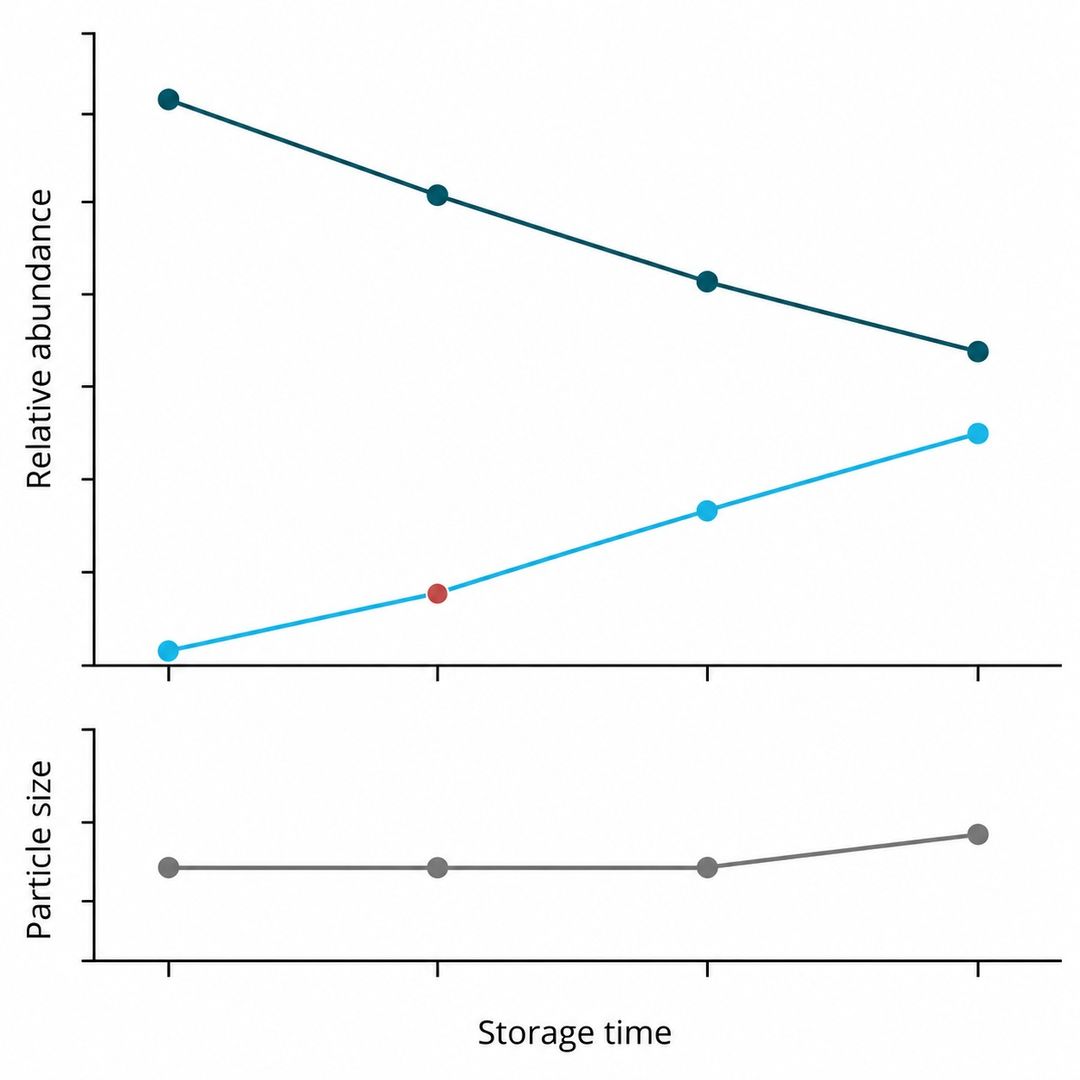
Phospholipid composition and lysophospholipid level plotted across storage time
points, showing the chemical change that precedes a shift in particle size.
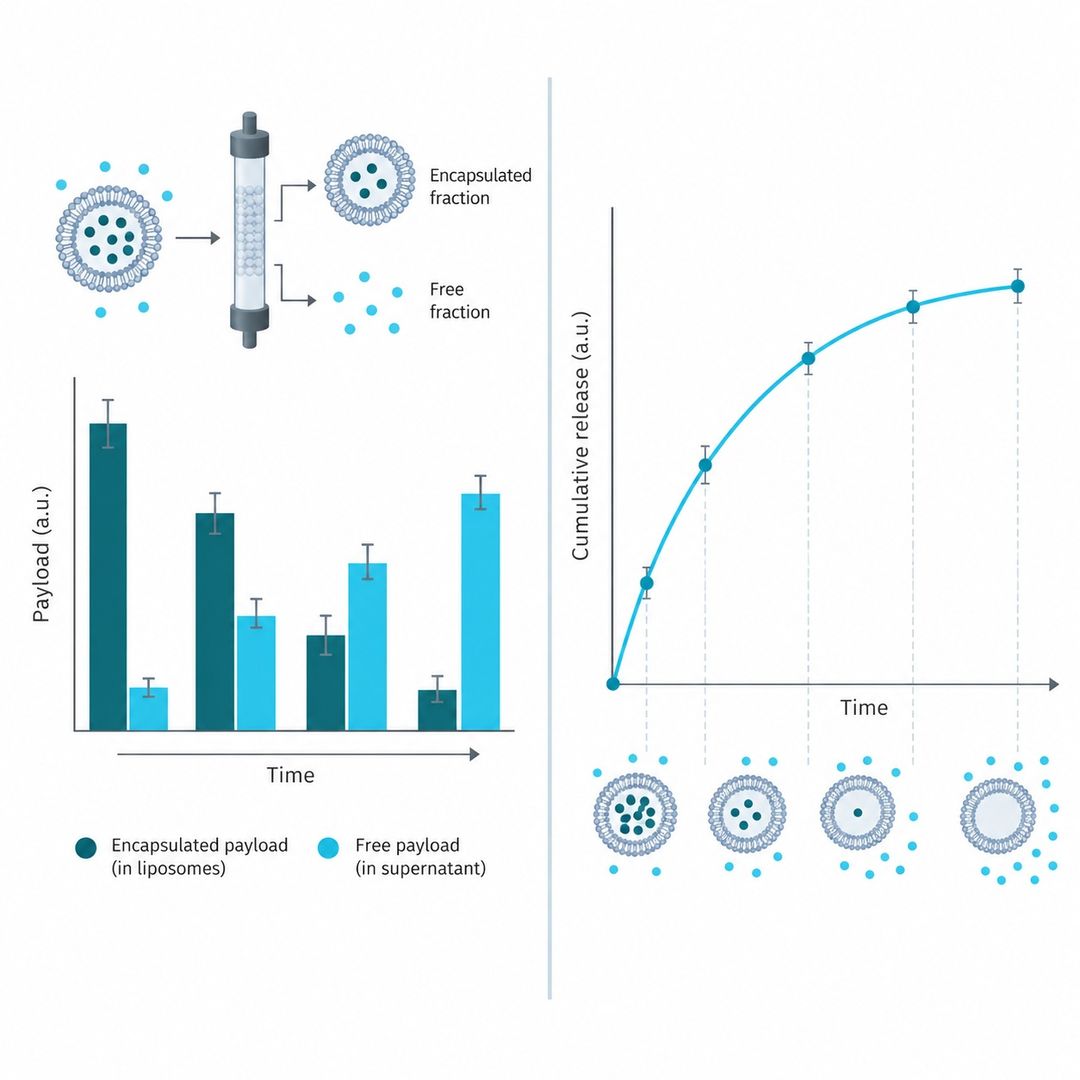
Encapsulated and free payload measured at each time point, with the release profile
calculated from the separated fractions rather than by subtraction.
Composition and Ratio Report
Where the decision concerns the bilayer itself, the deliverable is a composition table built so
that it can be placed directly beside the intended formulation.
Key Features:
- Phospholipid classes, sterol, and lysophospholipids reported as relative amounts from one
extraction
- Component ratio calculated from those values, with the intended ratio shown alongside for
direct comparison
- Raw lipid material characterized separately where the question concerns what was present
before preparation
Payload and Release Report
Encapsulation figures depend entirely on how free payload was separated from encapsulated
payload, so that step is part of the reported result.
Key Features:
- Encapsulated, free, and total payload reported individually, each measured directly rather
than derived by subtraction
- Drug loading expressed against the lipid content measured in the same preparation
- Release profile at defined time points, with the medium, temperature, and separation method
stated for every point
Sample Requirements for Liposome
Characterization
| Sample Type |
Collection and Handling |
Typical Starting Amount |
Planning Notes |
| Liposomal suspension |
Ship at the storage temperature used for the study, without freezing unless the formulation
tolerates it, and record the time since preparation |
1 millilitre or more at the working concentration |
State the intended composition and payload so that measured values can be compared with the
design rather than in isolation |
| Lyophilized or frozen preparation |
Provide both the pre-lyophilization material and the reconstituted form where the question
concerns the process |
Two aliquots of the same batch |
Reconstitution changes the dispersion state, so the medium and the reconstitution protocol
are recorded |
| Process intermediates |
Keep each step cold and process promptly, since a size distribution continues to evolve
after the step is complete |
0.5 millilitres or more per step |
Sampling at the step itself is what allows a difference in the final material to be
attributed to a defined operation |
| Raw lipid or excipient material |
Store sealed and protected from oxygen, light, and heat, and record the lot and the supplier
|
5 to 20 milligrams |
Characterizing the starting material separately is what distinguishes an impurity already
present from one formed during processing |
| Stored or stressed samples |
Provide the time point and the stress condition for each sample, and store unopened until
analysis |
0.5 millilitres or more per time point |
Time points from the same batch are compared against each other, so the day-zero sample is
part of the set rather than a separate request |
| Payload reference solution |
Provide the free payload as a solution at a known concentration, stored as the compound
requires |
100 microlitres or more |
A free payload reference is what allows the separated free fraction to be quantified against
a standard rather than estimated |
The amounts above are planning figures. Final quantities are confirmed once the attribute set has been
agreed, because a composition-only project and a full characterization set including release measurement do
not carry the same requirement.
Frequently Asked Questions About Liposome Characterization
Can size, composition, and encapsulation be measured on the same sample?
Yes, and it is the preferred arrangement. The dispersion is subsampled for the physical
measurements, then a separate subsample is taken for lipid extraction and for the
separation of free from encapsulated payload. All results are reported against one
sample identifier, so a composition finding and a size finding can be read as statements
about the same material. The one caveat is that dilution for light scattering changes
the medium, so the physical measurements are taken from a defined dilution and that
dilution is recorded in the report.
How is free payload separated from encapsulated payload?
By size exclusion, dialysis, or an equivalent validated separation, chosen according to
the payload and the formulation. What matters more than the choice is that the same
separation is applied to the standard, the sample, and every time point, and that it is
named in the report. Separation methods differ in whether they perturb the vesicles, so
a figure obtained by one method is not automatically comparable with a figure obtained
by another, and the free fraction is measured directly rather than calculated by
subtracting the encapsulated amount from a total.
Which degradation products can be detected in a stored liposome?
Three groups are covered routinely. Lysophospholipids form when one acyl chain is
hydrolysed away from a diacyl phospholipid, and they are more polar than their parent so
they separate early. Free fatty acids appear from the same hydrolysis or from oxidation
of an unsaturated chain, and they are a different analyte from the esterified form
measured in a composition panel. Oxidized phospholipids form when an unsaturated chain
inside the bilayer is oxygenated, which needs its own method and its own standards. All
three are reported against a day-zero sample from the same batch rather than against a
fixed reference value.
Can the measurement tell a formulation change from a storage change?
Only if the design separates them, and that is arranged at planning. A formulation
comparison needs process variants or composition variants measured at one time point,
with the raw lipid characterized separately so an impurity present from the start is not
attributed to the formulation. A storage study needs several time points from one batch,
including day zero, with the physical attributes and the degradation markers measured on
the same time points. When both questions are present, they are run as two arms rather
than pooled into one comparison.
How much sample is needed?
As a planning figure, around 1 millilitre of suspension at the working concentration
supports the physical attributes plus lipid composition, and each additional time point
or process step is sampled separately at roughly 0.5 millilitres. Raw lipid material
needs 5 to 20 milligrams, and a free payload reference of about 100 microlitres allows
the free fraction to be quantified against a standard. Final quantities are confirmed
once the attribute set is agreed, because a composition-only project and a full set
including release measurement do not carry the same requirement.
Is this service for clinical diagnostic use?
No. This service is for research use only. It is not intended for clinical diagnostic
procedures, patient management, or treatment decisions, and no result is reported as a
clinical index. Measurements intended for clinical interpretation are performed by
licensed clinical laboratories. If your study involves samples that may require clinical
follow-up, please indicate this during study design.
What information is needed for a quote?
Provide the formulation as designed, including the intended lipid components and their
ratio, the payload, and the preparation method. Add the attribute set the decision
depends on, the number of preparations and replicates, the time points if the study is
longitudinal, the storage history of the material, and the volume available. Mention the
comparison the data has to support, since a process comparison and a stability finding
need different sample arms and are quoted accordingly.