Core Redox Pair Quantification
Quantify oxidized and reduced CoQ in the same run and report per-sample results plus redox-ready fields.

When ubiquinone (oxidized) and ubiquinol (reduced) shift, the redox biology behind coenzyme Q is already changing. In most mammalian research settings, this redox pair primarily reflects CoQ10 status—measured as ubiquinone-10 (UQ10) and ubiquinol-10 (UL10)—while some models may also require CoQ9 coverage. Creative Proteomics provides a targeted Ubiquinone–Ubiquinol LC–MS/MS (MRM) service designed to report oxidized/reduced pools, total CoQ, and redox metrics with stability-aware handling.
At a glance
Submit Your Request Now
×Our services have earned the trust of companies, schools, and organizations globally, and we remain dedicated to maintaining that trust.









Ubiquinone and ubiquinol are the oxidized and reduced forms of coenzyme Q (CoQ)—a redox-active quinone central to mitochondrial electron transport and cellular redox chemistry. Measuring both forms enables readouts such as Ubiquinol:Ubiquinone ratio (or % oxidized) that can be compared across conditions in mechanistic research workflows.
A practical challenge is that ubiquinol can oxidize during collection, storage, and preparation, which can distort redox metrics if stability is not controlled. A fit-for-purpose assay therefore combines targeted detection with stability-aware workflow design so the redox pair is measured as it exists in the sample—not as it changes on the bench.
Most mammalian projects focus on CoQ10, quantified as ubiquinone-10 (UQ10) and ubiquinol-10 (UL10). Depending on the model system, other homologs (e.g., CoQ9) may also be relevant. Our service is structured as targeted options that match how clients use the data—either to obtain robust concentrations, redox metrics, or model-specific homolog coverage.

Core Redox Pair Quantification
Quantify oxidized and reduced CoQ in the same run and report per-sample results plus redox-ready fields.

Redox Metric–Focused Workflow (stability-controlled)
Designed for projects where redox metrics are the primary endpoint, with enhanced stability emphasis to reduce ex vivo oxidation effects.

Homolog Expansion (optional)
Add homolog coverage (e.g., CoQ9 alongside CoQ10) when required by your model system, while keeping the same reporting structure.
| Category | Item | Reported as | Notes |
|---|---|---|---|
| Core analytes (default) | Ubiquinone-10 (UQ10; CoQ10) | Concentration or normalized abundance | Oxidized form |
| Ubiquinol-10 (UL10; CoQ10H₂) | Concentration or normalized abundance | Reduced form (stability-controlled handling recommended) | |
| Optional homologs (model-dependent) | Ubiquinone-9 (UQ9; CoQ9) | Concentration or normalized abundance | Added when the model system requires CoQ9 coverage |
| Ubiquinol-9 (UL9; CoQ9H₂) | Concentration or normalized abundance | Reported with the same logic as CoQ10 forms | |
| Derived redox readouts (reported columns) | Total CoQ10 | UQ10 + UL10 | Provided as an explicit output field |
| Ubiquinol:Ubiquinone ratio (CoQ10) | UL10 / UQ10 | Ratio-ready output for statistics | |
| % oxidized (CoQ10) | 100 × UQ10 / (UQ10 + UL10) | Optional, project-defined | |
| Total CoQ9 (optional) | UQ9 + UL9 | Only when homolog module is included | |
| Ubiquinol:Ubiquinone ratio (CoQ9, optional) | UL9 / UQ9 | Optional, model-dependent | |
| % oxidized (CoQ9, optional) | 100 × UQ9 / (UQ9 + UL9) | Optional, model-dependent |
Core UHPLC Platform: Thermo Scientific Vanquish UHPLC (or equivalent UHPLC)
Typical chromatography (project-dependent)
Core MS/MS Platform: Thermo Scientific TSQ Altis (or equivalent triple quadrupole)
Key acquisition features
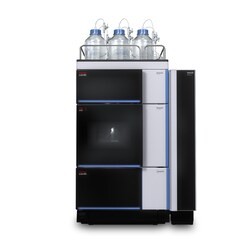
Vanquish UHPLC (Figure from Thermo)
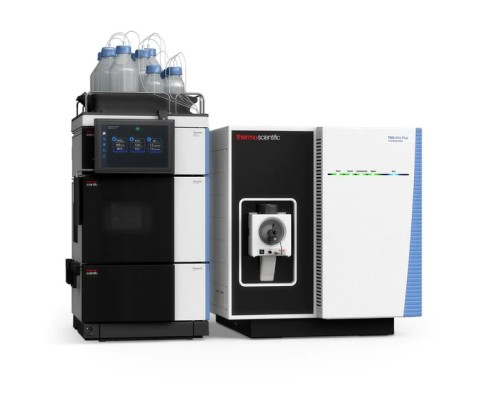
TSQ Altis Triple Quadrupole MS (Figure from Thermo Scientific)
| Method | Measures Ubiquinone + Ubiquinol in one run | Selectivity (matrix interference) | Sensitivity (typical) | Quantitation strategy | Redox artifact control | Throughput & robustness | Best-fit use cases | Key limitations |
|---|---|---|---|---|---|---|---|---|
| Targeted LC–MS/MS (Triple Quad, MRM) | Yes (core strength) | High (transition-based) | High (panel-ready) | Internal standard–anchored, multi-point calibration | Strong (can enforce cold/low-light workflow + fast run + QC) | High (batch QC, scheduled MRM) | Redox ratio, low-level samples, multi-matrix projects, CRO-scale validation | Requires MS method setup; needs stability-aware handling for ubiquinol |
| HPLC-ECD (Electrochemical detection) | Often yes (depending on setup) | Medium–High | High | External calibration + (optional) IS | Medium (handling still critical) | Medium (instrument-specific; maintenance) | Redox-focused studies with established ECD workflows | Detector-specific expertise; interference risk varies by matrix |
| HPLC-UV/Vis | Sometimes (often less reliable for both) | Medium–Low | Medium | External calibration | Weak–Medium | High (simple) | High-concentration formulations/supplements | Limited specificity; less suitable for complex bio-matrices and low levels |
| LC–HRMS (Orbitrap/QTOF, full-scan) | Yes | High (exact mass) | Medium–High | IS recommended; quant can be less straightforward vs MRM | Medium–Strong | Medium (data size/processing) | Discovery + confirmation; broader metabolite context | Not as efficient as MRM for high-throughput targeted quant; may need PRM/SIM tuning |
If your goal is reliable ubiquinol/ubiquinone ratio with QC-anchored quantification across batches, targeted LC–MS/MS (MRM) is typically the most direct and validation-friendly approach.
This section supports method-validation–oriented teams who need to justify assay selection.
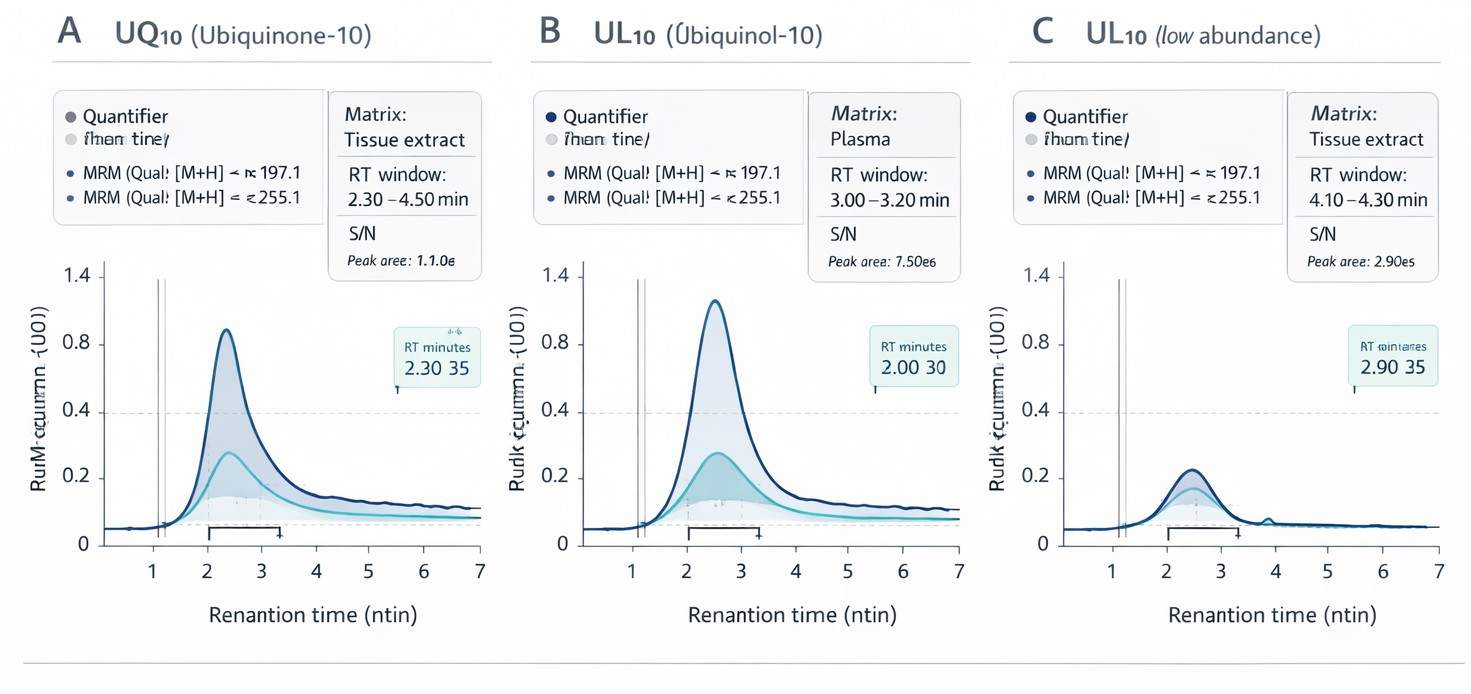
Scheduled-MRM chromatograms for UQ10, UL10, and UQ9 showing RT-windowed integration and qualifier-ion confirmation in tissue and plasma matrices.
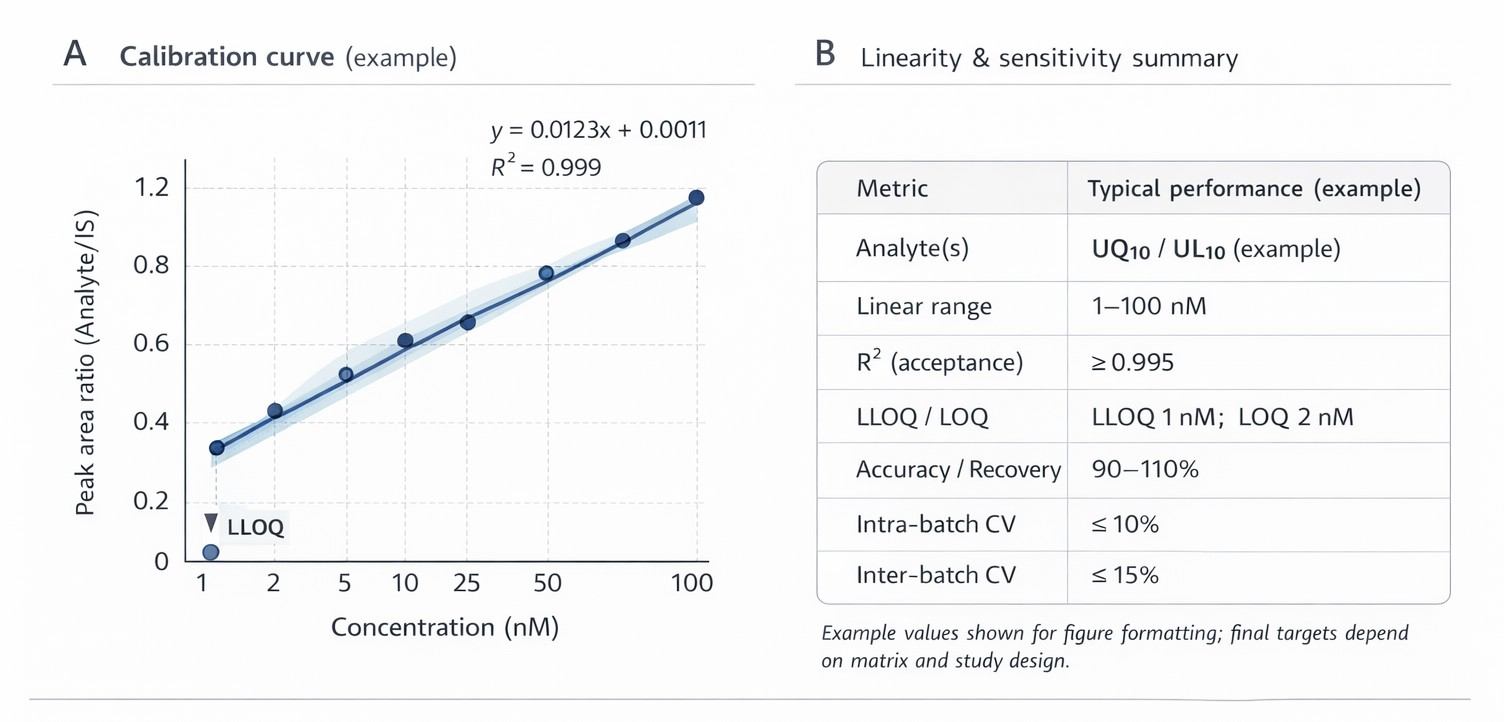
Calibration curve (≥6 points) with regression and R², plus a compact summary of linear range, LLOQ/LOQ, accuracy/recovery, and intra-/inter-batch CV.
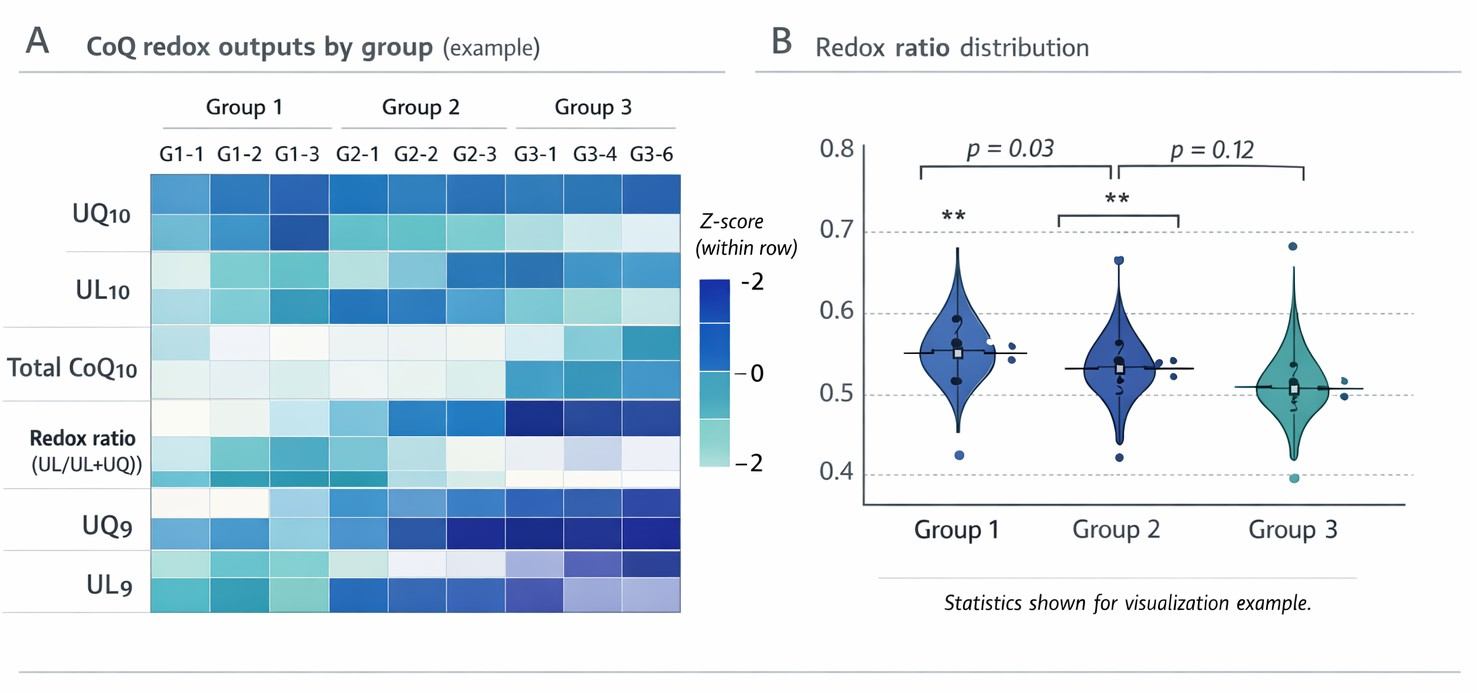
Group-level visualization of CoQ redox outputs: heatmap of UQ/UL and totals with an accompanying redox-ratio distribution plot for group comparison.
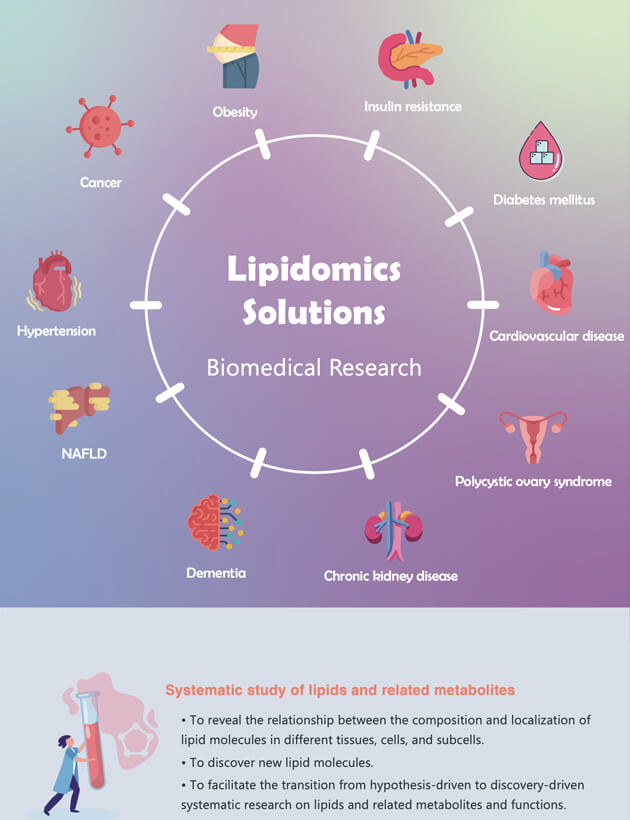
Explore our Lipidomics Solutions brochure to learn more about our comprehensive lipidomics analysis platform.


Mitochondrial Function Research
Track CoQ redox shifts under metabolic perturbations and ETC modulation.

Oxidative Stress Research
Compare ubiquinol:ubiquinone ratio or % oxidized across experimental conditions.

Drug Mechanism Projects
Monitor redox balance changes after compound treatment in cells or tissues.

Aging and Metabolic Research
Evaluate condition-driven changes in CoQ pools and redox status across cohorts.

Nutraceutical and Formulation R&D
Quantify ubiquinone/ubiquinol in supplements and formulations for stability testing.

Model-Specific Homolog Profiling
Add CoQ9 coverage when homolog composition varies by system.
Ubiquinol is redox-sensitive and can oxidize during handling. To preserve meaningful redox readouts, keep samples cold, protected from light, and minimize thaw time. Ship biological matrices on dry ice, and provide a clear sample manifest (ID, matrix, group, collection/freeze date, and any normalization info such as cell count or tissue weight).
| Sample type | Recommended amount | Container/format | Handling notes |
|---|---|---|---|
| Cell pellet | ≥ 1–5 × 10⁶ cells | Screw-cap tube, pellet | Snap-freeze; record cell count; avoid repeat freeze–thaw |
| Tissue | 20–50 mg | Cryovial, frozen piece | Snap-freeze; record wet weight; ship on dry ice |
| Plasma / Serum | ≥ 100–200 µL | 2–3 aliquots | Protect from light; freeze promptly; low levels possible |
| Mitochondrial / subcellular fraction | As available | Cryovial, frozen | Freeze immediately; include fractionation notes if available |
| Formulation / supplement | Project-dependent | Sealed vial/bag | Protect from heat/light; share excipients/solvent system |
What is the difference between ubiquinone, ubiquinol, and CoQ10?
Ubiquinone and ubiquinol are the oxidized and reduced forms of coenzyme Q. In most mammalian studies, the main homolog is CoQ10 (UQ10/UL10).
Why measure both ubiquinone and ubiquinol instead of total CoQ only?
Total CoQ can miss redox shifts. Measuring both forms enables redox metrics such as UL/(UL+UQ) or % oxidized for group comparisons.
How do you minimize ex vivo oxidation of ubiquinol during sample prep?
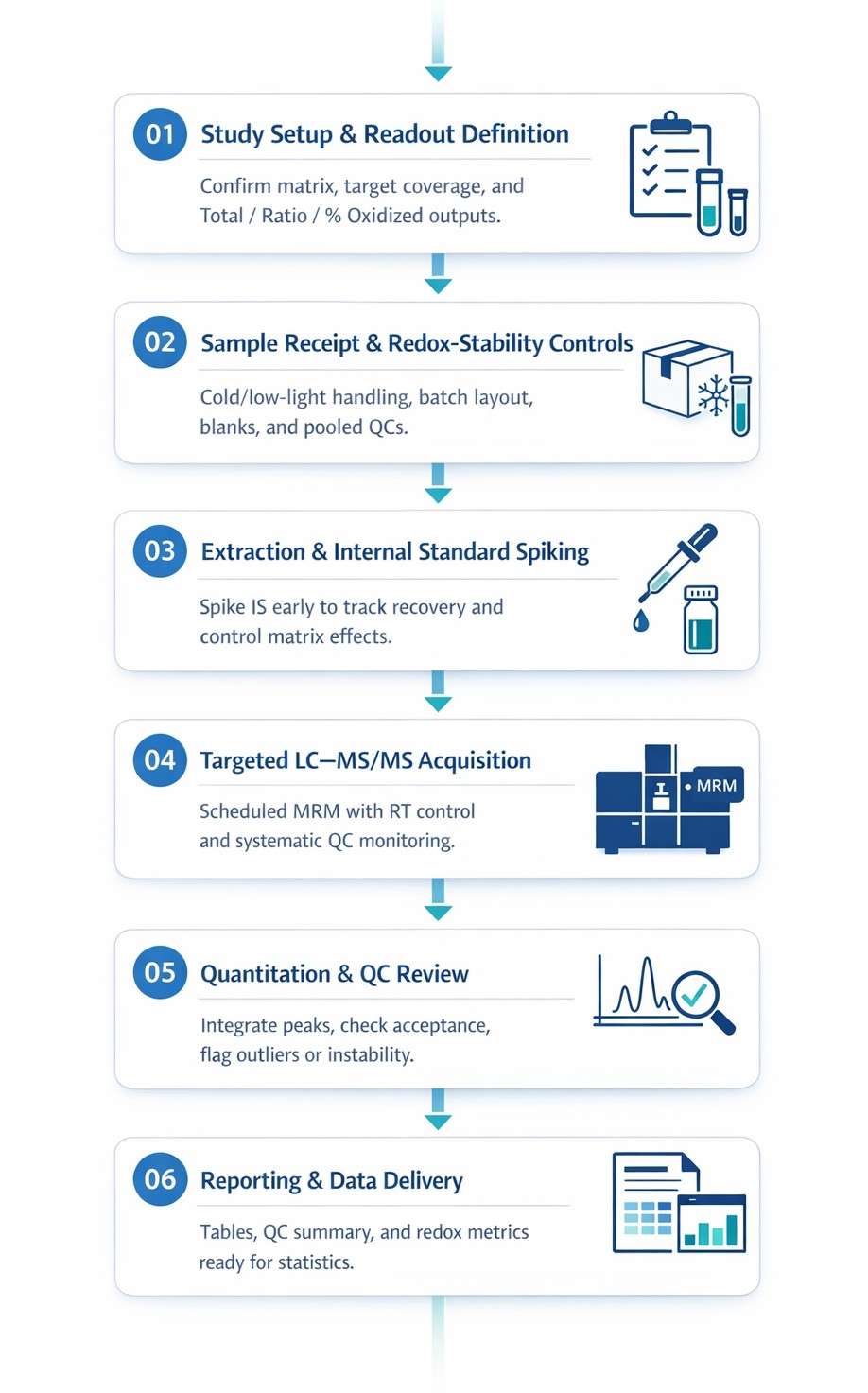
We use a stability-aware workflow: cold and light-protected handling, fast processing, early internal-standard spiking, and batch QC controls to reduce artifactual oxidation.
Why use targeted LC–MS/MS (MRM) rather than HPLC-ECD for redox profiling?
Targeted LC–MS/MS offers transition-based specificity in complex matrices, internal-standard anchoring for quantitation, and QC-tracked robustness across large batches.
Can you quantify CoQ9 and CoQ10 in the same run?
Yes. We can include CoQ9 (UQ9/UL9) alongside CoQ10 (UQ10/UL10) and report homolog-specific totals and redox metrics when required.
How is the ubiquinol-to-total CoQ ratio calculated?
A common metric is UL/(UL+UQ). We can output this ratio (and optional % oxidized) as dedicated columns in the results table.
Does hemolysis affect plasma ubiquinone/ubiquinol measurements?
It can bias redox readouts. We recommend avoiding visibly hemolyzed plasma and minimizing handling time; samples can be flagged if pre-analytical quality is questionable.
Do you provide absolute quantification for both oxidized and reduced forms?
Yes. We offer calibration-anchored absolute quantification (project-defined units) and can also provide normalized reporting when it better fits the study design.

Services:
Resource:
Online Inquiry
CONTACT US