








Microbial Cell Factory Lipidomics

Microbial Lipidomics for Microbial Cell Factory Engineering

Creative Proteomics provides high-resolution, targeted, and untargeted lipidomics services to accelerate the development of microbial cell factories. We empower metabolic engineers and synthetic biologists to transition from bulk dry-weight lipid assays to molecular-level pathway optimization, delivering absolute quantification of lipidome shifts, storage lipid accumulation, and membrane integrity across oleaginous yeast, microalgae, and engineered bacterial models.

Key capabilities

  • Targeted Lipid Yield Optimization: Quantify absolute concentrations of high-value triacylglycerols (TAGs), polyunsaturated fatty acids (PUFAs), and sterols to rapidly screen high-producing engineered strains.
  • Metabolic Bottleneck Diagnosis: Trace lipid biosynthesis pathways and identify specific acyltransferase bottlenecks by profiling intermediate diacylglycerols (DAGs) and free fatty acids.
  • Membrane Integrity & Toxicity Assessment: Evaluate phospholipid remodeling and membrane stress caused by excessive intracellular lipid accumulation, ensuring robust industrial scale-up.
Request Analysis

Submit Your Request Now

×

Our services have earned the trust of companies, schools, and organizations globally, and we remain dedicated to maintaining that trust.

Boston University
University at Buffalo
UMass Medical School
Hawaii Pacific University
Medizinische Fakultät
Louisiana State University
Nyulangone
Nature's Fynd
Dietary Supplement Manufacturer
  • Trends & Challenges
  • Integrated Solutions
  • Technical Advantages
  • Case Studies
  • FAQ

Situational Solution Matrix for Microbial Strain Engineering

From rapid untargeted screening of CRISPR-edited libraries to the absolute quantification of high-value nutritional lipids, select your engineering scenario below.

High-Titer Oleaginous Yeast Strain Screening

Situation

Screening a library of multi-gene edited Yarrowia lipolytica or Saccharomyces cerevisiae variants to identify high-oil phenotypes.

Goal

Rapidly compare global lipid profiles against the wild-type to lock in on the specific TAG signatures of high-yield performers.

Recommended path

Bundle A (Untargeted Discovery)

Recommended services
What you will get

A comprehensive, unbiased lipidomic landscape that immediately highlights which genetic edits successfully triggered massive lipid droplet expansion and significantly altered the neutral lipid-to-phospholipid ratio.

Triacylglycerol (TAG) Accumulation & Bottleneck Diagnosis

Situation

An engineered strain's oil production has plateaued well below the theoretical maximum conversion rate despite adequate precursor supplementation.

Goal

Absolutely quantify TAG molecular species and intermediate DAGs to determine if terminal acyltransferases (like DGAT or PDAT) are acting as rate-limiting bottlenecks.

Recommended path

Bundle B (Targeted Validation)

Recommended services
What you will get

Precise molar quantification of the substrate-to-product ratio at the final steps of microbial lipid production, providing biochemical evidence of where carbon flux is stalling in the Kennedy pathway.

Cellular Toxicity & Membrane Integrity Under Lipid Stress

Situation

During high-density fermentation, a hyper-producing engineered strain exhibits significant growth retardation and reduced viability.

Goal

Evaluate the degradation of essential membrane phospholipids and the toxic accumulation of free fatty acids to diagnose the root cause of lipotoxicity.

Recommended path

Bundle A → Bundle B

Recommended services
What you will get

Detailed profiles of Phosphatidylcholine (PC) to Phosphatidylethanolamine (PE) ratios and absolute FFA concentrations, guiding the engineering of enhanced membrane stress tolerance.

Engineering High-Value PUFAs in Microalgae

Situation

Optimizing cultivation conditions (e.g., nitrogen starvation) to maximize the production of EPA or DHA in microalgae cell factories.

Goal

Quantify specific long-chain polyunsaturated fatty acids and track their transition from polar membrane lipids into extractable neutral storage TAGs.

Recommended path

Discovery → Targeted Validation

Recommended services
What you will get

Absolute quantification of target nutritional PUFAs and a precise map of acyl-editing dynamics, confirming if the applied stress effectively forces target lipids into extractable lipid droplets.

Blocking Competing Pathways via Beta-Oxidation Knockout

Situation

Researchers have knocked out the POX (acyl-CoA oxidase) gene family to prevent the degradation of synthesized lipids back into energy.

Goal

Validate that lipid catabolism has been successfully halted and that the conserved carbon flux is redirected into the storage TAG pool.

Recommended path

Validation → Deep Insight

Recommended services
What you will get

Concrete biochemical proof of diminished beta-oxidation intermediates alongside corresponding increases in specific storage lipid species, confirming the success of the knockout strategy.

High-Value Sterol and Terpenoid Production Optimization

Situation

Utilizing microbial chassis cells to synthesize high-value, non-native lipid derivatives such as squalene or astaxanthin via the mevalonate (MVA) pathway.

Goal

Target and quantify specific sterol intermediates to identify bottlenecks in the engineered isoprenoid biosynthesis pathway.

Recommended path

Bundle B (Targeted Validation)

Recommended services
What you will get

High-resolution tracking of the entire sterol cascade, pinpointing where intermediate buildup occurs to guide further engineering of rate-limiting reductases or isomerases.

Client Studies in Microbial Lipid Production and Bioprocess Development

Client Publication: Quintas-Nunes et al. Plants, 2023. DOI: 10.3390/plants12030651
Study Profile: Discovery-Stage Profiling for a New Microalgal Production Chassis.

Discovery-Stage Profiling for a New Microalgal Production Chassis

Project Focus

Early-stage microbial cell factory programs often begin with a basic but important question: is this strain worth advancing into deeper development? This client publication focused on Micractinium rhizosphaerae NFX-FRZ, a rhizosphere-associated microalga characterized for its biological and chemical output profile.

Why This Study Is Relevant

For customers evaluating a new microbial or algal chassis, discovery-stage profiling can help determine whether the organism shows enough molecular complexity and application potential to justify strain optimization, pathway follow-up, or bioprocess development. This is particularly relevant when target analytes have not yet been fully defined.

What the Publication Demonstrates

The article reports broad metabolomic characterization of NFX-FRZ exudates and shows that the strain produces multiple biologically relevant compounds, including organic acids and phytohormone-related molecules. In a service-page context, this case illustrates the value of broad profiling when a team needs an evidence-based starting point for chassis evaluation rather than a single predefined assay.

Best-Fit Customer Scenarios
  • Evaluating a newly isolated microalgal or microbial strain
  • Comparing non-model strains before pathway engineering
  • Building a molecular evidence base for downstream production development
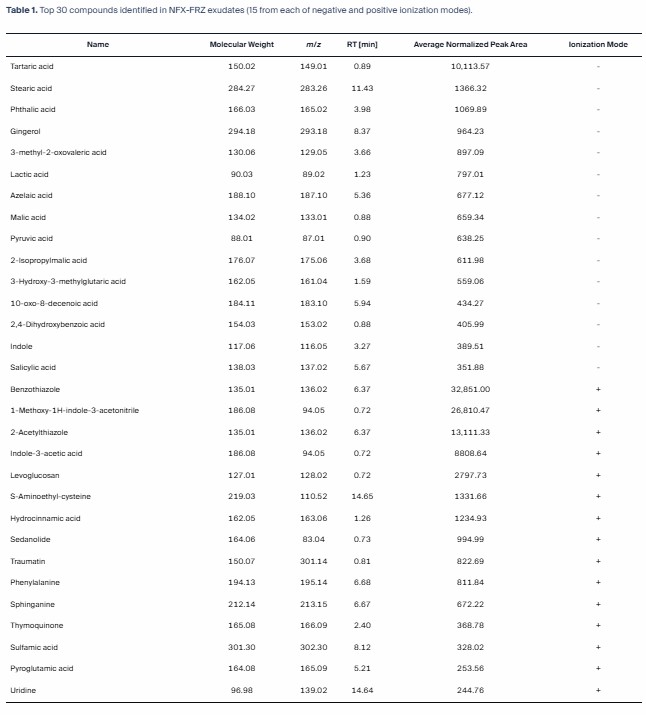
Compound table from a client publication showing untargeted molecular profiling results for Micractinium rhizosphaerae exudates.
Top 30 compounds identified in NFX-FRZ exudates
Client Publication: Kepesidis et al. Biotechnology for Biofuels and Bioproducts, 2026. DOI: 10.1186/s13068-025-02730-6
Study Profile: Multi-Omic Process Readout for Outdoor Microalgal Scale-Up.

Multi-Omic Process Readout for Outdoor Microalgal Scale-Up

Project Focus

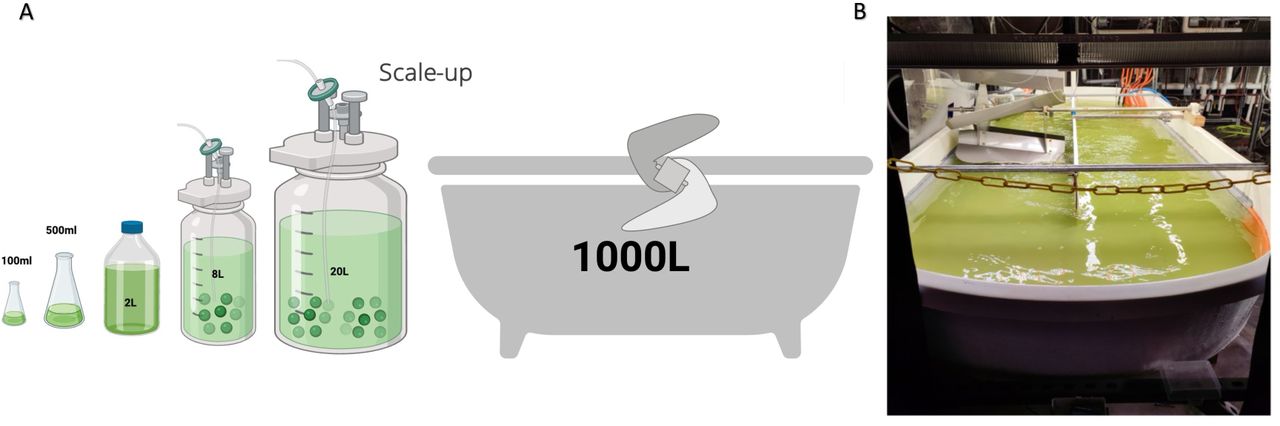
A common challenge in microbial production is that a strain performs well in controlled culture but behaves differently during scale-up. This client publication followed Monoraphidium minutum 26B-AM in 1,000 L open raceway ponds and examined molecular responses associated with scale-up and infection stress.

Why This Study Is Relevant

For customers working on lipid-producing microalgae or other microbial production systems, process transitions can change productivity long before the cause is obvious from growth or endpoint yield alone. This kind of study is relevant when a team needs a broader molecular readout to understand whether performance loss is linked to acclimation, environmental stress, or biological contamination.

What the Publication Demonstrates

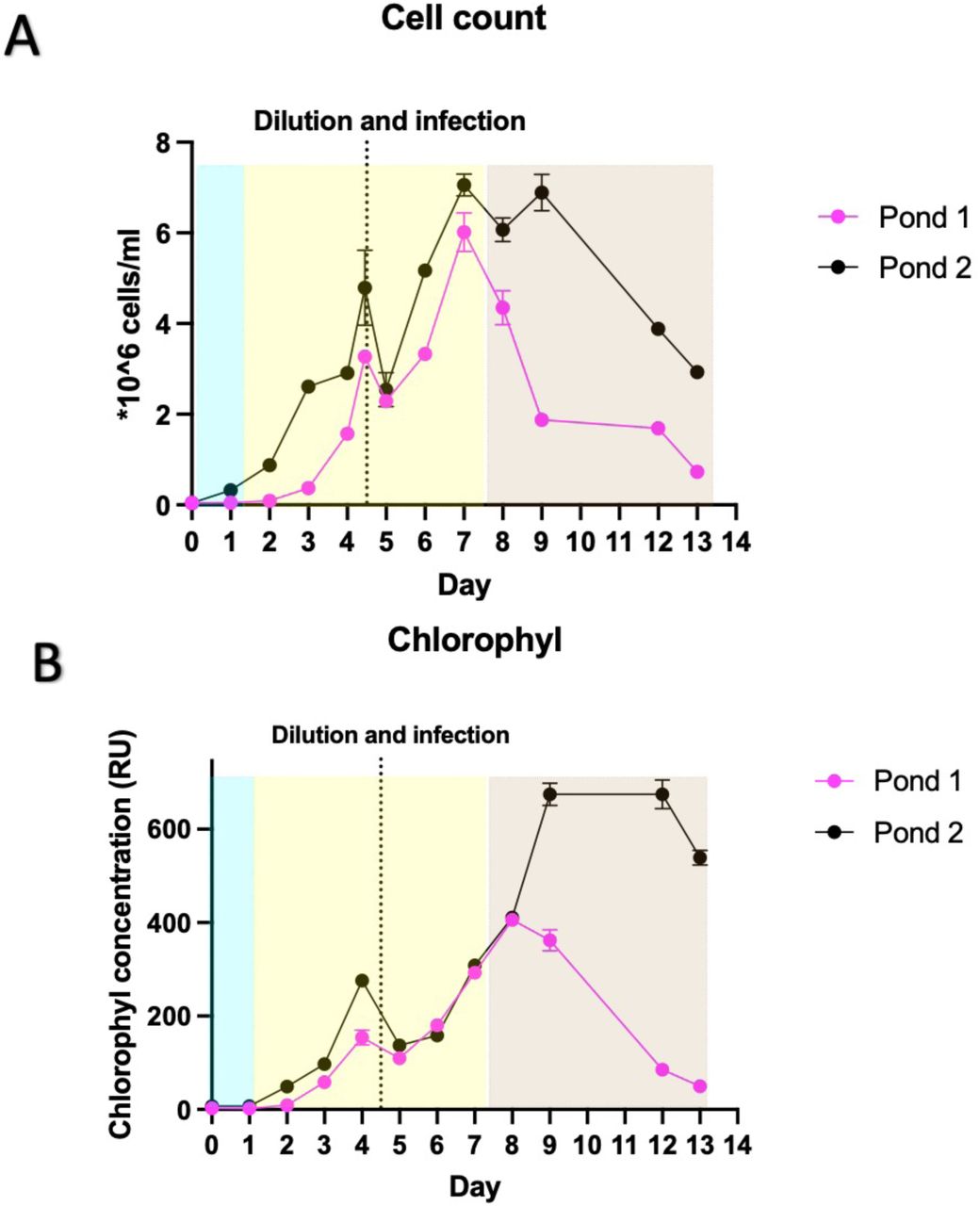
The publication reports a longitudinal multi-omic workflow integrating transcriptomics, proteomics, metabolomics, and phenomics across two 1,000 L raceway ponds. The authors identified scale-up-specific and infection-specific molecular patterns, supporting the use of omics-guided process interpretation in commercial-relevant algal production workflows.

Best-Fit Customer Scenarios
  • Troubleshooting unstable productivity during pilot or outdoor cultivation
  • Investigating scale-up-associated stress in algal production systems
  • Adding molecular evidence to process development and resilience studies
Scale-up schematic and pond image showing outdoor microalgal cultivation conditions in a 1000 L open raceway system.
Graphic representation of the scale-up.
Growth curve figure showing cell count, chlorophyll, and biomass trends during outdoor microalgal scale-up.
Growth tracking of the M. minutum pond cultures.

Frequently Asked Questions

How does lipidomics help identify metabolic bottlenecks in engineered microbial cell factories?
Traditional bulk assays only measure total fat. Microbial cell factory lipidomics measures every intermediate in the biosynthetic pathway. By absolutely quantifying the ratio of substrate to product (e.g., measuring DAG vs. TAG pools, or specific Acyl-CoAs vs. free fatty acids), we can definitively identify exactly which enzyme is acting as the rate-limiting step, directing your next round of gene overexpression or knockout.
Can you quantify specific triacylglycerol (TAG) molecular species to evaluate absolute lipid yield?
Yes. Industrial lipid production requires different TAG profiles (e.g., short-chain TAGs for biofuels vs. PUFA-rich TAGs for nutrition). Using optimized UHPLC gradients and high-resolution MS/MS fragmentation, we separate and quantify hundreds of specific TAG molecular species, allowing you to confirm that your engineered strain is producing the correct high-value lipids, not just increasing bulk fat.
How do you assess cell membrane integrity and toxicity in high-titer lipid-producing strains?
Hyper-accumulation of lipids often causes lipotoxicity and membrane stress. We assess this by quantifying shifts in critical membrane structural lipids (like the ratio of Phosphatidylcholine to Phosphatidylethanolamine) and tracking the accumulation of stress-signaling lipids like ceramides and toxic free fatty acids. This data is essential for engineering strains that survive high-density fermentation environments.
Are your extraction workflows optimized for difficult-to-lyse microbes like microalgae and oleaginous yeast?
Absolutely. We recognize that standard extraction methods often fail to penetrate the rigid cell walls of organisms like Yarrowia, Chlamydomonas, or Nannochloropsis. We deploy rigorous, multi-step cryogenic bead-beating and high-intensity ultrasonication protocols to guarantee complete cell lysis and 100% lipid recovery without inducing thermal degradation of target molecules.
Can metabolic flux analysis (MFA) trace the incorporation of 13C-labeled carbon sources into microbial lipids?
Yes. Through our Metabolic Flux Analysis services, we can feed your microbial models stable isotope-labeled precursors (like 13C-glucose or 13C-acetate). By tracking isotopic enrichment patterns through glycolysis, into acetyl-CoA, and finally into newly synthesized fatty acids and TAGs, we provide a dynamic, real-time map of the strain's actual lipid production capabilities.
What is the minimum sample requirement (e.g., dry cell weight) for comprehensive microbial lipidomics?
Due to the extreme sensitivity of our mass spectrometry platforms, we require very low sample biomass. Typically, a microbial pellet derived from a culture volume equivalent to ~10-20 OD600 units, or roughly 5-10 milligrams of dry cell weight (DCW), is completely sufficient to provide deep, absolute quantification of the microbial lipidome.
How do you prevent ex vivo lipid degradation (lipolysis) during microbial harvesting and quenching?
Microbial lipases activate the moment environmental conditions change. To prevent artificial degradation of TAGs into DAGs and FFAs, we enforce protocols requiring rapid harvesting and immediate sub-second flash-freezing in liquid nitrogen. We then conduct the lipid extraction at cryogenic temperatures using biphasic solvent systems designed to instantly denature all endogenous enzymes.
Can you profile and quantify high-value specialty lipids like squalene in engineered bacteria?
Yes. Beyond standard structural and storage lipids, our targeted platforms are designed to quantify high-value specialty compounds produced in engineered cell factories. This includes specific polyunsaturated fatty acids (like EPA and DHA) as well as valuable terpenoids and sterols like squalene, astaxanthin, and ergosterol synthesized via the mevalonate pathway.
* Our services can only be used for research purposes and Not for clinical use.

Applications:


Online Inquiry

CONTACT US

Copyright © 2026 Creative Proteomics. All rights reserved.