
Multi-batch lipidomics data remain comparable when biological groups are balanced across batches and the analytical sequence includes matrix-matched pooled QC samples, appropriate blanks, internal standards, and shared reference materials. Statistical correction can reduce measured drift, but it cannot repair a batch design confounded with biology.
This distinction matters in cohort studies. Instrument response, retention time, extraction recovery, column condition, solvent lots, and source contamination can change during a long acquisition. If all controls are processed first and all treated samples later, the biological comparison is inseparable from time and batch.
Multi-Batch Lipidomics Quality Control at a Glance
- Batch allocation: Distribute biological groups, sites, sexes, time points, and other major covariates across extraction and acquisition batches.
- Pooled QC: Use a representative, matrix-matched pool within every batch to monitor repeatability, drift, coverage, and correction performance.
- Blanks: Distinguish solvent, extraction, and internal-standard blanks because each reveals a different source of background or carryover.
- Internal standards: Add a documented panel consistently, preferably before extraction when recovery and preparation variation must be monitored.
- Bridge material: Include the same pooled or reference material across all batches; a different pool in every batch cannot establish a common scale.
- Correction validation: Accept batch correction only when technical variation decreases without compressing biological effects or creating new batch structure.
Why Lipidomics Batch Effects Begin Before Data Processing
A batch effect is systematic technical variation associated with preparation plate, extraction date, LC column state, instrument condition, reagent lot, operator, or acquisition period. It becomes a scientific problem when this variation is aligned with the experimental comparison.
Randomizing injection order alone is insufficient. If samples were collected, thawed, extracted, or plated by group, the confounding already exists. A robust design considers collection, aliquoting, extraction, injection, and data processing as one linked workflow.
Large studies commonly show nonlinear drift rather than a single constant offset. Response can gradually decline, recover after maintenance, or change differently for separate lipid classes.
Fan et al. used pooled QC information to model such behavior across lipidomics datasets containing 832, 1,162, and 2,696 samples. Their SERRF approach reduced average technical error to approximately 5% RSD in those datasets (Fan et al., 2019). This is evidence that correction can help, not permission to neglect experimental design.
Confounding cannot be solved mathematically
Suppose Batch 1 contains only vehicle samples and Batch 2 contains only treated samples. Any observed difference could be caused by treatment, extraction date, column aging, source cleaning, or reagent changes. No algorithm can identify the true cause because the design contains no independent information to separate them.
The remedy is balanced allocation. Each batch should contain representatives from every major comparison, while paired or longitudinal samples should be positioned according to a prespecified rule. When paired samples must remain together, the resulting constraints should still avoid placing an entire group or time point in one batch.
Technical variation is lipid dependent
One internal standard or one global scaling factor does not describe every feature equally. Lipids differ in extraction recovery, ionization, adduct formation, retention, fragmentation, and matrix suppression. Drotleff and Lämmerhofer showed that normalization strategies should be evaluated using several variation metrics rather than assumed to work uniformly across a lipidomics dataset (Drotleff and Lämmerhofer, 2019).
If a study needs broad discovery, untargeted lipidomics profiling should therefore be scoped with class-aware internal standards and feature-level QC evaluation. If the project centers on a defined panel, targeted validation can use analyte- or class-specific calibration and acceptance criteria.
How to Allocate Samples Across Lipidomics Batches
Batch design should be finalized before extracts are prepared. The allocation table needs sample ID, biological group, replicate or subject ID, matrix, collection site, time point, sex, age or developmental stage when relevant, preparation plate, extraction batch, acquisition batch, and planned injection order.
Balance the variables most likely to affect interpretation
Perfect balance across every metadata field is rarely possible. Priority should go to the primary comparison and the covariates most likely to influence the lipidome or sample handling. For a multi-site longitudinal study, these may include treatment group, site, visit, fasting status, and sample type. For cell experiments, plate, passage, harvest day, cell number, and treatment condition may be more important.
Randomization should be constrained, not purely arbitrary. A random sequence can accidentally create long runs of one group or place paired specimens far apart. Blocked randomization produces smaller, balanced sets that can be distributed across plates and batches while preserving unpredictability.
Separate extraction order from injection order
Using the same order for extraction and LC-MS injection can make it difficult to determine where drift arose. Independent, documented randomization reduces this alignment. It also allows extraction controls to identify preparation variation and acquisition controls to identify instrument variation.
The sequence should record every deviation, repeat preparation, reinjection, source interruption, column change, and maintenance event. Replacement values should never silently overwrite the original result. Both measurements and the reason for selection should remain auditable.
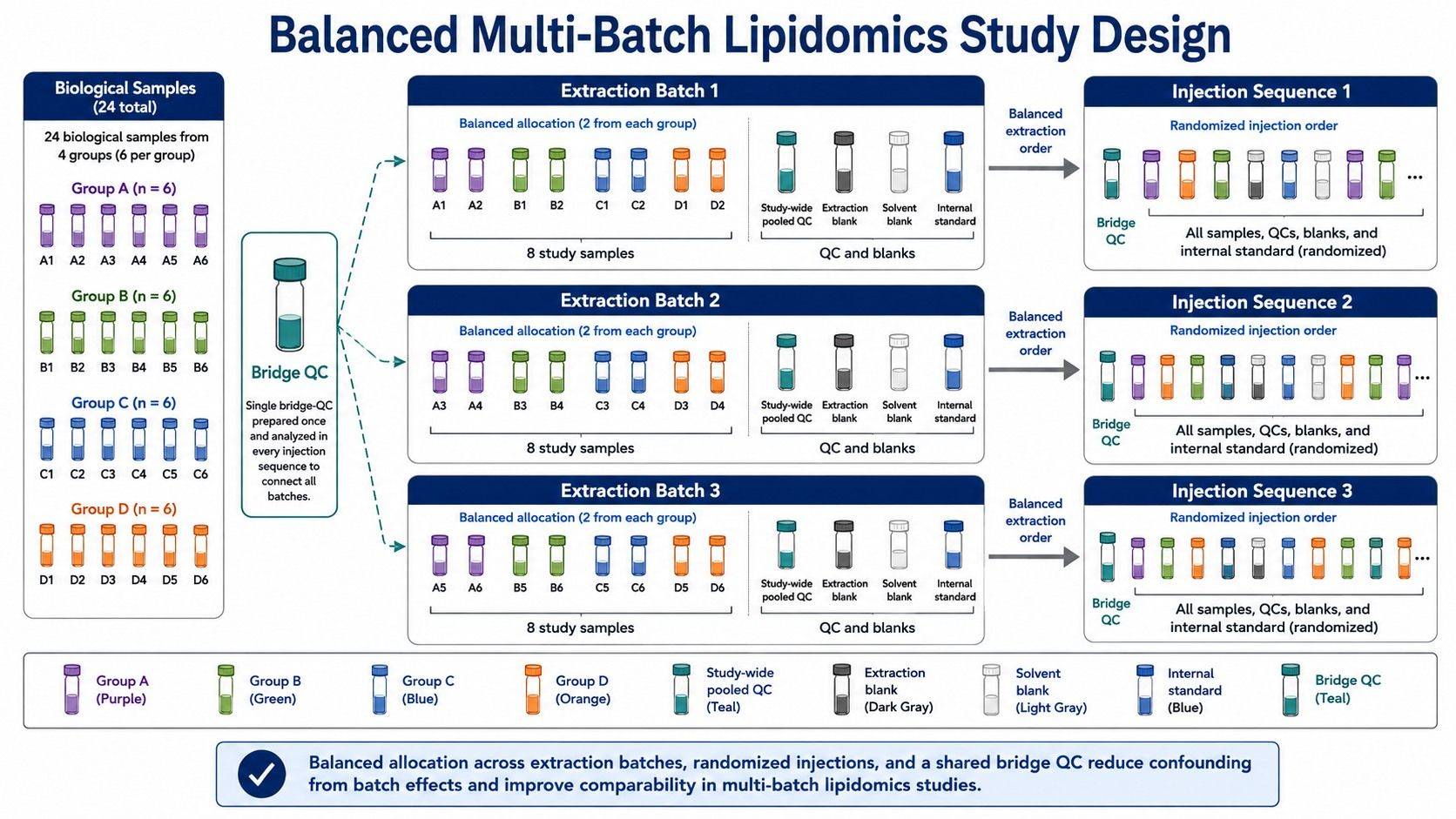 Balanced sample allocation and shared bridge QCs reduce confounding in multi-batch lipidomics.
Reserve material before the first batch
Long studies often fail because all specimen volume is assigned to the primary analysis. Reserve aliquots can support repeat preparation, targeted confirmation, bridge experiments, or investigation of an unexpected batch. A common reference pool should also be produced in sufficient volume, mixed thoroughly, aliquoted into single-use portions, and stored consistently before Batch 1 begins.
What Pooled QC Samples Can and Cannot Do
A pooled QC is commonly prepared by combining equal aliquots from representative study samples. It contains many of the lipids and matrix components expected in the cohort, so repeated measurements can reveal drift, retention changes, missing features, and declining repeatability.
Broadhurst et al. distinguished pooled study QCs from system-suitability mixtures, long-term reference QCs, and standard reference materials. These controls are complementary rather than interchangeable (Broadhurst et al., 2018).
Pooled QC roles across the analytical sequence
| QC role | What it evaluates | Typical decision supported | Main limitation |
|---|---|---|---|
| Initial conditioning QC | Stabilization of chromatography and source response | Whether study injections can begin | Early injections are not representative performance estimates |
| Interspersed pooled QC | Within-batch drift, repeatability, retention, coverage | Feature filtering and drift modeling | Represents the pool, not every individual specimen |
| Cross-batch bridge QC | Alignment of the same material across batches | Inter-batch comparability | Requires one consistent source across the whole study |
| Long-term reference QC | Performance over multiple studies or months | Historical trend assessment | May not match the study matrix closely |
| Matrix reference material | External comparability for supported matrices | Cross-study benchmarking | Coverage and concentration may not represent the cohort |
Interspersed QC frequency should be planned according to batch length, platform stability, and correction method. Published guidance often describes pooled QC injections every 5–10 study samples for untargeted assays, but this is a design reference rather than a universal rule (Broadhurst et al., 2018). The final frequency should provide enough points to model the expected drift without consuming disproportionate study capacity.
A different pool in each batch is not a bridge
If Batch 1 uses Pool A and Batch 2 uses Pool B, a difference between the pools may reflect composition rather than instrument response. A common bridge requires the same material in every batch. Matrix-specific pools are necessary when a project includes plasma, tissue, cells, or other matrices with substantially different backgrounds.
When there is too little specimen volume to create a study-wide pool, a characterized surrogate or long-term reference can provide a bridge. The limitation must be stated: it monitors analytical behavior in that reference material, not necessarily recovery or matrix effects in every study sample.
Pooled QC does not replace biological replication
Repeated injections of one pool measure technical stability. They do not increase biological sample size and cannot estimate between-subject or between-culture variance. A study with many QC injections but inadequate biological replication remains underpowered for its biological question.
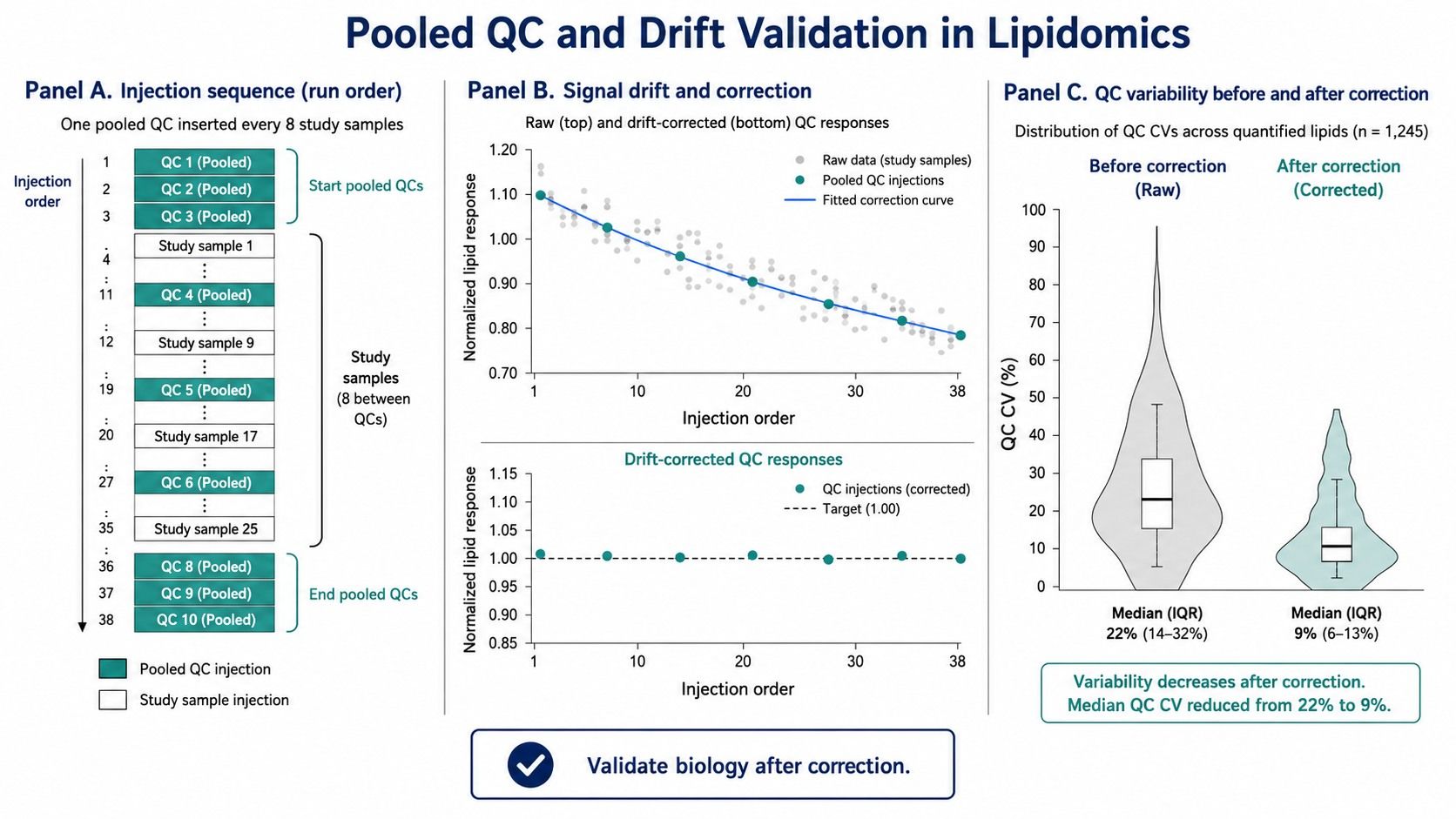 Pooled QC injections reveal within-batch drift and support validation of correction performance.
Which Blanks Are Needed in Multi-Batch Lipidomics?
The Lipidomics Standards Initiative identifies solvent blanks, extraction blanks, and internal-standard blanks as separate controls because contaminants can originate from different parts of the workflow (Kopczynski et al., 2024).
Solvent blanks monitor carryover and instrument background
A solvent blank passes through the injection and LC-MS system without biological extraction. Peaks appearing after a high-abundance sample can indicate carryover. Recurrent background may also reveal mobile-phase, wash-solvent, vial, or instrument contamination.
Solvent blanks are particularly informative after pooled QCs, high-concentration samples, or injections known to contain abundant neutral lipids. Their position should be intentional rather than limited to the start of a run.
Extraction blanks reveal preparation-derived signals
An extraction blank contains the tubes, solvents, additives, and handling steps used for samples but no biological material. It can reveal lipids and polymers introduced by consumables, solvents, plasticware, or laboratory handling. A feature that is strong and consistent in extraction blanks should not be interpreted as a biological lipid without additional evidence.
Each preparation batch needs relevant extraction blanks. One blank prepared months earlier cannot characterize a new reagent lot or plate.
Internal-standard blanks test the standard mixture
An internal-standard blank contains the standard mixture without biological sample. It can expose unlabeled impurities, isotope contributions, degradation products, or interfering signals originating from the standards themselves. This matters when a labeled standard produces signal in the channel assigned to an endogenous analyte.
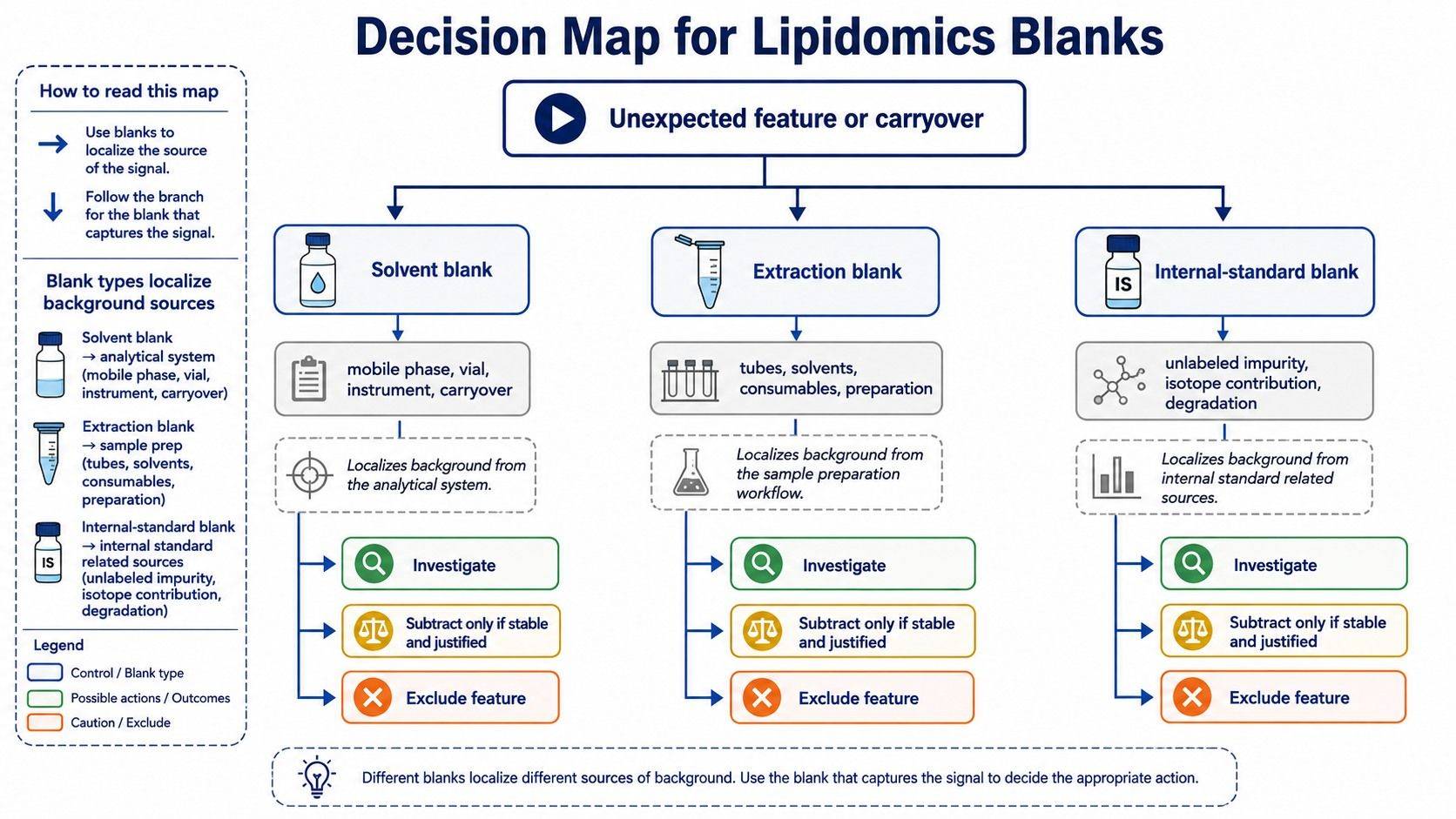 Different lipidomics blanks localize instrument, preparation, and internal-standard background.
For projects requiring calibrated endpoints, the targeted lipidomics service can incorporate analyte-appropriate calibrators, internal standards, blanks, and matrix-specific QC levels. The control plan should be defined for the requested lipid panel rather than copied from a broad profiling assay.
How Internal Standards Support Comparable Lipidomics Data
Internal standards help track technical variation within every individual sample. When added before extraction, they can reflect extraction loss, preparation variability, transfer loss, and ionization changes. Standards added after extraction mainly monitor injection and ionization behavior.
The timing of addition must therefore match the intended control function. Calling a post-extraction spike an extraction control overstates what it measures.
Match standards to lipid classes and analytical behavior
Stable isotope-labeled or non-endogenous analogs should represent the retention and ionization behavior of the target lipid as closely as practical. Broad untargeted studies typically cannot use a matched standard for every detected species. A class-matched panel is then used, but the assignment of each lipid to a standard should be documented.
Signal response may change with class, chain length, unsaturation, adduct, and concentration. One phosphatidylcholine standard should not automatically normalize triglycerides, ceramides, and free fatty acids. The correction must be evaluated using pooled QC behavior and known sample biology.
Internal standards and pooled QCs answer different questions
An internal standard is present in each sample and helps reveal sample-specific preparation or instrument variation. A pooled QC is repeated across the run and reveals time-dependent behavior of endogenous features in a representative matrix. Neither control replaces the other.
If internal-standard response changes in one sample while surrounding pooled QCs remain stable, the issue may be sample specific. If many pooled-QC features drift together while internal standards also shift, the analytical system may be changing. If endogenous lipids drift but the standards do not, the standard panel may not adequately represent those features.
How to Evaluate and Correct Lipidomics Batch Effects
Correction should follow a technical review, not precede it. The first question is whether a batch is analytically acceptable. The second is whether residual drift can be modeled without distorting biology.
Review uncorrected data first
Plot internal-standard response, total signal, retention time, peak width, detected-feature count, missingness, blank intensity, and pooled-QC CV against injection order and batch. Examine PCA or another unsupervised view with QCs, blanks, study samples, batches, and biological groups visibly identified.
A tight pooled-QC cluster is useful but not sufficient. PCA emphasizes large variance and may miss feature-specific failure. Each primary endpoint or feature class needs appropriate performance review.
Apply feature filtering before or with correction
Features dominated by blank signal, detected inconsistently in pooled QCs, outside the reliable response range, or affected by unresolved peak integration should be flagged or removed using prespecified rules. Batch correction should not turn an unreliable peak into an apparently precise result.
For untargeted data, QC RSD thresholds such as 20% or 30% are often used in published workflows, but no single cutoff fits every lipid class, abundance range, and study objective. The threshold should be justified in the analysis plan and supplemented by detection frequency, blank ratio, drift, and peak-quality criteria.
Select correction according to the observed error
| Observed pattern | Candidate approach | Required evidence |
|---|---|---|
| Smooth within-batch drift | QC-based LOESS or related local regression | Enough interspersed QCs across the full sequence |
| Step change between batches | Bridge-QC median alignment or batch factor | Same reference material in every batch |
| Nonlinear, correlated drift | Multivariate or random-forest QC correction | Adequate QC density and independent validation |
| Known plate or batch offset in a balanced design | Statistical batch covariate | Biological groups represented in every batch |
| Batch fully confounded with group | No defensible correction | Reanalysis or new bridging data may be required |
Fan et al. showed that SERRF can model nonlinear and correlated systematic errors, while Wehrens et al. demonstrated that multiple correction approaches can perform differently across datasets (Fan et al., 2019; Wehrens et al., 2016). The method name is less important than evidence that it improves this dataset without manufacturing separation.
The lipidomics bioinformation analysis service can incorporate QC filtering, batch assessment, prespecified transformations, group comparisons, and covariate models. Correction parameters and before-versus-after checks should remain part of the project record.
Validate the corrected dataset
After correction, confirm that pooled-QC variation and injection-order trends decrease for the retained features. Check whether blanks remain distinguishable, internal-standard behavior is plausible, and known replicate relationships are preserved.
Then examine biological safeguards. Effects supported by paired samples, known concentration series, technical replicates, or orthogonal measurements should retain their expected direction. A method that produces very low QC CVs by compressing all sample differences is not successful.
Multi-Batch Lipidomics Acceptance and Reporting Checklist
The acceptance plan should be agreed before unblinding. It does not need one global cutoff for every lipid, but it should define how features, samples, and batches are evaluated.
- Confirm that sample allocation is balanced across preparation and acquisition batches.
- Verify that the same bridge material appears in every batch.
- Review solvent, extraction, and internal-standard blanks separately.
- Track each internal standard by sample and injection order.
- Assess pooled-QC detection frequency, CV, drift, retention, and peak integration.
- Flag individual samples with abnormal standard response, total signal, missingness, or dilution behavior.
- Document maintenance, column changes, reagent lots, repeats, and exclusions.
- Compare uncorrected and corrected QC metrics and data structure.
- Preserve raw data, processed peak tables, control labels, batch metadata, and correction parameters.
- Report lipid annotation level and quantification basis without implying absolute concentration from relative peak area.
Kopczynski et al. developed the lipidomics reporting checklist to make collection, extraction, MS acquisition, identification, quantification, and QC decisions transparent (Kopczynski et al., 2024). Following these principles increases the value of the dataset for publication, reanalysis, and cross-study interpretation.
Common Multi-Batch Lipidomics Design Errors
| Design error | Why it fails | Better decision |
|---|---|---|
| One biological group per batch | Batch and biology are inseparable | Balance all primary groups across every batch |
| A new pooled QC for each batch | No common analytical scale exists | Prepare one study-wide bridge pool in advance |
| One blank type only | Background source cannot be localized | Use solvent, extraction, and standard blanks as needed |
| Internal standards added after extraction | Extraction loss is not monitored | Add before extraction when recovery control is required |
| Correction chosen before diagnostics | Method may not match the error pattern | Inspect drift, offsets, missingness, and QC density first |
| QC CV used as the only filter | Blank-dominated or misintegrated peaks may remain | Combine CV with blank, detection, response, and peak criteria |
| All samples globally normalized without biological review | Broad biological shifts may be removed | Validate normalization against design and known controls |
| Corrected values reported without raw metadata | Results cannot be audited or reprocessed | Preserve raw, processed, QC, batch, and parameter records |
Planning a Comparable Multi-Batch Lipidomics Project
A useful feasibility package includes the sample matrix, total sample number, biological groups, sites and time points, paired-sample structure, available aliquot volume, expected batch count, primary lipid classes, quantification objective, and any pilot data. It should also state which covariates must be balanced and whether a study-wide pool can be created.
Creative Proteomics can align sample allocation, matrix-specific extraction, internal-standard strategy, blanks, pooled QCs, bridge material, LC-MS acquisition, and statistical analysis within one project plan. For discovery cohorts, our untargeted lipidomics bioinformation analysis supports feature-level QC and batch-aware interpretation alongside the analytical workflow.
If the groups can be balanced and a common QC bridge is available, a multi-batch design can support comparable within-study results. If biology is already fully confounded with batch or no shared material exists, request a feasibility review before relying on post hoc correction.
FAQs
How many pooled QC injections are needed in each lipidomics batch?
There is no universal number. The sequence needs enough pooled QCs to condition the system, estimate repeatability, and model the expected within-batch drift. Published untargeted guidance often intersperses a pooled QC every 5–10 study samples, but platform stability, run length, sample matrix, and correction method should determine the final frequency.
Can ComBat, LOESS, or SERRF fix a confounded lipidomics study?
No. These methods can model certain technical patterns when biological groups are represented across batches. If one group occurs only in one batch, the data do not contain enough information to separate biology from batch. New bridge measurements or reanalysis may be needed.
Should targeted lipidomics use pooled QC samples?
Yes, when the study spans multiple preparation or acquisition batches. Targeted assays also require calibrators and matrix QC levels appropriate to the analytes. Pooled QCs add information about cohort-wide extraction and analytical comparability but do not replace calibration QCs.
Is one internal standard per lipid class sufficient?
It may be adequate for some relative or semiquantitative workflows, but it is not automatically representative of every species. Response can vary with structure, retention, adduct, and concentration. The mapping between analytes and standards should be documented and evaluated with QC data.
Should pooled QC data be included in PCA?
Yes, as a quality-control view. Tight QC clustering can indicate repeatable measurement, while trends or batch-separated QC clusters suggest technical variation. PCA should be supplemented with feature-level CV, missingness, blank, retention, and internal-standard checks.
What should be included in a quote request for a large lipidomics cohort?
Provide matrix, sample number, group and covariate structure, collection sites and time points, available volume, storage history, primary lipid classes, desired relative or absolute output, expected batches, and pooling feasibility. Include a proposed metadata table if available so batch balance can be reviewed before analysis.
References:
- Broadhurst, D., Goodacre, R., Reinke, S. N., et al. (2018). Guidelines and considerations for the use of system suitability and quality control samples in mass spectrometry assays applied in untargeted metabolomic studies. Metabolomics, 14, 72. https://doi.org/10.1007/s11306-018-1367-3
- Drotleff, B., & Lämmerhofer, M. (2019). Guidelines for selection of internal standard-based normalization strategies in untargeted lipidomic profiling by LC-HR-MS/MS. Analytical Chemistry, 91(15), 9836–9843. https://doi.org/10.1021/acs.analchem.9b01505
- Fan, S., Kind, T., Cajka, T., et al. (2019). Systematic error removal using random forest for normalizing large-scale untargeted lipidomics data. Analytical Chemistry, 91(5), 3590–3596. https://doi.org/10.1021/acs.analchem.8b05592
- Hirayama, A., Ishikawa, T., Takahashi, H., et al. (2023). Quality control of targeted plasma lipids in a large-scale cohort study using liquid chromatography–tandem mass spectrometry. Metabolites, 13(4), 558. https://doi.org/10.3390/metabo13040558
- Kopczynski, D., Ejsing, C. S., McDonald, J. G., et al. (2024). The lipidomics reporting checklist: a framework for transparency of lipidomic experiments and repurposing resource data. Journal of Lipid Research, 65(9), 100621. https://doi.org/10.1016/j.jlr.2024.100621
- Wehrens, R., Hageman, J. A., van Eeuwijk, F., et al. (2016). Improved batch correction in untargeted MS-based metabolomics. Metabolomics, 12, 88. https://doi.org/10.1007/s11306-016-1015-8
Author: CAIMEI LI, Senior Scientist