Our services have earned the trust of companies, schools, and organizations globally, and
we remain dedicated to maintaining that trust.
What Are Oxidized Phospholipids and Why Measure the Esterified Pool?
An oxidized phospholipid is a direct readout of membrane oxidative stress and the product family that drives
ferroptotic cell death. It is a family rather than a single analyte, because oxidation of one polyunsaturated acyl
chain yields several products from the same parent lipid, and each carries a different meaning. The measured value
also depends on how the sample was handled, so the collection protocol is fixed before the panel is.
Oxidized Phospholipid Services and What Each One
Answers
The routes below address different parts of the same problem. They can be combined within one project, and the
choice between them usually follows from what the study has to conclude about the oxidation event rather than from
the analyte list alone.
Oxidized Phospholipid Species Profiling
Quantify individual oxidized phosphatidylcholine and phosphatidylethanolamine species in plasma,
tissue, and cell samples, reported per species with the parent lipid named rather than as a single
pooled oxidation value.
Truncated Oxidation Products
Measure the shortened products that form when an oxidized acyl chain is cleaved, including the aldehyde
and acid forms that a hydroperoxide-focused panel does not report. Each is reported as its own species
with the surrogate standard identified.
Enzymatic versus Non-enzymatic Oxidation
Separate products formed by enzymatic oxygenation, which are regio- and stereo-specific, from those
formed by non-enzymatic oxidation, which are not. This distinction decides whether chiral separation and
stereochemical assignment belong in the method.
Ex Vivo Oxidation Artefact Control
Collection and storage protocols built for lipids that oxidize on contact with air or trace metals,
with matched aliquots carried through the workflow so that oxidation introduced after sampling is
estimated rather than ignored.
Oxidized to Parent Lipid Ratio
Report each oxidized species against its unoxidized parent measured in the same run, so a change in the
oxidative state is not confused with a change in how much of the parent lipid the sample held.
Coordinated with the Free Oxylipin Pool
When a study needs both the esterified and the free oxidation products, the two panels are planned
together so that internal standards, extraction, and reporting units stay consistent across the two
result sets.
Oxidized Phospholipid Classes Covered and Values
Reported
The panel is built from the head group outward, because the head group decides which parent lipid has been
attacked and which biological pathway the measurement speaks to. The tables below list the classes covered and
the form in which each value is returned.
- OxPL Classes
- Reported Values
Oxidized Phospholipid Classes Covered
Each class is reported separately, because the same oxidative insult produces a different signal depending
on which parent lipid it reaches.
| Class |
Parent Lipid |
Typical Matrices |
Why It Is Measured |
| Oxidized phosphatidylcholine (OxPC) |
Phosphatidylcholine |
Plasma, oxidized LDL and lipoprotein fractions, tissue, cell pellets |
Carries the largest published body of oxidized phospholipid data, so results can be placed beside
earlier work; truncated OxPC species are also what antibody-based assays target |
| Oxidized phosphatidylethanolamine (OxPE) |
Phosphatidylethanolamine |
Tissue, mitochondria-enriched fractions, cell pellets |
The class that accumulates when a cell commits to ferroptosis; oxidation of arachidonoyl and
adrenoyl PE is the event tied to that decision |
| Oxidized phosphatidylserine (OxPS) |
Phosphatidylserine |
Cell pellets, membrane fractions, platelet preparations |
Marks an oxidized membrane for recognition and clearance, which matters where the study tracks how
damaged cells are removed |
| Oxidized phosphatidylinositol and phosphatidylglycerol |
Phosphatidylinositol, phosphatidylglycerol |
Tissue, cell pellets, microbial and plant membranes |
Lower abundance in mammalian material; measured where the question concerns signalling lipids or
membrane composition in a non-mammalian system |
Where an unoxidized baseline is needed, the parent lipids are quantified through our phosphatidylcholine analysis and phosphatidylethanolamine analysis routes so
that the oxidized and unoxidized values share one extraction and one reporting basis.
Reported Values and Their Calculation Basis
An oxidized phospholipid result is only interpretable when the species definition and the calibration basis
are both stated, so every value is returned with them.
| Reported Value |
Definition |
Calculation Basis |
| Individual oxidized species |
One product defined by head group, parent acyl chain, and site of oxygenation |
Calibrated where an authentic standard exists; otherwise reported on a stated surrogate with the
limitation recorded |
| Total oxidized phospholipid |
Sum of the measured oxidized species within the panel |
Summed from species values, with the contributing species listed rather than implied |
| Truncated to non-truncated ratio |
Balance between products retaining the full acyl chain and products that have been shortened |
Both families measured in the same run, so the ratio is not affected by differences in preparation
|
| Oxidized to parent lipid ratio |
Amount of an oxidized species relative to its unoxidized parent |
Parent lipid quantified in the same extraction and reported beside the oxidized value |
| Enzymatic to non-enzymatic share |
Proportion of a species carrying the regio- and stereo-specific pattern of enzymatic oxygenation
|
Assigned from chromatographic behaviour and, where the study requires it, from chiral separation
|
Oxidized cardiolipin is treated as a separate problem rather than folded into this panel, because the
parent lipid is dimeric and behaves differently under extraction and chromatography; it is handled within
our cardiolipin analysis route, and a study needing
both pools is planned as one project so the samples are shared.
Free Oxylipins and Esterified Oxidized
Phospholipids Are Different Analytes
An oxidized acyl chain can sit in two places, and the two are not interchangeable. It can remain esterified to a
phospholipid backbone, which is the form that stays in a membrane and the form this service measures. It can also
be released by phospholipase activity as a free oxylipin, which is the form that circulates and acts on receptors.
Extraction, internal standards, and reporting units differ between the two, so a free oxylipin panel does not
answer a question about the esterified pool.
| Product Family |
Structural Feature |
Representative Species |
Reporting Consequence |
| Non-truncated hydroxide or hydroperoxide |
Oxygen added to an intact polyunsaturated chain, with no loss of carbon |
Phosphatidylcholine 16:0/20:4 hydroperoxide and the corresponding hydroxide |
Authentic standards exist for common species, so these can be calibrated and returned as concentrations
|
| Truncated aldehyde or acid |
Chain shortened by oxidative cleavage, leaving a polar terminus on the shortened chain |
POVPC, PONPC, and their carboxylic acid forms |
Few authentic standards are commercially obtainable, so these are usually reported against a declared
surrogate |
| Enzymatic mono-hydroxy ester |
A single defined hydroxyl position carried with a defined stereochemistry |
12-HETE esterified to phosphatidylethanolamine, 15-HETE esterified to phosphatidylcholine |
Regio- and stereo-assignment is stated, and the values can be related to free oxylipin data from the
same sample |
| Free oxylipin |
Oxygenated acyl chain no longer attached to a phospholipid |
12-HETE, prostaglandin E2, F2-isoprostanes |
Handled by the free oxylipin and isoprostane routes rather than by this panel |
Two consequences follow for study design. First, the panel has to match the question: a study of membrane
oxidation needs the esterified species, while a study of circulating mediators needs the released pool. A request
for both from one sample set is arranged at planning rather than added afterwards.
Second, where a product can only be reported against a surrogate standard, that is stated in the result table
instead of being presented as a calibrated concentration. The released products are covered separately by our oxylipin quantification and
isoprostane analysis routes.
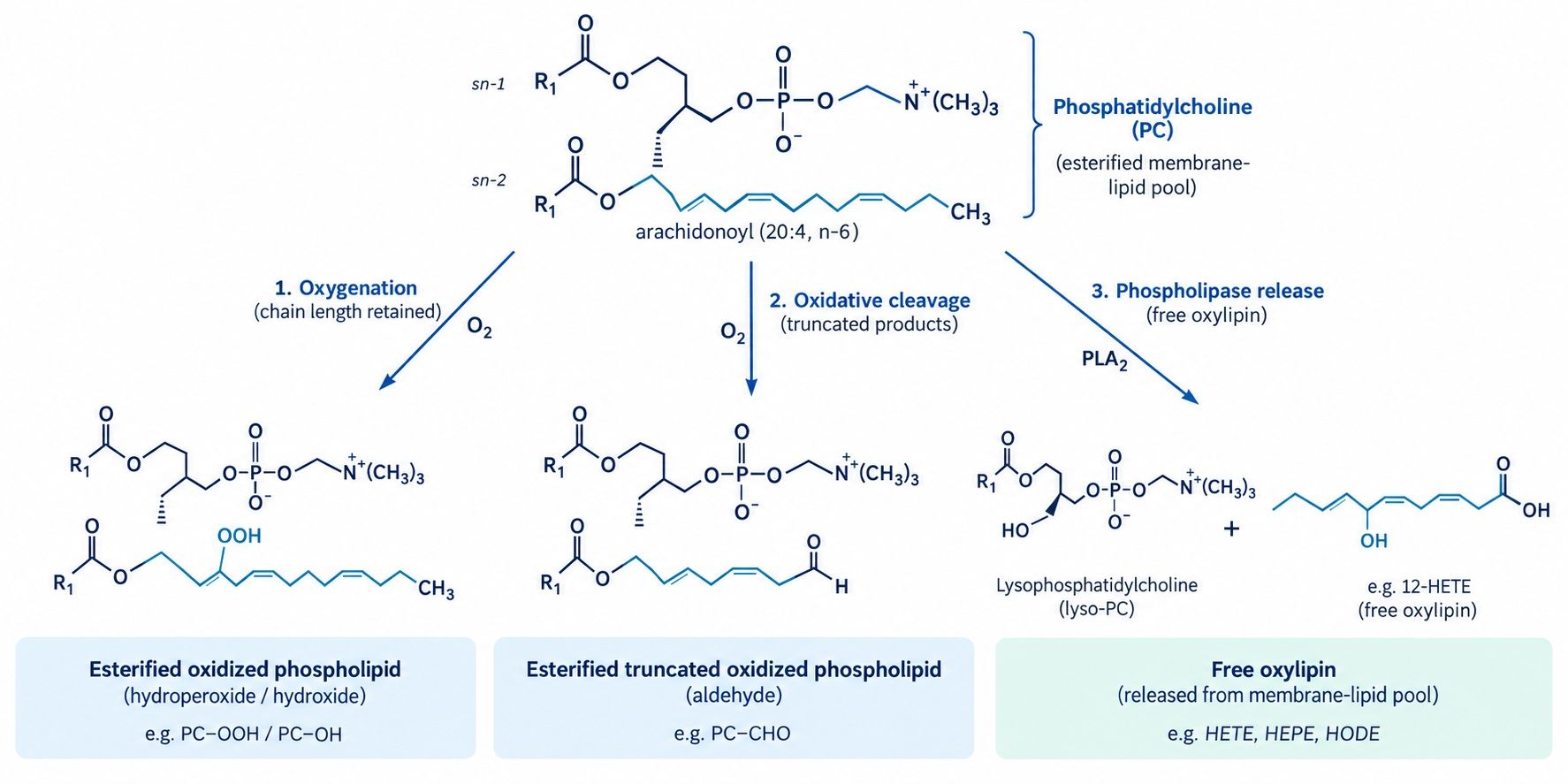 Oxidized Phospholipid Product Families: a polyunsaturated acyl chain esterified to a phospholipid head group, oxygenation without carbon loss giving a hydroperoxide or hydroxide, oxidative cleavage giving a truncated aldehyde or acid, enzymatic oxygenation giving a single defined hydroxyl position, and release of the chain as a free oxylipin by phospholipase activity.
Where Oxidized Phospholipid Analysis Is Used
Projects reaching this service differ in matrix, in the endpoint that matters, and in how much structural detail
the conclusion depends on. Designs outside the patterns below are adapted during feasibility review.
Oxidative Stress and Antioxidant Studies
Establish whether an intervention changes the oxidative state of membrane phospholipids, using the
oxidized to parent lipid ratio so that a shift in oxidation is separated from a change in how much
parent lipid the sample contained.
Ferroptosis and Regulated Cell Death
Quantify the oxidized phosphatidylethanolamine species that build up when a cell commits to
ferroptosis, reporting the arachidonoyl and adrenoyl species individually because they do not carry the
same diagnostic weight.
Inflammation and Innate Immunity
Measure the esterified oxidation products that act as inflammatory signals and that antibody-based
assays target, giving an isomer-resolved alternative to a summed immunoassay readout that cannot
separate related structures.
Lipid Excipient and Formulation Degradation
Follow phospholipid oxidation in liposomal and lipid-based materials across stress conditions, so that
a stability finding is attributed to a defined product rather than reported as a general rise in
oxidation.
Studies centred on oxidative cell death are normally planned alongside our ferroptosis lipidomics route, so
that the oxidized phospholipid panel and the wider peroxidation dataset come from one sample set and one
extraction.
Why Choose Our Oxidized Phospholipid Platform
- Artefact control written into the protocol: Collection, quenching, and storage conditions are specified
for lipids that oxidize on contact with air or trace metals, and matched aliquots are carried through so
that oxidation introduced after sampling can be estimated.
- Structure stated for every species: Each reported value names the head group, the parent acyl chain, and
the site of oxygenation, so a result can be compared across studies instead of being read as one pooled
oxidation figure.
- Truncated and non-truncated products both covered: Panels that stop at hydroperoxides miss the shortened
products that carry much of the biological signal, so both families are measured within one method.
- Calibration basis declared rather than implied: Where an authentic standard exists the species is
calibrated; where it does not, the surrogate and its limitation appear in the result table.
- Esterified and free pools kept consistent: When a study needs both, the two panels share internal
standards, extraction logic, and reporting units so that the result sets can be read side by side.
Oxidized Phospholipid Analysis Workflow
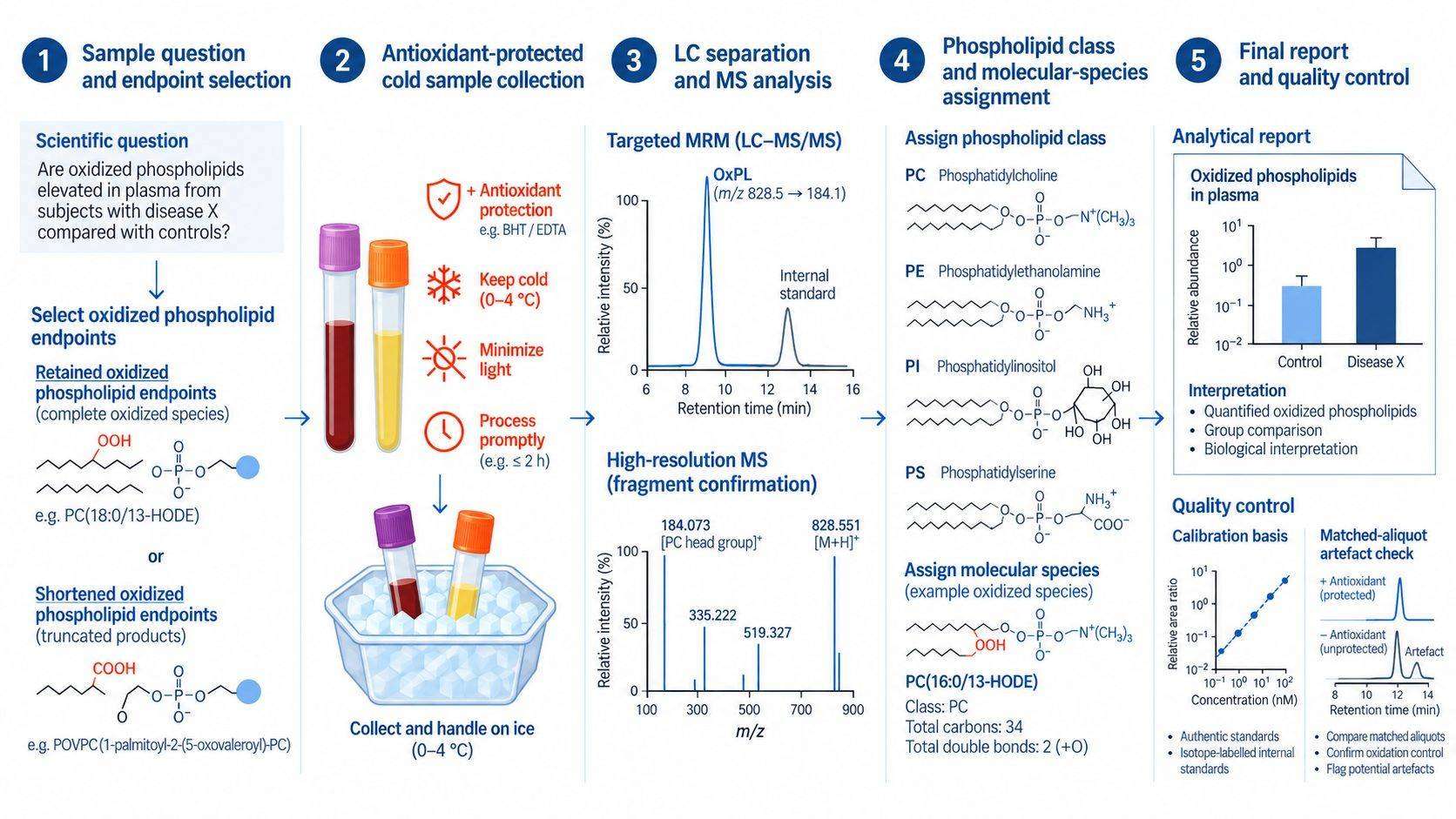 Five-step oxidized phospholipid analysis workflow: feasibility and question review, decision on whether retained or shortened products are the endpoint, antioxidant-protected collection with a fixed handling protocol, instrumental analysis with species and stereochemical assignment, and reporting with the calibration basis and the artefact check.
The workflow turns on one decision: whether the products that matter retain the full acyl chain or have been
shortened. A hydroperoxide-focused question needs a different panel, a different standard set, and a different
chromatographic method from a truncated-product question. Once that is settled, the handling protocol is fixed,
the panel is built around the species the study actually needs, and the artefact check is placed where it can
still change the interpretation.
Platforms Used for Oxidized Phospholipid Analysis
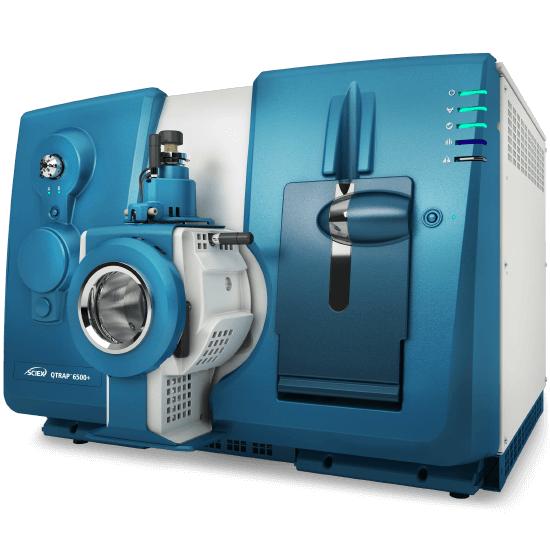
SCIEX Triple Quad 6500+ (Figure from SCIEX) — scheduled MRM for the defined oxidized species list
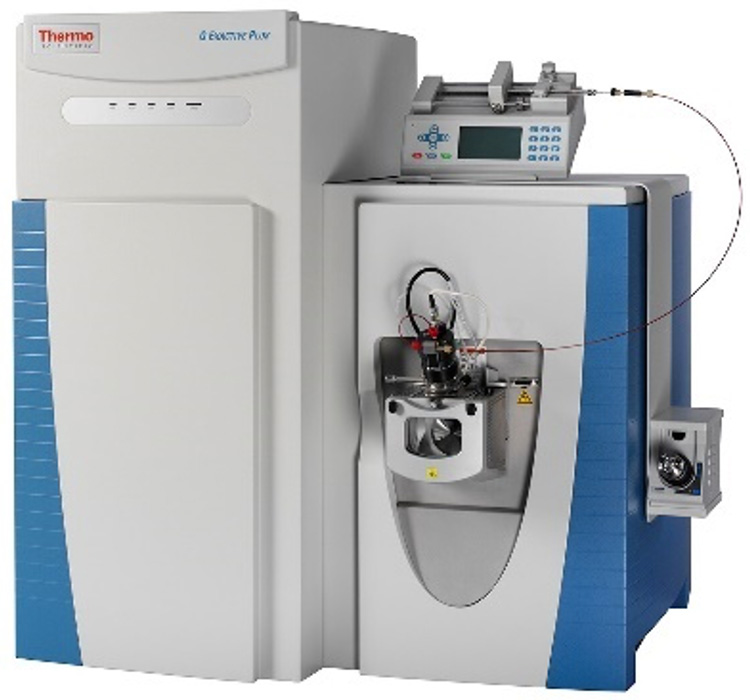
Thermo Fisher Q Exactive (Figure from Thermo Fisher) — accurate mass and fragment confirmation
where the product profile is not predefined
Method Specifications for Oxidized Phospholipid Analysis
| Parameter |
Specification |
| Extraction |
Matrix-specific extraction under antioxidant protection, with the antioxidant composition and the
interval from collection to extraction recorded for every batch |
| LC separation |
Reversed-phase C18 with gradient elution, optimized separately for truncated products, which are more
polar than their parent lipids, and for intact oxygenated species |
| Ionization |
Electrospray in negative ion mode for most oxidized phospholipid species, with positive ion mode used
where head group behaviour or adduct formation requires it |
| Acquisition mode |
Scheduled multiple reaction monitoring for targeted species; data-dependent high-resolution
acquisition where the product profile is not defined in advance |
| Species assignment |
Based on retention, accurate mass, and fragment behaviour together, because several oxidation products
of the same parent share a nominal mass |
| Reference standards |
Authentic standards where obtainable; otherwise a declared surrogate with the limitation recorded, and
isotope-labelled internal standards assigned per analyte where available |
| Stereochemistry |
Chiral separation applied where the study needs enzymatic and non-enzymatic products separated rather
than summed |
| Artefact control |
Matched aliquots and a handling blank carried through with each batch, so oxidation introduced during
processing is measured instead of assumed absent |
| Reporting basis |
Concentration, relative response, or ratio, with the contributing species and the surrogate standard
stated for every value |
Results and Data Analysis
Oxidized Phospholipid Profiling Report
The core report separates species-level results, the truncated and non-truncated families, and the artefact
assessment into tables that share sample identifiers and units.
Key Features:
- Species-level values with the head group, parent acyl chain, and site of oxygenation named for each
entry
- Truncated and non-truncated products grouped separately, with the ratio between the families calculated
and shown
- A quality control summary covering calibration performance, blank observations, replicate agreement, and
any value qualified for falling outside the calibrated range
- Method notes stating the extraction, antioxidant protection, and chromatographic conditions applied, and
whether chiral separation was part of the run
Raw instrument files can be discussed during project planning when they are needed for archiving or
independent review.
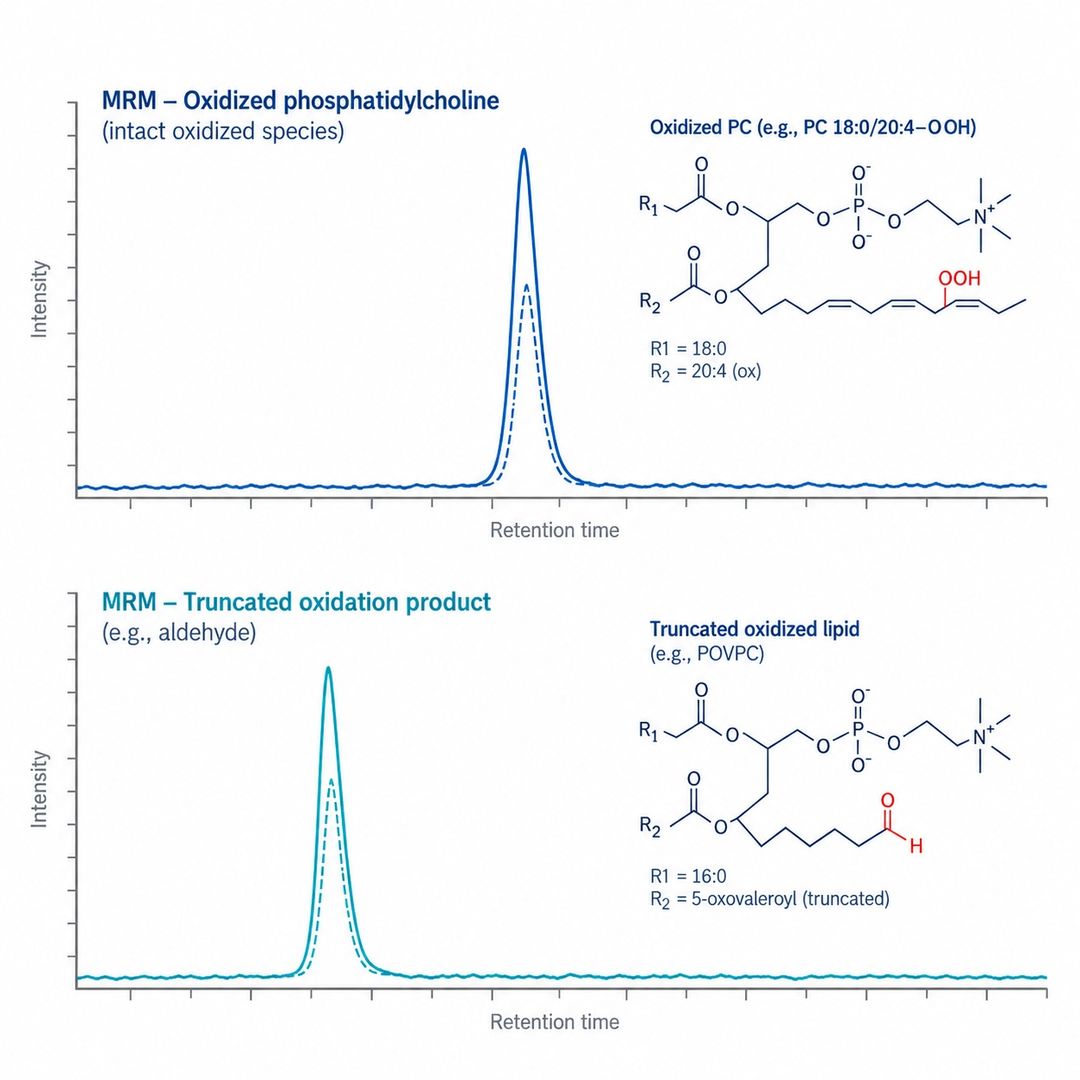
Representative MRM traces for oxidized phosphatidylcholine and phosphatidylethanolamine species, with
a truncated product resolved from the intact oxygenated species of the same parent lipid.
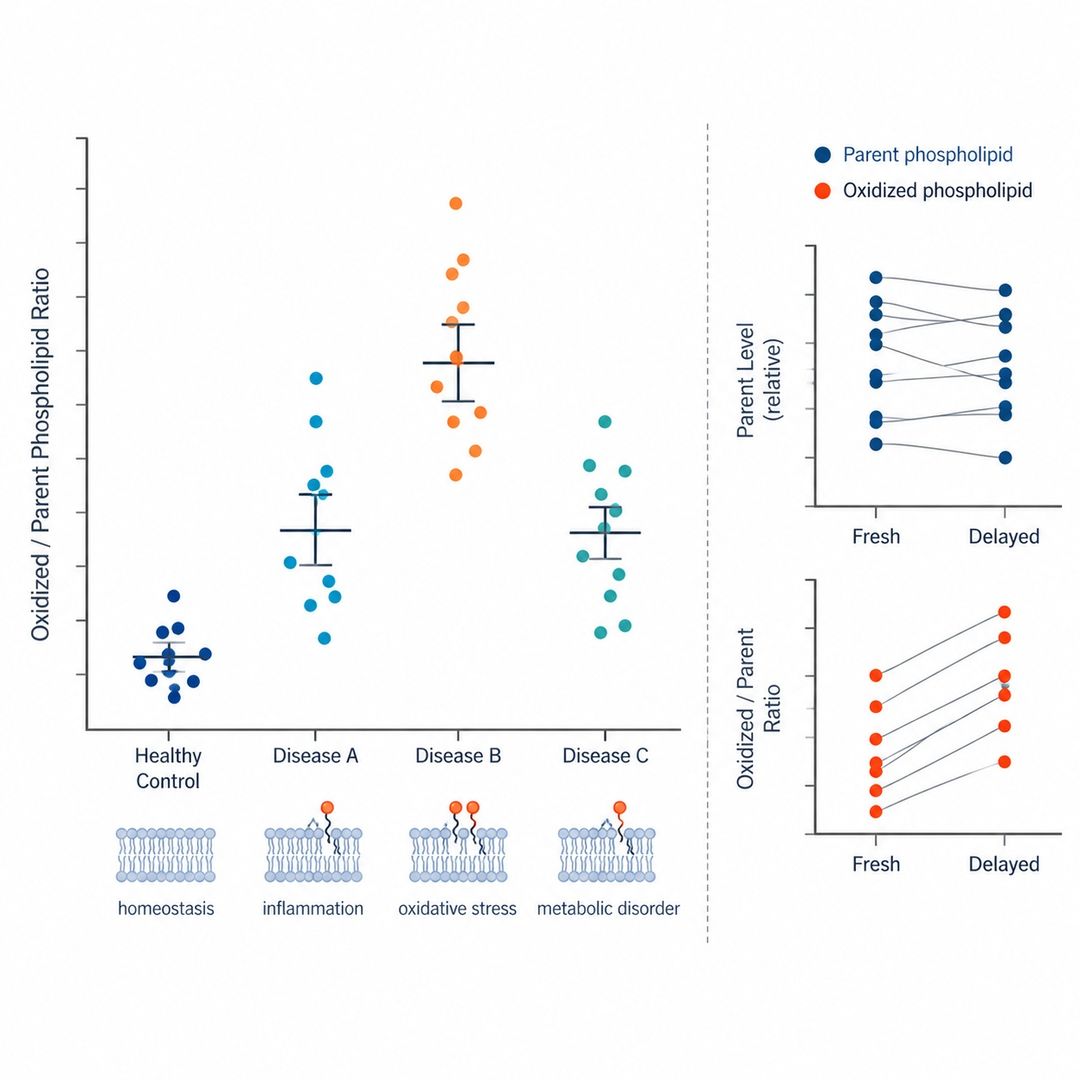
Oxidized to parent lipid ratio compared across sample groups, with matched aliquots from the same
collection used to separate a biological difference from an artefact.
Truncated Product Report
Where a study turns on the products that have been shortened, they are reported as a family of their own,
because a hydroperoxide-focused panel would miss them entirely.
Key Features:
- Aldehyde and acid products listed individually with their shortened chain length stated
- The surrogate standard used for each entry declared, and the entries that carry an authentic standard
marked as calibrated
- Truncated to non-truncated ratio calculated from values measured in the same run
Handling and Artefact Report
Because a meaningful part of a measured oxidized phospholipid value can form after collection, the handling
itself is reported rather than treated as a processing detail.
Key Features:
- Matched aliquots carried through the same workflow so that oxidation occurring during processing can be
estimated
- Observations from the handling blank reported alongside the sample data rather than discarded
- Recommendations on collection, antioxidant protection, and storage drawn from what the aliquots actually
showed
When the same sample set is also being profiled at class level, the oxidized results can be coordinated within glycerophospholipid analysis so
that the oxidized and total class values come from one preparation.
Sample Requirements for Oxidized Phospholipid
Analysis
| Sample Type |
Collection and Handling |
Typical Starting Amount |
Planning Notes |
| Plasma or serum |
Separate promptly at low temperature, aliquot under antioxidant protection, and store below minus 70
degrees Celsius; freeze once and analyze without repeated thawing |
200 microliters or more for a species-level panel |
The interval between collection and freezing is recorded for every sample, because it directly affects
the oxidized fraction |
| Tissue, including liver and brain |
Dissect quickly, freeze in liquid nitrogen, and hold below minus 70 degrees Celsius |
30 to 50 milligrams fresh weight |
Perfusion before dissection changes the blood-derived contribution, so the protocol is agreed in advance
and applied to every group |
| Cultured cells or cell pellets |
Remove medium completely, rinse with cold buffer, and freeze the pellet immediately |
5 million cells or more |
Medium contains its own oxidized lipid content, so the rinse step matters when the comparison is between
treatments |
| Oxidized LDL or lipoprotein fractions |
Keep fractions cold and protected from light throughout isolation, and record the isolation method used
|
100 micrograms of protein or more |
Oxidation can be introduced by the isolation procedure itself, so the method is stated in the report
alongside the result |
| Liposomal or lipid-based formulations |
Store sealed, protected from oxygen, light, and heat, and provide the time point and stress condition
for each sample |
20 to 100 microliters of suspension, or 5 to 20 milligrams of lipid |
The declared lipid composition is requested so that the oxidized species can be related to the intended
formulation |
The amounts above are planning figures. Final quantities are confirmed once the species range, the matrix, and
whether truncated products are part of the endpoint have been settled, because a targeted hydroperoxide panel and
a truncated-product panel do not carry the same requirement.
Frequently Asked Questions About Oxidized Phospholipid
Analysis
Which oxidized phospholipid species can be quantified against an authentic standard?
It depends on the product family. For non-truncated products, where the polyunsaturated chain is
oxygenated but still complete, authentic standards are obtainable for the common species, so those are
returned as calibrated concentrations. For major enzymatic mono-hydroxy esters, standards exist for the
principal species and the assignment is stated with them. Truncated products are the difficult group:
only a few authentic standards are commercially obtainable, so most are reported against a declared
surrogate and the entry is marked accordingly. The result table states which basis applies to each
species rather than leaving it to be assumed.
Can enzymatic oxidation be told apart from non-enzymatic oxidation?
Often, yes, and the distinction decides how the method is set up. Enzymatic oxygenation produces a
single defined hydroxyl position with a defined stereochemistry, so the product set is narrow and
reproducible. Non-enzymatic oxidation gives a wider spread of positional and stereo isomers from the
same parent lipid. Where the study needs the two told apart, chromatographic conditions are chosen to
resolve the positional isomers and a chiral separation is added for the stereochemistry, and the
assignment is stated in the result rather than implied by the species name.
How is oxidation during shipping and processing controlled?
Samples are collected into conditions defined at planning, which normally means rapid processing at low
temperature, antioxidant protection in the collection tube and through extraction, minimal headspace,
and storage below minus 70 degrees Celsius with no repeated freeze-thaw cycles. The interval between
collection and freezing is recorded for every sample because it changes the result measurably.
Beyond the protocol itself, matched aliquots are carried through the workflow so that the oxidation
introduced after collection can be estimated and reported. That is what allows a difference between
groups to be defended as biological rather than assumed to be.
Is this the same measurement as a free oxylipin panel?
No. A free oxylipin panel measures oxygenated acyl chains that are no longer attached to a
phospholipid, while this service measures the oxygenated acyl chain in its esterified form, still on the
parent phospholipid. The two require different extraction, different internal standards, and different
reporting units, and their values are not interchangeable. Where a study genuinely needs both, the two
panels are planned together so that the sample is shared and the result sets are consistent, but they
remain two distinct measurements.
Are truncated products such as POVPC and PONPC covered?
Yes, and they are reported as their own family rather than appended to the intact species. Shortened
products are more polar than their parent lipids, so they elute earlier and are chromatographed
separately, and they are the group for which authentic standards are hardest to obtain. Each entry
states the shortened chain and the standard basis used. Studies that need the balance between shortened
and intact products receive that ratio calculated from values measured in the same run.
Which sample types give the clearest results?
Plasma and serum, tissue, cultured cells, isolated lipoprotein fractions, and lipid-based formulations
are all supported, with different handling requirements. The main determinant of interpretability is not
the matrix but the handling record: samples with a recorded interval from collection to freezing and a
consistent antioxidant protocol compare across groups far more reliably than samples handled without
that information. Where a matrix is unfamiliar, feasibility is reviewed before the panel is fixed.
Is this service for clinical diagnostic use?
No. This service is for research use only. It is not intended for clinical diagnostic procedures,
patient management, or treatment decisions, and no result is reported as a clinical index. Measurements
intended for clinical interpretation are performed by licensed clinical laboratories. If your study
involves samples that may require clinical follow-up, please indicate this during study design.
What information is needed for a quote?
Provide the matrix, the number of groups and replicates, the total sample count, and whether the
endpoint is the intact oxygenated species, the truncated products, or both. Add the parent lipids of
interest, the requested reporting units, the available sample amount, and the handling history of the
material, including the interval from collection to storage. Mention any known oxidative challenge or
stress condition the samples were exposed to, and the comparison the data has to support.