










Food Authenticity Lipidomics & Oil Adulteration Detection

Food Lipid Fingerprinting and Adulteration Detection Services

Creative Proteomics provides high-resolution food lipid fingerprinting to authenticate food origins, detect economically motivated adulteration, and monitor lipid degradation. Utilizing advanced LC-MS/MS platforms, we empower food scientists to transition from basic iodine values to absolute molecular quantification, securing supply chains and verifying label claims with publication-grade accuracy.

Key capabilities

  • High-Resolution Adulteration Detection: Uncover trace blending of lower-grade oils (e.g., hazelnut in olive oil) by analyzing exact triacylglycerol (TAG) regioisomeric profiles.
  • Shelf-Life & Oxidation Monitoring: Track the precise kinetics of lipid degradation and the formation of secondary oxidative metabolites under thermal or long-term storage stress.
  • Complex Isomer Separation: Achieve baseline chromatographic separation to accurately differentiate naturally occurring cis-fatty acids from regulated industrial trans-fats.
Request Analysis

Submit Your Request Now

×

Our services have earned the trust of companies, schools, and organizations globally, and we remain dedicated to maintaining that trust.

Boston University
University at Buffalo
UMass Medical School
Hawaii Pacific University
Medizinische Fakultät
Louisiana State University
Nyulangone
Nature's Fynd
Dietary Supplement Manufacturer
  • Trends & Challenges
  • Integrated Solutions
  • Technical Advantages
  • Case Studies
  • FAQ

Situational Solution Matrix for Food Safety R&D

Protecting brand integrity requires workflows that address specific regulatory and quality control challenges. From broad origin tracing to targeted fraud detection and degradation monitoring, our situational pathways provide the exact analytical evidence required to secure your food products.

Premium Edible Oil Adulteration Detection

Situation

Suspecting the economically motivated blending of extra virgin olive oil (EVOO) with lower-cost seed oils (e.g., hazelnut or refined canola oil).

Goal

Establish an authentic lipid profile and detect trace blending (even <5%) using exact intact triglyceride (TAG) regioisomers.

Recommended path: Bundle B (Validation)

Recommended services:
Triacylglycerol Targeted Lipidomics, Fatty Acid Methyl Ester Analysis
What you will get

Absolute quantitative TAG profiles and comparative statistical models that definitively prove or disprove oil purity.

Geographical Origin & Traceability Mapping

Situation

Verifying the Protected Designation of Origin (PDO) or Protected Geographical Indication (PGI) of specialized regional foods or premium plant oils.

Goal

Perform broad, unbiased profiling to create a unique molecular signature shaped by specific environmental, feed, and soil variables.

Recommended path: Bundle A (Discovery)

Recommended services:
Foods Untargeted Lipidomics
What you will get

Unbiased metabolomic datasets, PCA/OPLS-DA clustering maps, and the identification of unique origin-specific lipid markers.

Lipid Oxidation & Shelf-Life Monitoring

Situation

Formulating high-fat food products or emulsions and needing to track degradation kinetics under accelerated thermal, UV, or long-term storage stress.

Goal

Quantify primary and secondary oxidative degradation products to establish reliable expiration dates and safety parameters.

Recommended path: Bundle C (Deep Insight)

Recommended services:
Fatty Acid Oxidation and Its Metabolites Assay, Diacylglycerol Targeted Lipidomics
What you will get

Time-course degradation curves of specific oxidized lipid species, providing a definitive molecular readout of lipid oxidation stability monitoring.

Vegan vs. Animal Fat Cross-Contamination

Situation

Verifying strict "100% Plant-Based/Vegan" claims or detecting the illicit addition of cheap vegetable oils to premium animal fats (e.g., butter adulteration).

Goal

Exploit the intrinsic differences in sterol composition (cholesterol vs. specific phytosterols) to prove matrix purity.

Recommended path: Bundle B (Validation)

Recommended services:
Phytosterols Analysis Service, Cholesterol Targeted Lipidomics
What you will get

Highly sensitive detection and absolute quantification of trace sterol contaminants indicating matrix mixing.

Trans-Fatty Acid Regulatory Compliance

Situation

Ensuring processed foods, baked goods, or partially hydrogenated oils meet strict FDA/EFSA regulatory limits for industrial trans-fats.

Goal

Achieve chromatographic baseline separation of cis- and trans-isomers to quantify absolute TFA content without interference.

Recommended path: Bundle B (Validation)

Recommended services:
Fatty Acid Analysis Service, Fatty Acid Methyl Ester Analysis
What you will get

Compliant, high-resolution fatty acid profiles accurately differentiating naturally occurring TFAs from industrial variants for trans-fatty acid assessment.

Specialized Marine & Algal Oil Authentication

Situation

Characterizing high-value nutritional oils (e.g., krill, microalgae) to prevent substitution with standard, lower-cost fish oil.

Goal

Detect unique polar lipid signatures, specific sn-positioning of EPA/DHA, and minor complex lipid classes.

Recommended path: Bundle A &rarr; Bundle B

Recommended services:
Phospholipids Analysis Service, Triacylglycerol Targeted Lipidomics
What you will get

Structural confirmation of polar lipid vectors demonstrating the true identity and quality for special oil authentication.

Selected Case Studies in Food Quality & Origin

Client Publication: Foods, 2022. DOI: 10.3390/foods11213404
Focus: Lipid Fingerprinting for Feeding-System Verification in Premium Eggs.

Lipid Fingerprinting for Feeding-System Verification

Research Goal

A specialty egg producer and quality assurance team sought molecular evidence to differentiate pasture-raised, soy-free eggs from conventional production systems.

Method Used

A validation-oriented lipid profiling workflow centered on high-resolution fatty acid composition analysis was applied to characterize production-system-associated differences in egg lipids.

Result Obtained

The lipid readout distinguished eggs produced under different feeding strategies using compositional markers linked to dietary inputs, providing analytical evidence to support premium claims and strengthen internal quality standards.
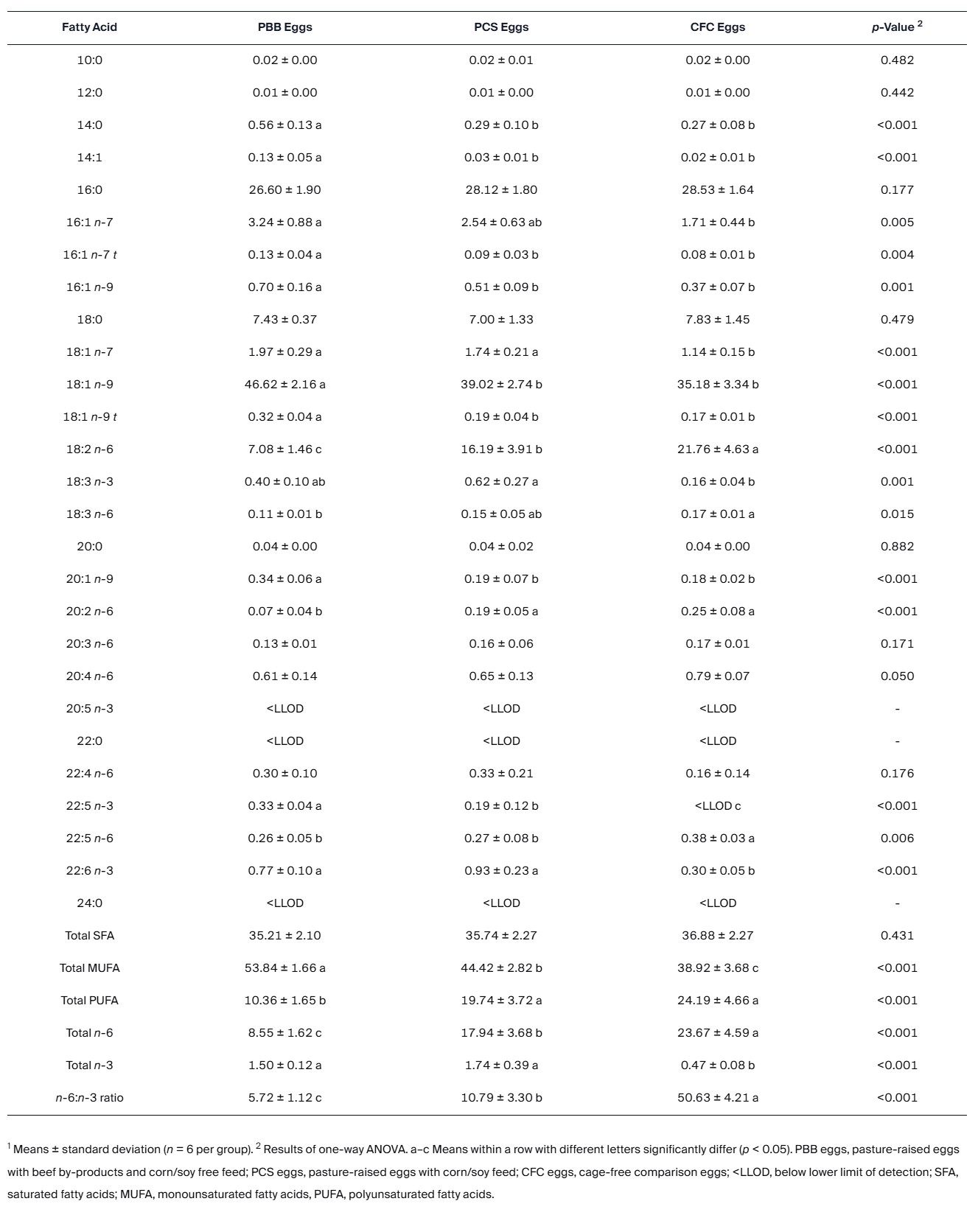
Table showing egg yolk fatty acid composition across production groups for feeding-system-related lipid fingerprinting.
Table 5: Fatty acid profile of the egg yolks (% of total fatty acids).
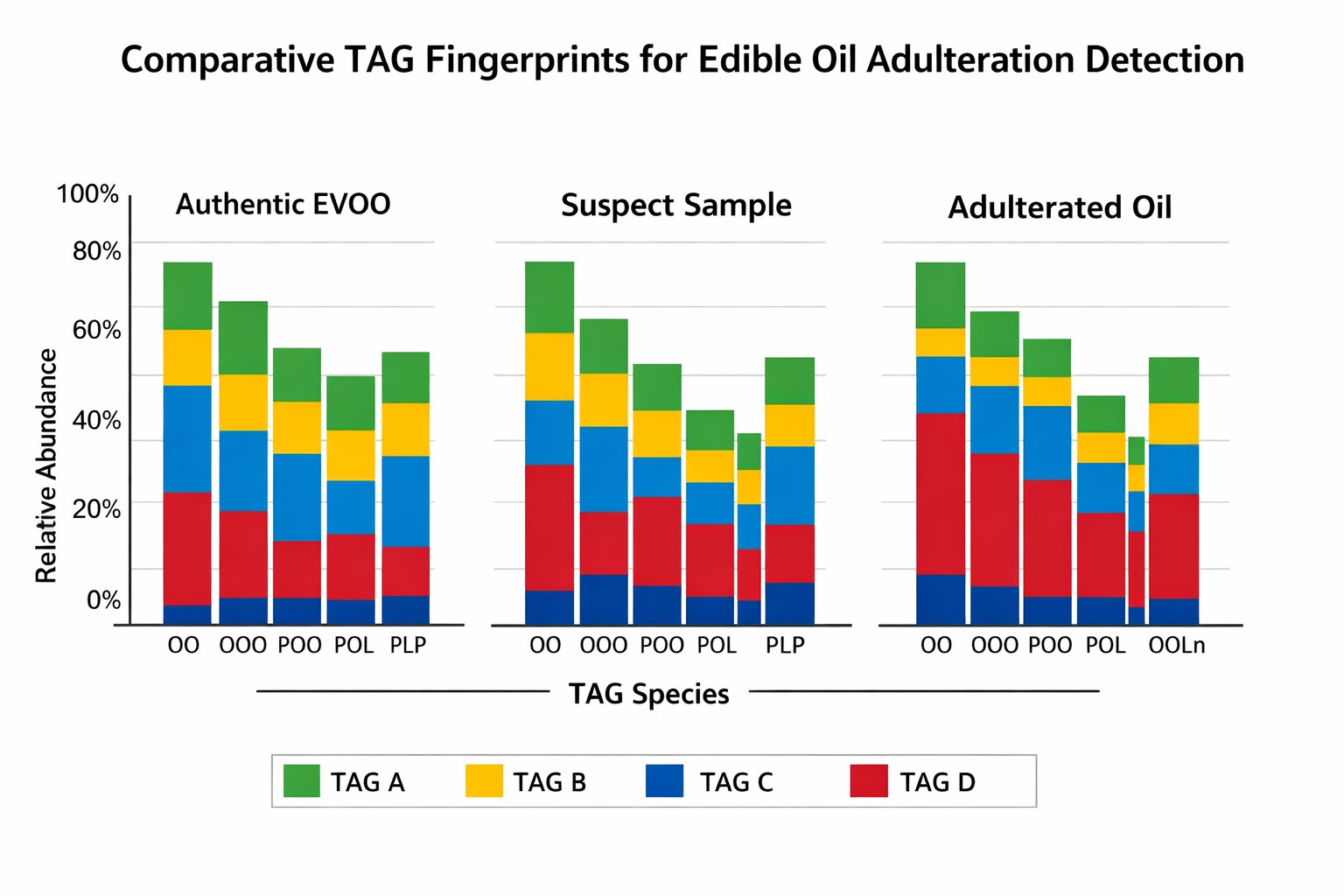
Focus: Authenticity Assessment of Premium Edible Oils by TAG Fingerprinting.

Authenticity Assessment of Premium Edible Oils

Research Goal

A premium edible oil brand and third-party quality team needed to investigate whether extra virgin olive oil had been diluted with lower-cost vegetable oils during sourcing or distribution.

Method Used

A targeted triacylglycerol (TAG) lipidomics workflow was used to compare intact TAG distributions and characteristic regioisomer patterns between authenticated reference oils and suspect samples.

Result Obtained

The workflow detected abnormal TAG signatures inconsistent with authentic extra virgin olive oil, providing actionable evidence for raw material acceptance and label protection.

Comparative TAG profile plot showing molecular differences between authentic and suspect edible oil samples.
Recommended custom visual: Comparative TAG fingerprints of authentic and suspect edible oil samples.

Frequently Asked Questions

How does lipidomics improve upon traditional GC-FID for edible oil adulteration detection?
While GC-FID only measures total fatty acid composition (which adulterators easily mimic by blending oils), lipidomics analyzes intact triacylglycerols (TAGs) using high-resolution mass spectrometry. This reveals the exact, unforgeable structural arrangement of fatty acids on the glycerol backbone, providing definitive proof of adulteration.
Can food lipid fingerprinting determine the geographical origin of an oil?
Yes. Environmental factors, soil composition, and local climate heavily influence the plant's lipid biosynthesis pathways. By using untargeted lipidomics and multivariate statistics (like PCA), we can create a unique molecular fingerprint that authenticates Protected Designation of Origin (PDO) claims.
What markers are used for lipid oxidation stability monitoring during shelf-life studies?
Instead of relying on basic peroxide values, our platforms quantify specific primary oxidation products (lipid hydroperoxides) and, more importantly, highly reactive secondary metabolites like oxylipins, epoxides, and specific short-chain aldehydes, which directly correlate with rancidity and off-flavors.
Can you differentiate naturally occurring trans-fats from industrial trans-fats?
Yes. Through optimized 45-minute UHPLC gradients coupled with silver-ion chromatography, we achieve baseline separation (<0.1 min retention time variance) between naturally occurring trans-vaccenic acid (found in ruminant fats) and industrial elaidic acid created during partial hydrogenation.
How do you detect the blending of vegetable oils into premium animal fats?
We use targeted sterol profiling. Animal fats naturally contain cholesterol, while plant oils contain phytosterols (like β-sitosterol, campesterol, and stigmasterol). Detecting trace levels of specific phytosterols in a product labeled as 100% butter or animal fat provides undeniable evidence of vegetable oil adulteration.
What is the minimum sample weight required for special oil authentication?
Because mass spectrometry is incredibly sensitive, we typically require very little material. For pure oils or high-fat matrices, 1 to 5 grams is more than sufficient to perform comprehensive lipid extraction and targeted authentication profiling.
How does high-resolution mass spectrometry resolve complex triacylglycerol (TAG) regioisomers?
We utilize advanced fragmentation techniques (MS/MS) and often Trapped Ion Mobility Spectrometry (TIMS). By analyzing the specific neutral loss patterns of fatty acyl chains during fragmentation, we can confidently determine which fatty acid was located at the sn-2 position versus the sn-1/3 positions.
Are your methods suitable for verifying the authenticity of highly processed food matrices?
Yes. Processed foods (like baked goods or complex emulsions) present significant matrix suppression challenges. We overcome this by utilizing rigorous liquid-liquid extractions, solid-phase extraction (SPE) cleanups, and the use of over 50 heavy-isotope internal standards to ensure accurate quantification regardless of the background matrix.
* Our services can only be used for research purposes and Not for clinical use.

Applications:


Online Inquiry

CONTACT US

Copyright © 2026 Creative Proteomics. All rights reserved.