
Yes, lipidomics can be performed on FACS-sorted cells, but there is no universal minimum cell number. Feasibility depends on cell size and lipid content, target abundance, sorting buffer, collection volume, sample losses, analytical platform, desired coverage, and whether the endpoint is targeted or untargeted.
Published research ranges from focused lipid detection in single cells to broader targeted workflows using thousands or tens of thousands of sorted cells. These demonstrations do not make every assay a single-cell service. A project-specific pilot should establish signal above matched blanks, repeatability, recovery, and the number of reportable lipids before a full rare-cell cohort is committed.
FACS-Sorted Cell Lipidomics at a Glance
- Feasibility: Low-input lipidomics is possible, but "detectable" and "suitable for group comparison" are different standards.
- Cell input: Define input as recovered cells or verified sorted events per analytical replicate, not only the number loaded into the sorter.
- Pooling: Pool only when the biological unit and inference remain valid; document how many donors, animals, wells, or organs contribute to each pool.
- Recovery: Reduce transfers, collection volume, tube surface exposure, and post-sort washing because losses can dominate at low input.
- Background control: Include sheath or collection-buffer blanks, empty-sort or debris controls, extraction blanks, and internal standards.
- Pilot design: Test a cell-number series with biological replicates to identify the input range where coverage and precision stabilize.
What Determines the Minimum Cell Number for Lipidomics?
Cell number alone is an incomplete measure of analytical input. A large lipid-rich cell and a small quiescent lymphocyte do not contribute the same lipid mass. A panel of abundant phosphatidylcholines requires less input than broad profiling that must also detect low-abundance signaling lipids.
The correct question is not "What is the minimum?" but "What input supports the required lipid panel, structural confidence, precision, and biological comparison in this cell type?"
Targeted and untargeted studies have different input needs
Targeted LC-MS/MS concentrates acquisition and validation on predefined lipids. It can remain informative at lower input when those analytes are abundant, transitions are selective, standards are available, and the panel is intentionally limited.
Untargeted lipidomics distributes analytical capacity across a broader lipidome. As cell input falls, low-abundance features disappear first, MS/MS coverage becomes sparse, missingness rises, and background represents a larger proportion of signal. A low-input untargeted result may still distinguish groups, but it will not necessarily reproduce the coverage of a conventional bulk-cell experiment.
The cell lipidomics service provides a starting point for standard cellular profiling. FACS-sorted or otherwise rare populations should be treated as a special feasibility case because their sample handling and blank requirements differ from routine cell pellets.
Published cell numbers are method-specific evidence
Schönberger et al. described targeted metabolomics of FACS-purified rare cells optimized around 5,000 sorted events, with reduced metabolite coverage at lower inputs and selected signals detectable from 100 events (Schönberger et al., 2023). A related targeted metabolomics and lipidomics protocol used 10,000 or 40,000 hematopoietic stem cells depending on sorting configuration (Schönberger et al., 2022).
Conventional submission guidance on this site lists millions of cells for routine cell lipidomics, including lower preferences for primary cells than for some cultured-cell workflows. Those values describe standard submissions, not a universal lower limit for a specially qualified low-input assay. Rare-cell projects therefore need a separate feasibility path.
At the other extreme, specialized single-cell workflows have detected selected phosphatidylcholine and sphingomyelin species from FACS-isolated cells or broader lipid profiles using microflow/nanoflow and ion-mobility platforms (Hancock et al., 2023; von Gerichten et al., 2024; Kim et al., 2025). These methods demonstrate technical possibility under specialized conditions; they should not be used to promise comprehensive cohort-scale lipidomics from every single sorted cell.
Minimum input should be defined by acceptance criteria
A defensible minimum input is the lowest tested level that meets prespecified criteria such as:
- Target signals are distinguishable from matched collection and extraction blanks.
- Primary analytes are detected in the required proportion of replicates.
- Peak shape, retention, mass accuracy, and MS/MS evidence support annotation.
- Internal-standard response is stable and not dominated by matrix or volume effects.
- Replicate CV or another precision metric is suitable for the expected biological effect.
- The number of reportable lipids is sufficient for the biological question.
- Biological groups remain separable without being confounded by sort day or input amount.
If the project requires broad discovery, choose an input where coverage has begun to plateau. If it requires a small, high-abundance panel, a lower input may be feasible after targeted qualification.
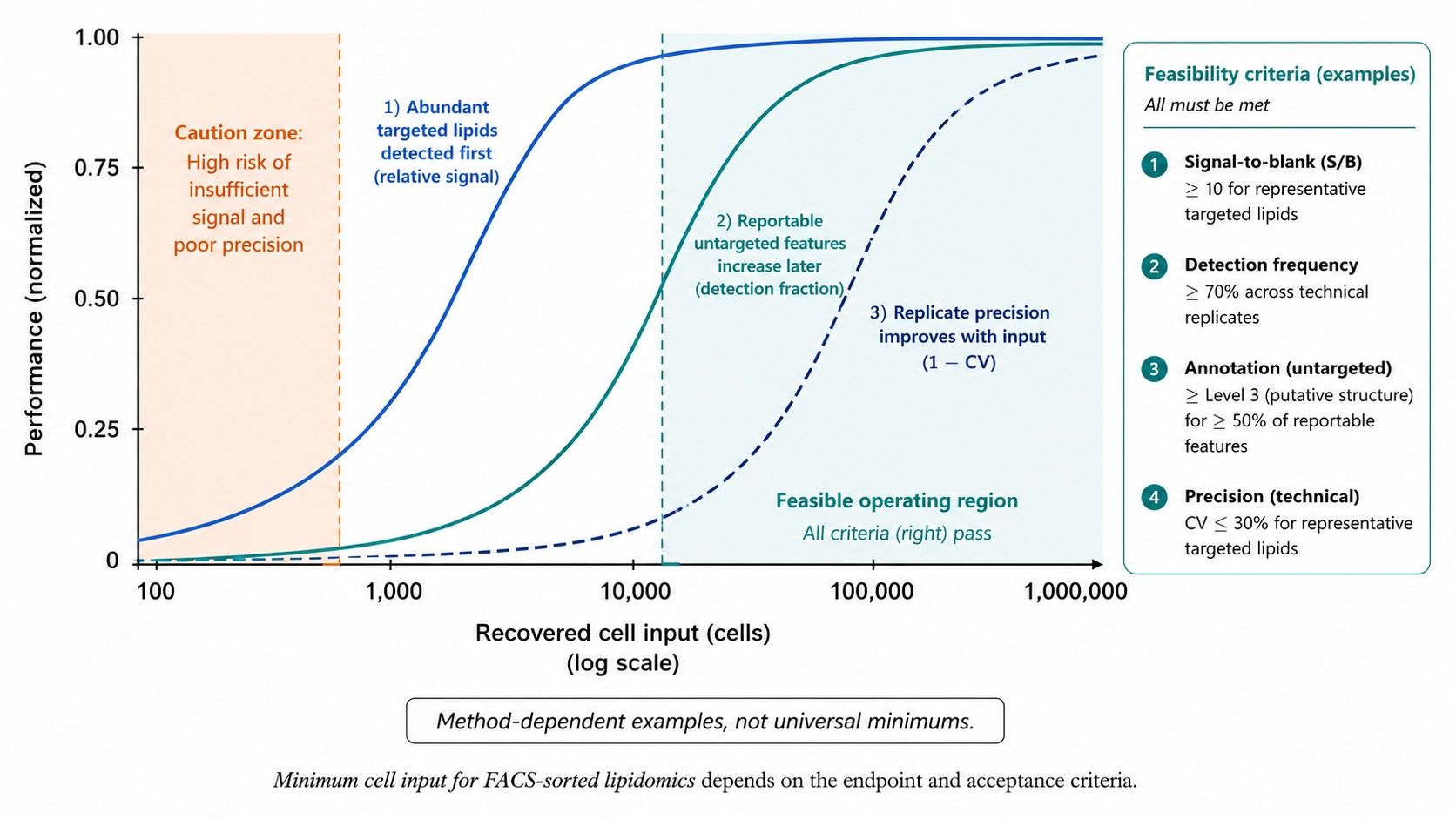 Minimum cell input for FACS-sorted lipidomics depends on the endpoint and acceptance criteria.
How FACS Can Change the Measured Lipidome
FACS is not a neutral isolation step. Tissue dissociation, antibody staining, nutrient-poor buffer, temperature shifts, pressure, electrical charge, collection time, and delayed quenching can alter cellular state. The extent and direction of the effect can vary among cell types and metabolites.
Llufrio et al. found that cell sorting altered redox state and many polar metabolomic features in astrocytes; nearly half of the profiled features changed by at least 1.5-fold under their comparison (Llufrio et al., 2018). The study did not establish the same magnitude for every lipid class, but it provides strong evidence that sort-induced artifacts cannot be assumed away.
Sort all comparison groups consistently
If one group is FACS sorted and another is collected by scraping or centrifugation, method effects can be mistaken for biology. All primary comparison groups should undergo the same dissociation, staining, sorting, collection, and storage workflow whenever possible.
A mock-sort control can compare sorted with rapidly collected material from a homogeneous cell system. This does not recreate a rare primary population, but it helps quantify the direction of sorting effects and identify unstable lipid endpoints.
Sorting time is a biological variable
Rare populations may require long collection times. During that interval, early and late fractions experience different delays. Sort duration, target frequency, event rate, temperature, buffer, collection volume, and time to quenching should be recorded as sample metadata.
Holding paired groups for equal total time can reduce timing imbalance, but it does not restore the original state. A recovery period after sorting may increase analytical signal while simultaneously changing metabolism. For quiescent or activation-sensitive populations, this tradeoff must be resolved according to the biological question rather than analytical convenience.
Fluorescent labels and collection additives need review
Antibody reagents, dyes, serum, albumin, EDTA, buffers, and sheath fluid can contribute chemical background or change ionization. Lipophilic dyes are especially relevant because they may extract with endogenous lipids. The staining panel and collection formulation should be disclosed during feasibility review.
If sorting can be performed using label-free physical parameters or a minimal surface-marker panel without compromising biological specificity, chemical background may be reduced. However, gate accuracy and population purity remain more important than eliminating a necessary marker.
The primary cell separation service can be considered when cell isolation and downstream lipidomics need to be coordinated. The isolation strategy should be selected with both population purity and biochemical preservation in mind.
How to Reduce Sample Loss in Low-Input Cell Lipidomics
At conventional input, a small transfer loss may be tolerable. At low input, the same loss can remove a substantial fraction of the sample. Every tube wall, wash, aspiration, evaporation step, and phase transfer becomes part of the recovery budget.
Collect into an analysis-compatible format
Direct collection into a low-volume, low-binding, analysis-compatible vessel can reduce transfers. The collection solution must maintain sort performance while remaining compatible with extraction and LC-MS. A large aqueous collection volume can dilute the sample and require concentration or transfer steps that increase loss.
Bench-level settings should be finalized jointly by the sorting and analytical teams. A buffer optimized only for cell viability may introduce salts, proteins, polymers, or lipids that complicate MS analysis. Conversely, an extraction-compatible solvent may not be suitable for live-cell passage through the sorter.
Minimize post-sort washing
Washing removes extracellular buffer and contaminating lipids but can cause severe cell loss when the pellet is invisible. The project should compare the benefit of cleaner background with the risk of losing rare cells. Direct-to-extraction approaches or a single controlled wash may be preferable when validated.
The decision should be based on matched blanks and recovery experiments. If buffer-derived background is below relevant lipid signals, eliminating an extra wash may improve data. If background overlaps the targets, collection chemistry or cleanup needs revision.
Add internal standards early
Internal standards added before or at extraction can reveal variability in extraction, transfer, and ionization. For low-input work, the standard amount should be appropriate to the analyte range; excessive standard can contribute isotope interference or suppress weak endogenous signals.
An injection standard added at the end monitors injection behavior but cannot report cells lost during sorting or washing. Recovery assessment needs orthogonal information such as verified event count, post-sort count where feasible, spiked standards, or a cell-number response series.
Do not normalize away cell recovery errors
Normalizing every sample to the sorter event count assumes each event represents one recovered intact target cell and that collection efficiency is constant. Doublets, debris, aborts, adhesion, dead cells, and collection loss can violate this assumption.
Event-normalized results are useful when gate and recovery metrics are documented. Protein or DNA normalization may be difficult at low input because the normalization assay consumes material or falls near its own detection limit. Choose one primary denominator and retain input, recovery, and purity metadata for sensitivity analysis.
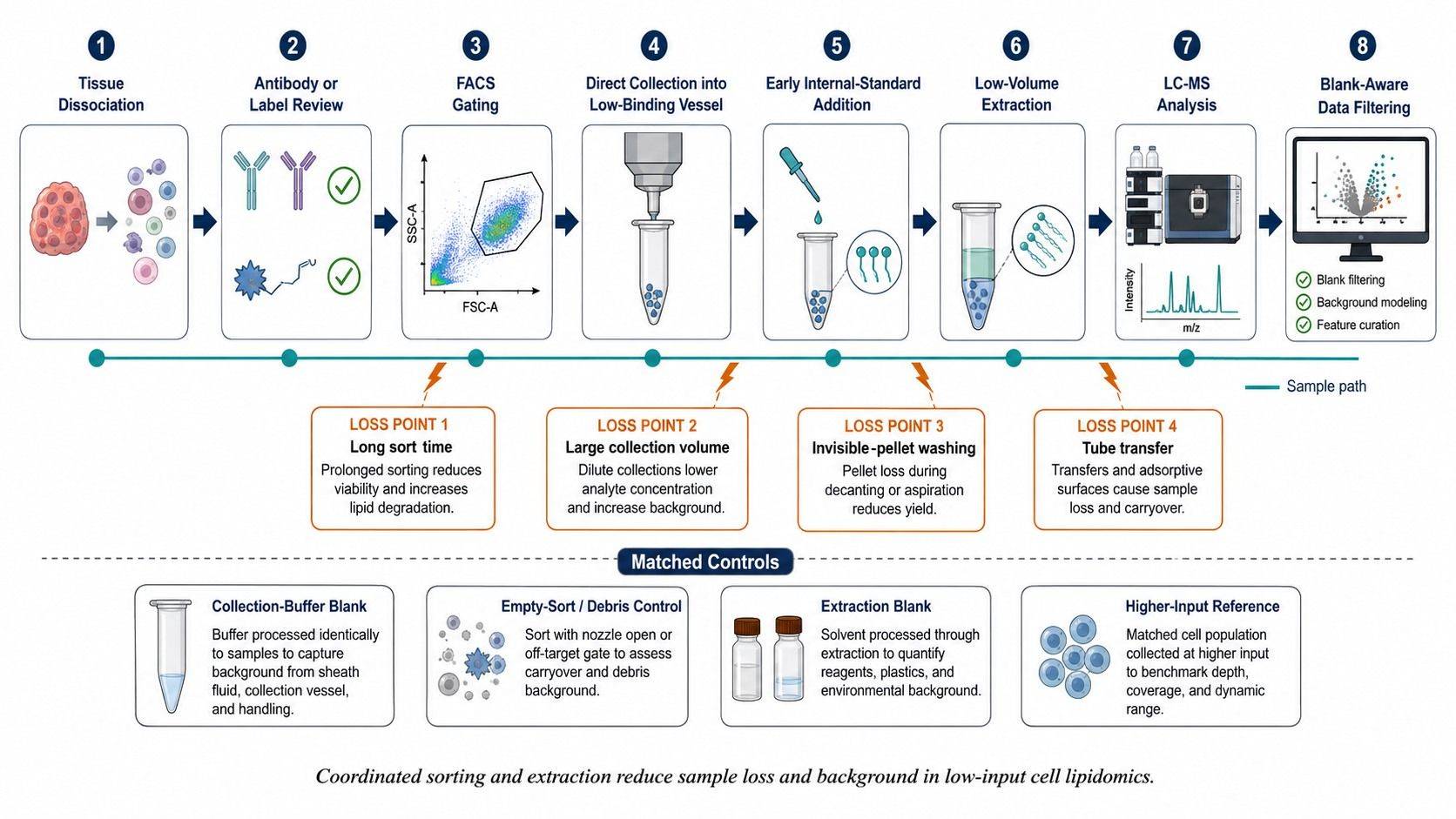 Coordinated sorting and extraction reduce sample loss and background in low-input cell lipidomics.
When Should FACS-Sorted Cells Be Pooled?
Pooling increases analytical input but changes the unit of replication. Ten animals combined into one tube produce one analytical sample, not ten biological replicates. This distinction should be fixed before sorting begins.
Pool within a biological replicate when the source is naturally composite
Pooling may be appropriate when several organs, wells, or technical collection tubes represent one predefined experimental unit. Examples include splitting a single specimen across multiple sort tubes or combining wells from one culture replicate to reach sufficient cell number.
The pool record should preserve every contributor, the cell count from each, collection order, and final recovered amount. Pool composition must be consistent across groups.
Avoid pooling that erases the intended variance
Combining cells from independent animals or donors may conceal biological heterogeneity and reduce the effective sample size. If pooling is unavoidable, create multiple independent pools per group using a balanced scheme. Do not combine all material from one group into one pool.
Pooling can also create unequal contribution. A high-yield specimen may dominate the pool unless cell counts or volumes are controlled. Equal-event pooling answers a different question from equal-volume or whole-yield pooling.
Compare pooling with a narrower analytical target
Before pooling independent biological units, consider whether a smaller targeted lipid panel could answer the question at lower input. The targeted lipidomics service may support selected abundant or pathway-specific lipids when untargeted coverage is not feasible.
If broad pathway discovery is essential, pool according to a replicated biological design. If preservation of individual variability is essential, reduce panel scope or use a specialized low-input workflow instead of creating one composite sample.
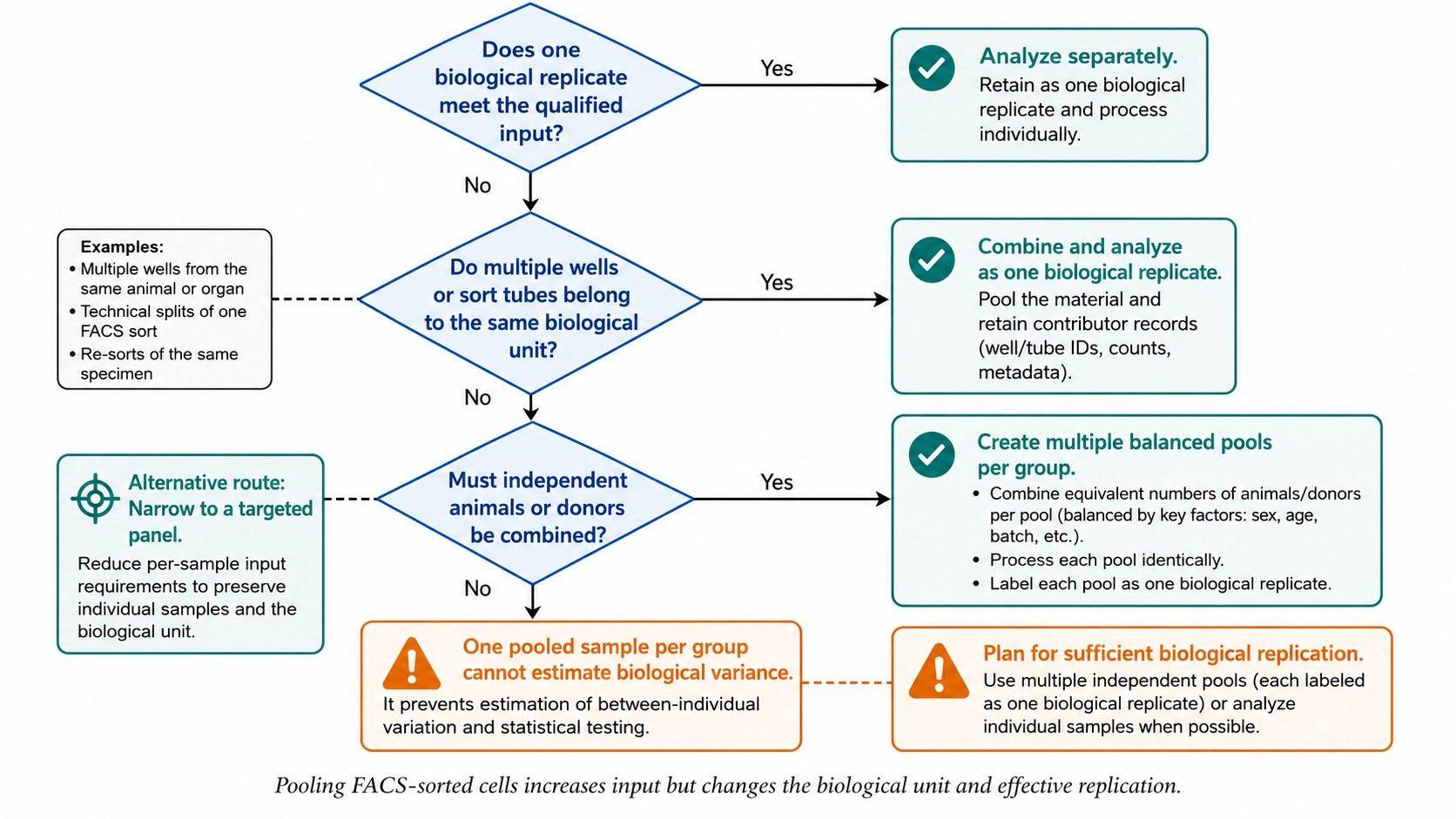 Pooling FACS-sorted cells increases input but changes the biological unit and effective replication.
Essential Blanks and Controls for FACS-Sorted Cell Lipidomics
Low-input signal must be interpreted against controls that reproduce the sorting and collection background. A routine solvent blank alone is not enough.
| Control | What it contains | Main question answered |
|---|---|---|
| Solvent blank | Injection solvent | Is there instrument background or carryover? |
| Extraction blank | All extraction materials without cells | Do tubes, solvents, or preparation steps contribute lipids? |
| Collection-buffer blank | Sorting buffer collected and processed like samples | Does the buffer create overlapping features or ion suppression? |
| Empty-sort or debris control | Matched sort events without target cells | What enters the collection vessel from the sorter and sample suspension? |
| Staining-reagent control | Relevant antibodies or dyes without target cells | Do labeling reagents contribute extractable signals? |
| Bulk or higher-input reference | Same cell type when available | Which features scale with cell input and match expected biology? |
| Pooled low-input QC | Aliquots of representative extracts where feasible | Is the LC-MS sequence repeatable at the relevant matrix level? |
Schönberger et al. used matched debris events as background references in rare-cell metabolomics and showed that these controls also reflected sample-type-specific background (Schönberger et al., 2023). For lipidomics, equivalent blanks are especially important when collection media contain serum, albumin, or lipophilic additives.
Include a cell-number dilution series
A pilot series should span the expected recovered input, for example several levels from the lowest feasible count to a higher reference. Each level needs biological or independently prepared replicates, not only repeated injections of one extract.
Plot each feature against verified cell input. Cell-derived signals should generally increase with cell number within the working range, while background features remain flat or behave inconsistently. Features that do not separate from collection blanks or show reproducible input response should not define the project minimum.
Predefine what counts as feasible
Feasibility should not be declared because one abundant lipid is detectable. The pilot must meet the primary study requirement: a named panel, a minimum number of annotated lipids, class coverage, replicate precision, group-separation capacity, or another explicit endpoint.
For untargeted projects, the untargeted lipidomics bioinformation analysis service can integrate blank filtering, missingness, QC variability, cell-count relationships, batch covariates, and differential analysis. Analytical feasibility and statistical power should be reviewed together.
FACS-Sorted Cell Lipidomics Pilot Design
A practical pilot can follow this sequence:
- Define the cell population, gating markers, expected frequency, and whether staining reagents are lipophilic.
- Define the endpoint as targeted analytes, class coverage, or untargeted discovery.
- Estimate recovered cell numbers after sorting rather than relying only on starting tissue yield.
- Select three or more input levels that bracket the expected range.
- Prepare independent replicates at every level and matched collection backgrounds.
- Use the same sorting duration, buffer, temperature, vessel, and storage conditions intended for the cohort.
- Add an appropriate internal-standard panel at the earliest validated stage.
- Measure signal-to-blank, detection frequency, annotation confidence, precision, missingness, and coverage.
- Choose the lowest input that meets the project-specific acceptance criteria with reserve margin.
- Lock the cohort workflow, batch map, pooling rule, and rerun criteria before full collection.
The site's general sample size guidelines for lipidomics describe conventional cell-input preferences. A rare FACS-sorted project falls outside those routine assumptions and should not be shipped without a feasibility discussion.
Common FACS-Sorted Cell Lipidomics Errors
| Design error | Consequence | Better approach |
|---|---|---|
| Treating a published minimum as universal | Coverage may fail in a different cell type or platform | Run a cell-number pilot with acceptance criteria |
| Reporting loaded cells instead of recovered input | Analytical amount is overstated | Track sorted events, purity, recovery, and final replicate input |
| Comparing sorted with unsorted groups | Isolation method is confounded with biology | Process all primary groups through the same workflow |
| Using serum-rich collection medium without matched blanks | Exogenous lipids can dominate low-input signals | Review additives and include collection-background controls |
| Multiple washes of an invisible pellet | Rare cells and lipids are lost | Validate a reduced-transfer or direct-collection workflow |
| Pooling all specimens in a group | Biological replication disappears | Create multiple balanced independent pools or narrow the panel |
| Normalizing only to event count | Debris, doublets, and recovery differences are ignored | Retain gate, purity, recovery, and secondary loading metadata |
| Requesting broad untargeted coverage from extremely low input | Missingness and incomplete MS/MS increase | Pilot coverage or choose a focused targeted panel |
Planning FACS-Sorted Cell Lipidomics with Creative Proteomics
A useful feasibility request should provide the species and tissue, target cell type, approximate frequency, sorting markers, staining reagents, sorter buffer, collection solution and volume, expected sorted events per replicate, biological replicate structure, allowable pooling, storage plan, and required lipid endpoints.
Also state whether the study needs broad relative profiling or absolute measurement of defined targets. If previous bulk-cell lipidomics, pilot spectra, or expected lipid concentrations are available, they can help prioritize analytes and input levels.
Creative Proteomics can review the isolation-to-analysis chain, including collection compatibility, low-volume extraction, internal standards, targeted or untargeted platform choice, matched blanks, pooled QC, cell-count pilots, and batch-aware data analysis. Early discussion is most valuable before marker panels and collection buffers are fixed.
If the expected input is close to conventional bulk-cell amounts, standard cellular profiling may be appropriate. If the input is rare or uncertain, begin with a pilot rather than pooling all available biological material into an unvalidated workflow.
FAQs
What is the minimum number of FACS-sorted cells for lipidomics?
There is no universal minimum. Published methods range from specialized single-cell detection to broader workflows using thousands or more cells. The minimum for a project is the lowest tested input that meets its signal-to-blank, coverage, precision, and identification requirements.
Can 10,000 sorted cells support untargeted lipidomics?
Possibly, but coverage will depend strongly on cell type, lipid content, background, extraction, LC-MS sensitivity, and reporting criteria. A 10,000-cell pilot should be compared with higher inputs and matched blanks before the full study is committed.
Should sorted cells be washed before lipid extraction?
Only when the reduction in buffer-derived background outweighs cell loss. At low input, an additional wash can remove a large fraction of the sample. Compare direct collection and limited washing during method qualification rather than adopting a routine bulk-cell wash automatically.
Can samples from several animals be pooled?
Yes, if pooling is biologically justified and multiple independent pools remain in each group. Pooling converts the contributors into one composite replicate. It should not be used in a way that leaves only one analytical sample per condition.
Are conventional FACS buffers compatible with lipidomics?
Compatibility varies. Salts, serum, albumin, dyes, and other additives can affect extraction, background, and ionization. Provide the complete formulation and staining panel so collection blanks and an analysis-compatible strategy can be planned.
What data are needed for a low-input feasibility assessment?
Provide cell type and size, starting material, target frequency, expected sorted events, replicate number, buffer and collection volume, marker panel, storage conditions, allowed pooling, target lipid classes, and desired relative or absolute result. Include pilot recovery or post-sort purity data when available.
References:
- Hancock, S. E., Ding, E., Johansson Beves, E., et al. (2023). FACS-assisted single-cell lipidome analysis of phosphatidylcholines and sphingomyelins in cells of different lineages. Journal of Lipid Research, 64(4), 100341. https://doi.org/10.1016/j.jlr.2023.100341
- Kim, J., Mun, D.-G., Ding, H., et al. (2025). Single cell untargeted lipidomics using liquid chromatography ion mobility-mass spectrometry. Journal of Proteome Research, 24(4), 1579–1585. https://doi.org/10.1021/acs.jproteome.4c00658
- Llufrio, E. M., Wang, L., Naser, F. J., & Patti, G. J. (2018). Sorting cells alters their redox state and cellular metabolome. Redox Biology, 16, 381–387. https://doi.org/10.1016/j.redox.2018.03.004
- Schönberger, K., Mitterer, M., Buescher, J. M., & Cabezas-Wallscheid, N. (2022). Targeted LC-MS/MS-based metabolomics and lipidomics on limited hematopoietic stem cell numbers. STAR Protocols, 3(2), 101408. https://doi.org/10.1016/j.xpro.2022.101408
- Schönberger, K., Mitterer, M., Glaser, K., et al. (2023). LC-MS-based targeted metabolomics for FACS-purified rare cells. Analytical Chemistry, 95(9), 4325–4334. https://doi.org/10.1021/acs.analchem.2c04396
- von Gerichten, J., Saunders, K. D. G., Kontiza, A., et al. (2024). Single-cell untargeted lipidomics using liquid chromatography and data-dependent acquisition after live cell selection. Analytical Chemistry, 96(17), 6922–6929. https://doi.org/10.1021/acs.analchem.3c05677
Author: CAIMEI LI, Senior Scientist