









Client Publication: Xia, T., Wu, X., Hong, E., et al. (2023). PLOS Pathogens. DOI: 10.1371/journal.ppat.1011232
Client Profile: Research team investigating viral entry mechanisms and host lipid metabolism, where glycosphingolipids modulate membrane fusion.
Targeted Sphingolipid Quantitation for Membrane-Fusion MoA Support
Analytical Challenge
Precisely track structurally similar glycosphingolipids (e.g., GlcCer vs GalCer) and determine whether the pathway signal reflects causal MoA involvement (entry/fusion) rather than downstream stress effects—something that broad “omics” layers often fail to resolve.
Our Solution & Technology
We recommend a Bundle B validation path centered on targeted lipidomics (LC–MS/MS, MRM/PRM) for sphingolipid-class quantitation, with a panel designed around MoA hypotheses (glycosphingolipid biosynthesis / remodeling). This enables clear pathway engagement readouts across inhibitor treatment, genetic perturbation, or time-course designs.
Outcome & Value For Target Identification & MoA Research
- MoA anchoring: Quantitative sphingolipid readouts provide a direct biochemical anchor for mechanism hypotheses when membrane biology is central.
- Cleaner target deconvolution: Helps prioritize upstream enzymes/transporters as candidate targets and guides follow-up validation experiments.
- Formulation relevance (optional extension): The same lipid classes are also relevant to vesicle membranes and lipid-based delivery systems, supporting cross-program learning.
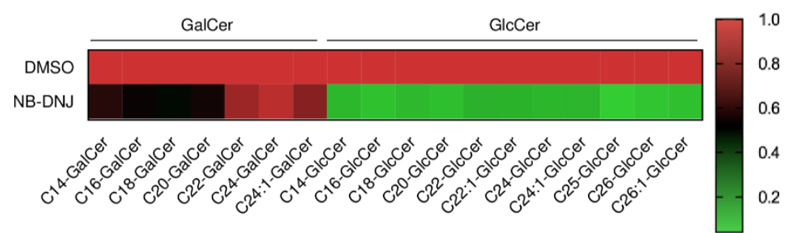
Heat map of the levels of intracellular GalCer and GlcCer in 293T cells with or without NB-DNJ treatment.
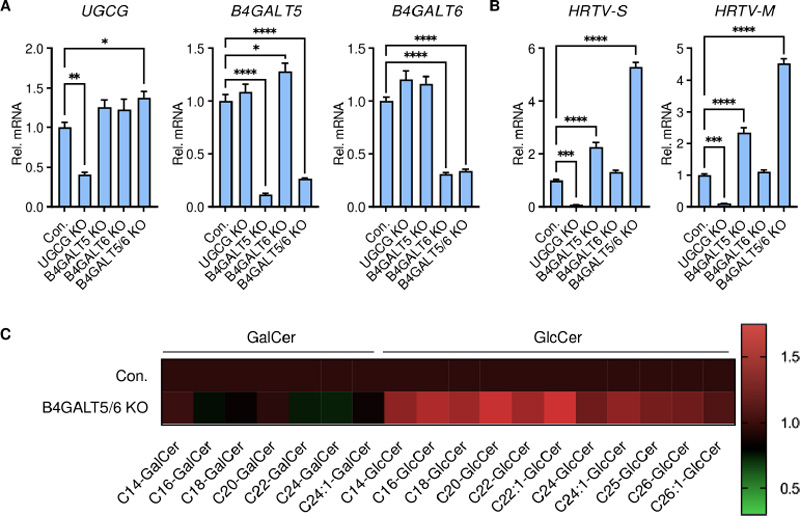
Glycosphingolipid downstream of GlcCer is not required for HRTV infection.