









Lipidomics Services for Cosmeceuticals and Personal Care Efficacy

Lipidomics Services for Cosmeceuticals and Personal Care Efficacy

Cosmeceutical lipidomics provides the objective biochemical evidence required to validate advanced skincare efficacy claims. By utilizing high-resolution LC-MS/MS, Creative Proteomics empowers personal care formulators to quantify stratum corneum ceramides, track transdermal active delivery, and measure oxidative stress markers, transitioning product claims from subjective consumer perception to publication-grade molecular data.

Key capabilities

  • Ultra-Long-Chain Ceramide Quantification: Absolute quantification of specific barrier ceramides (e.g., CER[EOS], CER[EOP]) to validate physiological skin and scalp barrier restoration.
  • Spatial Penetration Imaging: Advanced MALDI-MSI to visualize the precise transdermal penetration depth of active cosmetic ingredients (APIs) at 10–50 µm spatial resolution.
  • Microbiome & Sebum Profiling: Comprehensive sebaceous gland profiling and short-chain fatty acid analysis to substantiate oil-control and microbiome-friendly claims.
Request Analysis

Submit Your Request Now

×

Our services have earned the trust of companies, schools, and organizations globally, and we remain dedicated to maintaining that trust.

Boston University
University at Buffalo
UMass Medical School
Hawaii Pacific University
Medizinische Fakultät
Louisiana State University
Nyulangone
Nature's Fynd
Dietary Supplement Manufacturer
  • Trends & Challenges
  • Integrated Solutions
  • Technical Advantages
  • Case Studies
  • FAQ

Situational Solution Matrix for Cosmetic Formulators

From broad discovery profiling to targeted absolute quantification, our context-driven pathways empower R&D teams to substantiate product claims with publication-grade data.

Anti-Aging & Photoaging Active Screening

Situation

Evaluating novel botanical extracts or peptides for their protective effects against photoaging.

Goal

Discover biomarker shifts in the epidermal lipidome, specifically tracking lipid peroxidation markers.

Recommended path: Global Lipid Profiling

Recommended services:
Skin Untargeted Lipidomics, Fatty Acid Analysis Service
What you will get

Differential lipid heatmaps revealing new, claimable anti-aging mechanisms and oxidative protection.

Microbiome-Friendly & Postbiotic Efficacy

Situation

A "microbiome-friendly" formulation must prove it maintains lipid homeostasis and supports beneficial flora.

Goal

Concurrently detect host surface lipid stability and microbe-derived metabolites (e.g., SCFAs).

Recommended path: Host-Microbiome Lipid Panel

Recommended services:
Short Chain Fatty Acids, Skin Untargeted Lipidomics
What you will get

Integrated datasets confirming the physiological harmony between the cosmetic formula and the skin microbiome.

Skin & Scalp Barrier Repair Validation

Situation

Developing a barrier-repair moisturizer or soothing scalp lotion needing objective evidence of lipid replenishment.

Goal

Absolute quantification of specific ceramide subclasses (EOS, NP) to calculate the physiological CER:CHO:FFA ratio.

Recommended path: Targeted Barrier Panel

Recommended services:
Ceramides Targeted Lipidomics, Cholesterol Targeted Lipidomics
What you will get

Absolute molar concentrations proving structural barrier restoration for clinical claims.

Sebum Control Formulation Testing

Situation

Validating a cosmetic serum's ability to regulate sebaceous gland hyperactivity in oily skin types.

Goal

Precisely dissect Skin Surface Lipids (SSL), focusing on triglycerides, squalene, and free fatty acids.

Recommended path: SSL Composition Panel

Recommended services:
Triacylglycerol Targeted Lipidomics, Fatty Acid Analysis Service
What you will get

Objective quantitative shifts in sebum components to definitively substantiate oil-control and anti-acne claims.

Soothing & Anti-Redness Claims

Situation

Testing a "sensitive-skin" formulation aimed at reducing UV-induced erythema or chemical irritation.

Goal

Quantify the suppression of highly bioactive pro-inflammatory lipid mediators in 3D skin models.

Recommended path: Cutaneous Inflammation Panel

Recommended services:
Eicosanoid Analysis Service, Skin Untargeted Lipidomics
What you will get

Biochemical proof of soothing efficacy via the targeted reduction of inflammatory lipid cascades (e.g., prostaglandins).

Transdermal Delivery Imaging

Situation

Assessing the penetration depth of a new liposome-encapsulated active cosmetic ingredient.

Goal

Visualize the spatial distribution of exogenous lipids across the stratum corneum, epidermis, and dermis.

Recommended path: Spatial Lipid Mapping

Recommended services:
MALDI-Imaging Lipidomics Services, Ceramides Targeted Lipidomics
What you will get

High-resolution ion images proving effective transdermal delivery without altering the formula with fluorescent tags.

Deep Moisturizer Mechanism of Action

Situation

Substantiating deep hydration claims by showing active synthesis of barrier lipids rather than simple surface occlusion.

Goal

Track the conversion of precursor lipids (sphingomyelins) into functional ultra-long-chain ceramides.

Recommended path: Sphingolipid Pathway Panel

Recommended services:
Sphingomyelins Targeted Lipidomics, Ceramides Targeted Lipidomics
What you will get

Pathway-level evidence demonstrating active cellular engagement for long-lasting, intrinsic hydration.

Selected Case Studies in Cosmeceutical Research

Client Publication: Kendall, A. C., et al. (2017). Scientific Reports. DOI: 10.1038/srep43761
Focus: Validating Epidermal Lipidome Shifts in Skin Aging.

Age-Associated Shifts in the Skin Lipidome (Anti-Aging Benchmarking)

Research Goal

Cosmetic R&D teams developing anti-aging serums and seeking objective lipidomic baselines across age groups.

Method Used

Human skin samples were profiled using untargeted LC-MS/MS lipidomics, and multivariate statistics were applied to evaluate age-associated clustering patterns.

Result Obtained

The study demonstrated clear, age-associated separation of skin lipidome profiles and highlighted lipid classes that shift with chronological aging—supporting biomarker-driven screening for anti-aging interventions.
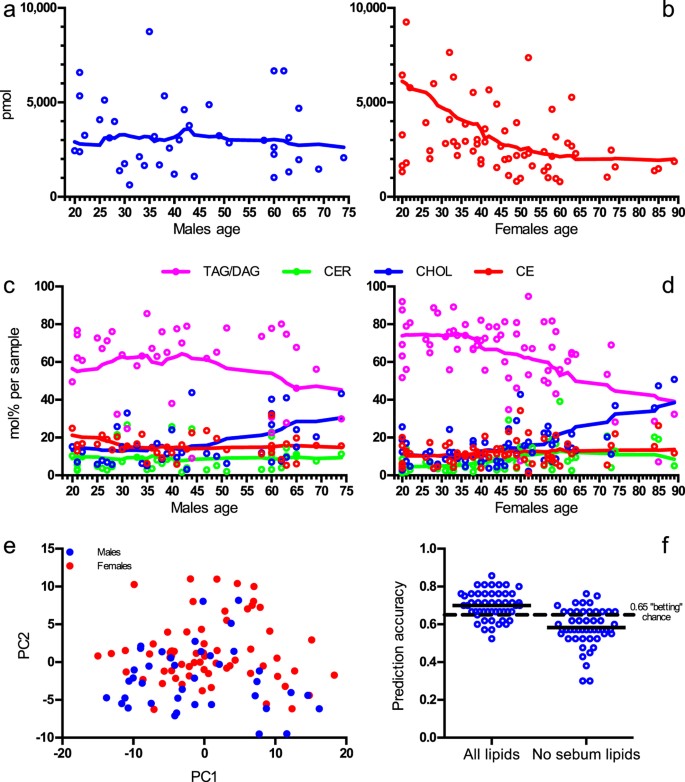
PCA plot showing age-related clustering of skin lipidome profiles.
Figure 4e: PCA score plot demonstrating age-associated separation of human skin lipidomes.
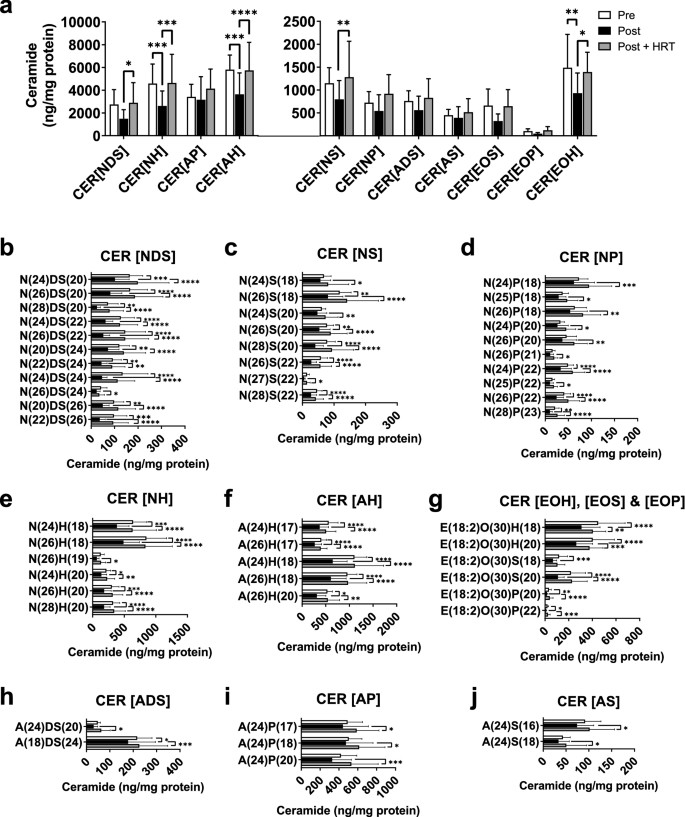
Client Publication: Kendall, A. C., et al. (2022). Scientific Reports. DOI: 10.1038/s41598-022-26095-0
Focus: Absolute Quantification of Ceramides in Compromised Barriers.

Absolute Quantification of Ceramides in a Compromised Barrier State (Barrier-Repair Validation)

Research Goal

Formulators of barrier-repair and sensitive-skin products who need quantitative evidence of ceramide depletion and restoration.

Method Used

Stratum corneum ceramides were quantified with targeted lipidomics (LC-MS/MS) using stable isotope-labeled internal standards to enable absolute quantification across ceramide classes/species.

Result Obtained

The study reported a measurable reduction in stratum corneum ceramide abundance in a compromised barrier state, establishing a quantitative benchmark to validate barrier-repair claims and restoration trajectories.

Bar chart of stratum corneum ceramide quantification highlighting reduced ceramide abundance.
Figure 2: Bar chart showing decreased stratum corneum ceramide levels in a compromised barrier state, supporting barrier-repair validation.

Frequently Asked Questions

How many D-Squame tape strips are typically needed for accurate stratum corneum lipidomics?
For robust and reliable lipid profiling, we generally recommend pooling 3 to 5 consecutive D-Squame or Sebutape strips from a single anatomical site. This protocol ensures sufficient biological mass to accurately quantify low-abundance lipids, such as ultra-long-chain ceramides, while accounting for the depth-dependent distribution of lipids across the stratum corneum.
Can your platforms quantify the precise CER:CHO:FFA ratio to substantiate barrier repair claims?
Yes. By utilizing stable isotope-labeled internal standards for all three major lipid classes, our targeted panels provide true absolute molar concentrations. This precise data allows formulators to accurately calculate the CER:CHO:FFA ratio, providing objective proof of barrier restoration.
What is the analytical difference between profiling Skin Surface Lipids (SSL) and full 3D skin models?
SSL profiling focuses on non-polar lipids secreted by the sebaceous glands (like squalene, triglycerides, and wax esters) and is ideal for evaluating oil-control products. Profiling full 3D skin models (e.g., RhE) requires rigorous biphasic extraction to release the complex structural sphingolipids and phospholipids that constitute the viable epidermis.
Can you visualize the penetration depth of cosmetic lipids without fluorescent tagging?
Absolutely. Our spatial lipid mapping utilizes advanced MALDI-Mass Spectrometry Imaging (MALDI-MSI). This technology maps the exact spatial distribution of exogenous cosmetic active ingredients across the skin layers (stratum corneum, viable epidermis, dermis) without the need for potentially altering chemical or fluorescent labels.
How do you ensure the absolute quantification of ultra-long-chain ceramides like CER[EOS]?
Ultra-long-chain O-acylceramides are highly hydrophobic. We utilize elevated-temperature Folch-variant extractions to ensure complete solubilization. During LC-MS analysis, specific MRM transitions and closely matched internal standards are used to quantify these molecules with sub-pg/mL sensitivity and high reproducibility.
Does lipidomics detect changes induced by anti-inflammatory or "soothing" cosmetic ingredients?
Yes. Lipidomics is exceptionally well-suited for substantiating soothing claims. We can accurately quantify the targeted suppression of highly bioactive pro-inflammatory lipid mediators, such as specific prostaglandins and leukotrienes, following the application of the cosmetic formulation.
How does lipid profiling provide biochemical evidence for anti-aging skincare formulations?
Beyond simple moisturization, lipid profiling tracks the molecular hallmarks of aging, such as the accumulation of oxidized squalene and shifts in specific fatty acid chain lengths. Demonstrating a formulation's ability to halt or reverse these specific lipidomic changes provides powerful, patentable anti-aging evidence.
How do you mitigate interference from cosmetic vehicle matrices during mass spectrometry?
Cosmetic vehicles containing silicones and heavy emulsifiers can cause severe ion suppression. We mitigate this through rigorous sample preparation, including selective solid-phase extraction (SPE) cleanups and optimized chromatographic gradients, ensuring that excipients do not mask the detection of endogenous epidermal lipids.
* Our services can only be used for research purposes and Not for clinical use.

Applications:


Online Inquiry

CONTACT US

Copyright © 2026 Creative Proteomics. All rights reserved.